Tuesday, March 19, 2013

Enhanced Campaigns for Display: Powerful Bidding Tools for a Multi-Device World

Last month we announced enhanced campaigns to help advertisers more simply and scalably reach their customers in a multi-screen world.  Today, we’ll look more closely at how enhanced campaigns work with your display campaigns.

Why Enhanced Campaigns For Display
In this constantly connected world, our customers are accessing information across multiple devices, and might look at 10 different sources - online reviews, newspaper and magazine articles, recommendations from friends and more - before making a purchase. Display advertising captures these signals and is an important part of connecting with consumers in this multi-screen world.  But determining the best way to reach the right person with the right ad is more complex than ever. Enhanced campaigns for display help you reach people with the right ads, based on people’s context like their location, time of day and device type -- all from a single campaign.

Key Features
Search and display use very different signals. In search, we use keywords to capture users’ intent. For instance, a travel booking website knows that a user searching for ‘Rome Vacation Packages’ is looking for a vacation in Rome. In Display campaigns, advertisers use a variety of other signals to reach their target customers with the right ad. In this example, a travel website may use:
  • Interest Categories: to reach customers interested in “Rome”
  • Demographics: to reach people 35-44, who have historically spent 3x the average
  • Topic Targeting: to reach people browsing travel websites
  • Remarketing: to reach customers who booked a vacation with them last year
In today’s constantly connected world, someone's intent and the actions they're looking to take may differ depending on their context, signals such as time of day, location and device:
  • Time of day: Travelers typically book between 9am and 6pm
  • Location: “People in the US” who may convert more often than people in Italy
  • Device: Mobile users tend to browse on their smartphones, then book on their desktop
With enhanced campaigns, instead of having to create multiple campaigns, this travel website can easily manage all of this in one place. In a single campaign they can adjust bids across these various signals to reach the right people with the right ads.

Learn More
More tips on how to use enhanced campaigns for display are available in the AdWords Help Center. To learn more on how you can take advantage of Enhanced Campaigns for Display, register for our upcoming webinar this Thursday March 21st, at 10am PST.

Posted by Christian Oestlien, Product Management Director for the Google Display Network

The Mystery of Bleach, Brand Loyalty, and The Latino Story

Spring is here and cleaning is in the minds of many. For years I have heard that bleach is an important cleansing agent in Hispanic households.  When visiting Latino households I regularly smell bleach in the kitchens and bathrooms.  

Using data from Experian Marketing Services’ Simmons National Hispanic Consumer Study that was collected in the twelve months ending on November 20, 2012, I found that 87% of Hispanic adults live in households that use bleach while only 82% of non-Hispanic adults live in households that use bleach. That represents an index of 105 for Latinos compared with an index of 99 for non-Latinos.

Interestingly, then, the attitudes expressed by Hispanics during my many years of doing research seem to be reflected in quantitative data. Bleach is an important part of the cleaning and disinfecting routine of Hispanics, and to a larger extent than anyone else.

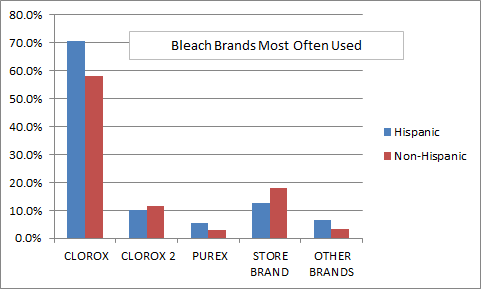
Also, we all have heard about how brand loyal Latinos are. Because of a weak economy and other factors I suspected that private label and less expensive products would be most popular at this time. To my surprise Clorox is the brand of bleach most likely to be used by Latinos, even though it is a more premium brand. The following chart reports the brands used “most often” in Hispanic and non-Hispanic households.


Clearly, brand loyalty is alive and well among Latinos.  How else would one explain that Clorox bleach is their preferred brand? When doing qualitative research with Hispanics I frequently hear comments regarding the importance of staying with brands that have shown their efficacy over time.  In particular, Hispanics seem to be more brand loyal when it comes to products that are more central to the wellbeing of their families. This is good news for the Clorox company and an interesting challenge to alternative bleach manufacturers. This is a category where there is ample opportunity to grow among Hispanics.

Clorox 2 is a different type of product as it is not an oxidant, instead of bleach it uses oxygen as a cleaning agent. Interestingly, this product does not do as well among Hispanics, at least not yet.

At any rate, the story told here serves as a brand loyalty case study and a reminder of the value of cleanliness that Latinos hold dear. This also serves as a reminder that cultural values for product usage can be very powerful in determining consumer behavior.

The data used here is from Experian Marketing Services’ Simmons National Hispanic Consumer Study and was collected from October 24, 2011 to November, 2012. The sample of Hispanics contains 8,521 individuals and the non-Hispanic sample has 17,043 people.


Monday, March 18, 2013

New ValueTrack parameters for enhanced campaigns: managing keyword level URLs by device

In a multi-screen world, it’s increasingly important for advertisers to show relevant ads based on a user’s context: location, time of day, and device. We launched enhanced campaigns to help advertisers take full advantage of user context, maximizing the effectiveness of their ad campaigns.

We’ve been listening to your feedback, and in the next few weeks we’ll be launching new ValueTrack features for advertisers using keyword level URLs.  These features will help advertisers achieve specific conversion and ROI goals, and make the upgrade to enhanced campaigns easier by:
  1. Directing users to a device-specific landing page at the keyword level.
  2. Enabling measurement of the effectiveness of campaigns by device.
What’s new

We’ve added a new parameter, {ifnotmobile:[value]}, where you can replace [value] with text that will then show up in your URL when the user clicks on your ad from a computer or tablet. We’re also changing the existing ValueTrack parameter {ifmobile:[value]}.  This parameter will now insert the specified value into the URL only if the user clicks from a mobile device.

In this post, we will discuss using the ifmobile and ifnotmobile parameters to direct users to a device-specific landing page.  We will also discuss performance tracking by device, and how the ifmobile and ifnotmobile parameters differ from the existing device parameter.

Example 1: Redirecting users to device-specific landing pages

Responsive web design is often a good fit for advertisers who provide device-optimized experiences to their users. If you must specify different landing pages depending on device, you have two options. If the landing page varies by creative, you can simply create mobile-optimized ads by setting the device preference to “Mobile.”  If the device-specific landing page varies for each keyword, then you can use the ifmobile and ifnotmobile parameters in the keyword-level destination URL.  It is important to remember that if you are using the ifmobile parameter today, it will no longer insert a value into the URL for tablet clicks.  The new parameter ifnotmobile will now insert a value into the URL for tablet and desktop/laptop.

Let’s say you want to send mobile users to "m.example.com/widgets," and desktop and tablet users to "www.example.com/widgets" for the keyword “widgets.”  In this scenario you could set the destination URL for this keyword to:

{ifmobile:m.example.com/widgets}{ifnotmobile:www.example.com/widgets}

Example 2: Tracking performance by device

If you want to track performance by device, the existing device parameter will work for most cases.  Using device inserts an “m”, “t”, or “c” into the destination URL, depending on whether the user clicked from a mobile device, tablet, or desktop/laptop computer. If your tracking system requires different internal ids for the same keyword on different devices, then you may need to use the ifmobile and ifnotmobile parameters.

For the keyword “widgets”, let’s say you have assigned an internal keyword id of “df32” for desktops and tablets and “df33” for mobile devices. You can set the keyword-level destination URL to:

www.example.com/widgets?kwid={ifnotmobile:df32}{ifmobile:df33}

Then, if the user clicks from a desktop or tablet, the landing page is:

  www.example.com/widgets?kwid=df32

and for a mobile click:

www.example.com/widgets?kwid=df33

Success in action

Advertisers are upgrading to enhanced campaigns and seeing strong results.  VivaStreet in France, the 4th largest free classified website in the world, upgraded all of their campaigns within the two weeks after launch.  When they upgraded, they increased their mobile bid adjustment to 125% and saw overall conversions increase by 34%.  After seeing the positive results, VivaStreet went on to increase their mobile bid adjustment to 140%.  By using ValueTrack parameters, you can also direct users to device-specific content and measure the effect it has on conversions.

We appreciate the feedback we have received on enhanced campaigns and encourage you to continue helping us understand how to make a great product.  Please join us on March 21st at 10:00AM PST (1:00PM EST) for the latest in our enhanced campaigns webinar series, EC 205, covering enhanced campaigns and the Google Display Network.

Posted by Karen Yao, Senior Product Manager, AdWords

How to Build Your Brand on Twitter


Source: Twitter.


If you are one of the millions of who watched last month’s Super Bowl, then odds are you remember that the lights went out before the third quarter started. But if you also use Twitter either for personal communication or business marketing, then you know that Oreo was the real winner on Super Bowl Sunday.

The reason is simple: Twitter provides the opportunity to comment and respond in real time based on whatever is happening. The ability to tailor comments, target audiences, and engage with customers or prospective customers is an incredible advantage over static advertising, television broadcasts, and taped events.

As a midsize business, Twitter can be an effective marketing tool. While the lights were out in New Orleans, the Oreo team got busy in a conference room. They designed an image and carefully chose the short message, or in Twitter lingo, the tweet: “Power out? No problem.” The image’s message was, “You can still dunk in the dark.”

So, are you still on the fence about Twitter? Yes, you need to decide how Twitter fits into your overall marketing and social media strategy. Yes, you need to create a Twitter plan. And yes, you need to allocate resources to maintain the Twitter account. But once that is all said and done, there is no doubt that Twitter can help to build your brand. Here are five tips:

[1] Understand your brand promise, your competitive advantage, your unique selling proposition. Now, keep this in mind with every tweet. Naturally, every tweet cannot be a sales pitch – then you’d probably not have any followers. But, remember the value that you provide to your audience so that you create interest and engagement. Also, respond in real time whenever possible, so that problems can be solved. If problems are solved, your customers will become brand advocates for you via all social platforms.

[2] Think of your audience before your tweet. Will articles, photos, or quotes be best? What will your audience value? But remember, Twitter is a hodgepodge of conversations, so many things might constitute your strategy.

[3] Create a hashtag that is unique for your brand or company – this will be a great way to monitor every time your brand is mentioned and talked about.

[4] Create and host a branded tweetchat (same time and day every week) to discuss new product launches, interview company experts, or interview industry experts, etc. This is an excellent way to get your brand heard and talked about – and to participate in the talk.

[5] Follow others in your industry – this may include industry leaders, industry spokespeople, and even your competitors. But the reality is, you cannot hide under a rock and work in secret. Everyone sees everything thanks to social media.

The most obvious Twitter branding tips are to use your company name or most famous brand as your Twitter handle and your logo as your Twitter avatar. As with all corporate collateral, websites, promotional give-aways, etc., you want your company name, logo, and tagline to appear in social media.

And last but not least, above all, BE CONSISTENT. Speak in a unifying voice for all tweets. Know who from your team will be your company’s Twitter voice, and make sure that the individual or individuals have set time responsibilities as well as some standard replies for specific issues. And a timeless reminder, your tweets should always be friendly and welcoming.

To see some funny Twitter comments during Super Bowl 47, check out my post: http://debbielaskey.blogspot.com/2013/02/is-super-bowl-now-twitter-bowl.html


This post was written as part of the IBM for Midsize Business program, which provides midsize businesses with the tools, expertise and solutions they need to become engines of a smarter planet. I’ve been compensated to contribute to this program, but the opinions expressed in this post are my own and don't necessarily represent IBM's positions, strategies or opinions.

The brand revolution is underway

As we’ve said before, we’ve entered the next wave of digital marketing, as major brands like L’Oreal, Audi and Kay Jewelers embrace digital media and make it a core part of their marketing strategy.  We’ve seen a 65 percent increase in the last quarter alone in the number of brand advertisers using our brand formats and buying tools.

This influx of brand investment is translating into meaningful results for digital publishers.
  • We looked at the 50 top publishers that enable brand-friendly ad formats on their sites.  Over the past three months we found that, on average, they experienced a CPM increase of 2x or more when running these engagement-driven ads, such as our Lightbox ad, which expands to a full page only after a user has deliberately engaged with the ad. "We've seen CPM increases of more than 3X, and our advertisers love the large canvas and pay for engagement model," says Rich Dredge, Answers.com's Chief Revenue Officer.
  • We’ve seen an overall increase in higher CPMs across our exchange -- in the U.S., CPMs over $5 have increased 24% year-over-year while those over $10 have increased 23% year-over-year. Brand spend is a critical piece of these increases.
Fueling brand adoption
    To continue this momentum, we’ve been investing in a suite of brand solutions over the past year to help these advertisers make the most of what digital marketing has to offer:
    • New Ways to Buy -- Last year, we introduced Active View, offering for the first time the ability to not only measure whether ads are viewable, but actually buy based on it. Brands are able to “reserve” a guaranteed number of impressions on brand-friendly sites across the web -- and they pay only for impressions that are viewed. 

      • Over the past year, the number of advertisers using the reserve option has increased fourfold.
      • Nearly two-thirds of those are Ad Age top 100 brands.

    • New Ways to Engage -- Last year, we introduced a new family of brand-friendly, engagement-focused ad formats. Engagement formats are already showing terrific early returns.  For example, L’ORÉAL PARiS was one of the first brands to run a campaign using engagement ads. They ran an expandable ad in Germany as part of their “Beauty Minute” campaign and found that 30% of those who expanded the ad watched the entire 30-second embedded video. 
    • New Ways to Measure -- We’re committed to providing meaningful metrics for brands, measurement that goes beyond just clicks and conversions. Earlier this week, we introduced Brand Lift in AdWords, which will enable marketers to run surveys along with their ad campaigns, to determine how their ads helped their marketing objectives (i.e., whether their ads helped build awareness, increased favorability towards their brand, etc.). Brand Lift complements our other investments in brand measurement, like ActiveView and Active GRP.

    Digital media represents an amazing opportunity for both brands and publishers, bringing together sight, sound, motion, interactivity and measurement in ways we’ve never seen before.

    Over the coming year, we’ll be continuing to invest in our products and systems that will help brands thrive in the digital space, as well as help publishers capitalize on the shift...so stay tuned for more to come.

    Posted by Neal Mohan

    Thursday, March 14, 2013

    Google Analytics Premium expands to Japan

    Good news, or 良いニュース as they say in Japanese. We’re excited to announce that Google Analytics Premium is now available in Japan.


    Google Analytics Premium offers all the power and ease you expect from the standard version of Google Analytics plus extras that make it great for large businesses. With more processing strength for granular insights, a dedicated services and support team, service guarantees and up to 1 billion hits per month, all for one flat fee. It provides access to more data, flexibility, and 24/7 support to help power the analytics of world-class brands including Travelocity, Gilt, TransUnion, Zillow, Papa Johns, & IGN.

    Over the last year we’ve launched Google Analytics Premium in the US, UK, & Canada and our customers have been doing some really cool stuff, for example:
    • Glit was able to gain a more holistic view of their customers by using the increased number of custom variables to power their predictive modeling 
    • They found that access to unsampled data helped them to remove uncertainty and enabled them to act on test and campaign results with confidence
    • Travelocity was able to provided greater access to data across their company, enabling agile, data driven decision making 
    For more details check out the full case studies from Gilt and Travelocity.

    We’re excited to learn how the data driven marketers in Japan will use Google Analytics Premium to find insights that help them to grow their businesses online.

    Partner network provides expert support & customizable service 
    We’re also pleased to have an international network of Google Analytics Authorized Resellers that have been quality checked to ensure they are best in class analytics consultants. They have highly trained analysis teams and can perform deep analysis projects to reveal valuable insights. Below is the select group of companies that we have partnered with in Japan:

              IMJ Ayudante
              e-Agency NRI Netcom
              Dentsu eMarketing One transcosmos
              Mitsue-Links

    We plan to make Premium available to even more countries in 2013. If you would like to learn more about Google Analytics Premium and how it can help your business, contact the Google Analytics sales team or one of our Google Analytics Premium Authorized Resellers.

    Posted by Clancy Childs, Google Analytics Premium Team

    Think Insights: Marketer data, information and inspiration just got a new address

    Today marks the debut of the new Think Insights, Google’s hub for marketing insights and inspiration for advertisers and agencies. On google.com/think, you can learn about the latest research in digital marketing, be inspired by creative brand campaigns, and find useful products and tools. You’ll also find industry-leading case studies and Google’s latest research, strategic perspectives, interviews with innovators and experts and more—all to help you make the most of the web.

    Every week, we’ll feature content that spans industries and interests. Here’s a snapshot of our top stories:
    • In Understanding the Full Value of Mobile, learn how sporting goods industry leader adidas worked with digital performance agency iProspect to understand how mobile drives value beyond mobile commerce, particularly in-store sales. The campaign proved that mobile brought a 680% incremental increase in ROI.  
    • The Hyundai Elantra: Driveway Decision Maker campaign lets you watch your favorite Hyundai model drive right to your driveway, using a combination of Google Maps Street View, projection mapping and real-time 3D animation.
    • YouTube Ads Leaderboard shows which YouTube ads most moved audiences this month, through a winning combination of savvy promotion and smart creative strategy; a new list is featured each month.
    In our Perspectives section, we tap our own experts—as well as heads of industry, digital visionaries and Wharton professors—to lend their insights and analyses on the topics that matter most to marketers. The Product & Tools section contains information about our products and advertising platforms, as well as Planning Tools like the Brand Impressions tool and the popular Real-Time Insights finder.

    We built google.com/think to help you do it all—stay up-to-date on the latest in digital marketing, arm yourself with data to support your business cases and create inspiring campaigns. Explore the site now, and if you like what you discover, don't forget to subscribe to our Think Letter for a monthly round-up of our most popular content.

    Authored by Lisa Gevelber, Head of Global Ads Marketing