Showing posts with label Latinos. Show all posts

Wednesday, November 20, 2013

Beyond Tacos, Guacamole, and Hugs: El Dia de los Muertos

Latino influence in the US keeps growing one cultural example at a time. The Wall Street Journal published on Friday November 1, 2013 an article entitled "No Bones About It, Day of the Dead Is Finding New Life." The article talks about a trend among non-Hispanics, particularly in areas of heavy Latino presence like California and Texas, who now set up altars to their dead relatives in different locations. An interesting example is that of a non-Hispanic woman in Oceanside, California, who created an altar to her father in the trunk of his car.

I am surprised as I thought that this particular ritual would not transfer from the population of Mexican origin to non-Hispanics.  I had the impression that spiritual rituals tend to be more strongly culture bound and related to deeply ingrained beliefs and emotions.  Emotions that are derived from people's upbringing and sense of self.

But there it is! Not only has hugging become popular (see a prior blog post), but now more spiritually oriented beliefs are transcending their origin. The Day of the Dead celebrated on All Saints Day, has its roots in cultural beliefs that talk about the skies opening on that day so the souls of the dead pour back to earth to spend time with loved ones. Then, the loved ones left behind celebrate the life of the departed with lively parties at cemeteries, homes, and other locations.

In Google.com/trends one can see that the highest number of searches for both "dia de los muertos" and "day of the dead" happened in 2013 in the United States and that the States where those searches originated most prominently were California, New Mexico, and Texas. Clearly these searches may have been originated mostly by Latinos, nevertheless, why would 2013 be the highest incidence year when immigration from Mexico and Latin America is lower than in many prior years? It is likely that these searches originate from many non-Hispanics who are embracing the celebration.

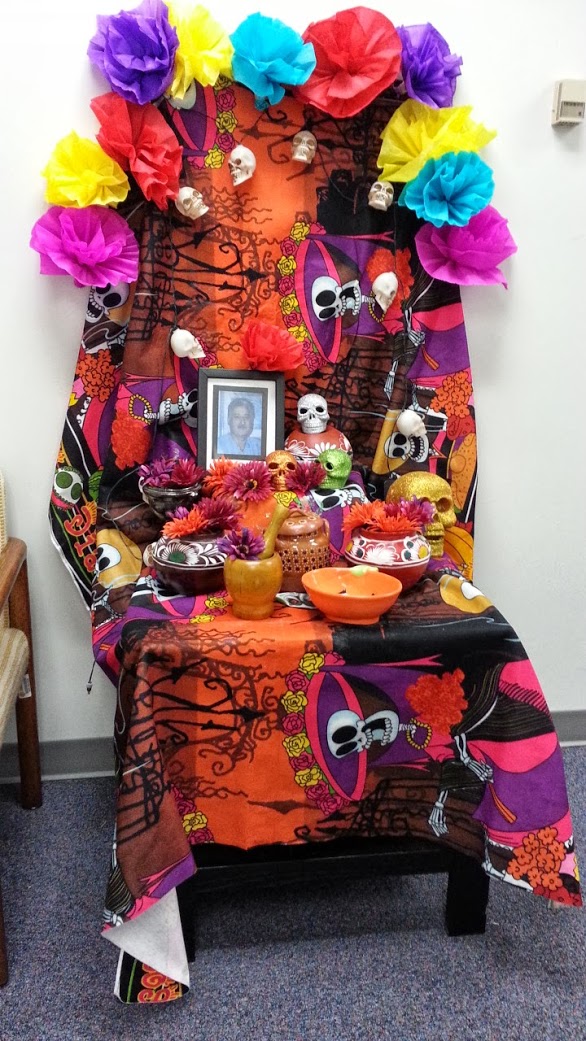
At the Center for Hispanic Marketing Communication at Florida State University, where many of the students are non-Hispanic, Dr. Sindy Chapa erected an altar in the memory of her father as shown below.


Museums around the US have had exhibits of altars for dia de los muertos both to celebrate the culture and to show the folkways of mesoamerica. From Oakland, California, to El Paso, Texas, even to the Idaho Historical Society, museums have in one way or another presented exhibits to mark the celebration.

Skelita Calaveras the Monster High doll created for Dia de Los Muertos has been a great success for Mattel, and the doll has been searched by name extensively in US States with strong Latino presence. As marketers realize the importance of Latinos to their bottom line, almost by accident they also educate the rest of the population about Latino cultural features.

What do all these stories and anecdotes tell us? As Hispanics acculturate they also spread the allure of their customs and beliefs. Acculturation is a two way street in which we learn from each other and find aspects of the culture of others attractive and meaningful. When cultural influence goes beyond the material aspects to the intangible and spiritual, one witnesses a societal transformation that should make marketers think more about culture and the future of marketing.

Thursday, September 19, 2013

Salsa, Tortillas, Dulce de Leche, and now Hugs

I read in the Wall Street Journal (September 14 - 15, 2013*) that hugs are an issue now in the United States as many more people hug than ever before.  My first reaction was that as tortillas overtake white bread and salsa overtakes ketchup, hugs overtake social distance.  Is this the Latino influence? Now the WSJ article talks about how to defend yourself from huggers. That is a serious departure from the nature of hugging in Latin America and other "hugging" regions of the world where the hugging is seen as a welcome sharing of human warmth and reassures people of their relationship.

When I was young, in high-school and then in college in Mexico, every day, I had to hug and kiss many women, which I thought was nice, and hugged many men as well, which I felt were my dear friends. It was routine, the business of social life.  You hug those you care for and those you want to keep as part of your circle of friends.  Also, it felt good. It was reassuring. I felt I belonged.

Hugging feels good.  It releases chemicals in our body that make us feel good. A most interesting substance is oxytocin which contributes to our social happiness and well being. It is known to be released when people touch and hug and helps people bond together.  Hispanics are good at this. I believe this is an important contribution that Latinos and other "hugging" people are making to US society.

Chipotle, mango, salsa, papaya, tortillas, cilantro, yuca, and many other flavors are clearly now part of the mainstream. Also, Latin music and architecture have become part of the American mainstream.  But that is only the part of the culture that is clearly observable.  What about the less observable parts of the culture?  What about the subjective culture composed of values, ideas, attitudes, and ways of thinking? Hugging is part of the subjective culture that is now influencing the United States. Subjective because it emanates from primitive impulses, beliefs, and values that take us back to our origins.

Marketers ought to consider that the most powerful insights come from those attitudes, beliefs, values, and perceptions that are transmitted via our cultural groups but that are hidden from view. Hugging is visible, but not its motives and consequences. Touching produces a different social structure. Marketers can capitalize on those motivations and the effects of touching and hugging (haptics) by establishing connections associated with their brands.

Human contact feels good and makes people happy.  Clearly, it has to be appropriate, but Latin Americans don't worry about that. They know when the toucher is a creep.  In low contact cultures any contact can be misinterpreted.  But in high contact cultures contact means care and affection. As we move into a more touch oriented society in the US, our ways of behaving, thinking, and feeling change as well.

Now that Latinos have influenced the US culture beyond imagination, it is not only with the material things of life where Hispanics are making a statement but also with emotions. While marketers have long thought that differences in culture are apparent in the numerous manifestations we observe, now we need to take notice of the more hidden aspects.

Marketers do not only capitalize on high contact cultures when understanding their motivations and bonding feelings, but they may now have a "total market" approach in their hands. Hugging will likely transcend cultural groups.

The author of the WSJ article was trying to help others with larger personal space needs to defend themselves from the rising tide of huggers. Well, another take on the trend is that it is good for you and potentially excellent for marketers who understand cultural patterns.  

In Hispanic Heritage month let's celebrate hugging and all that comes along with it.

______________________________
*"The Delicate Protocol of Hugging: For fans of personal space, these are difficult times: America has become a nation of huggers" by Peggy Drexler

Wednesday, June 5, 2013

The Juice Mystique: Hispanic and Non-Hispanic Consumption of Orange Juice Brands and Drinks

I have spent quite a few years asking consumers about their consumption of orange juice and juice drinks. In visiting stores that cater to Latinos in Texas and California I tend to see large displays of shelf stable drink products like Tampico and Sunny Delight. Over the years I have heard Hispanic consumers state that these products have high percentages of juice in them, as high as 80% and sometimes even higher. Which is surprising because the actual juice content is low.  I was not sure about the extent to which the consumption of these juice beverages was higher or lower than popular orange juice brands.


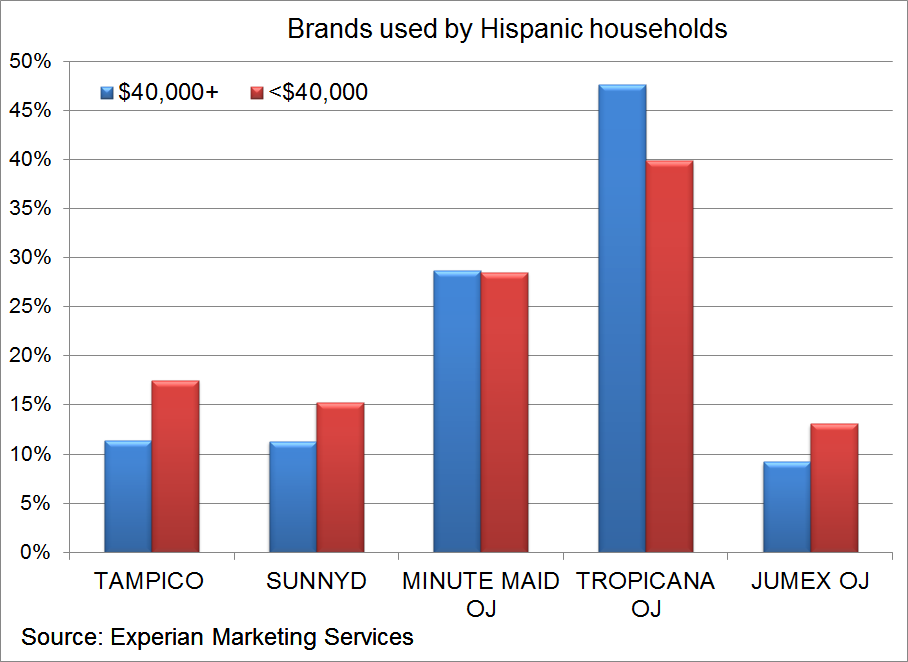
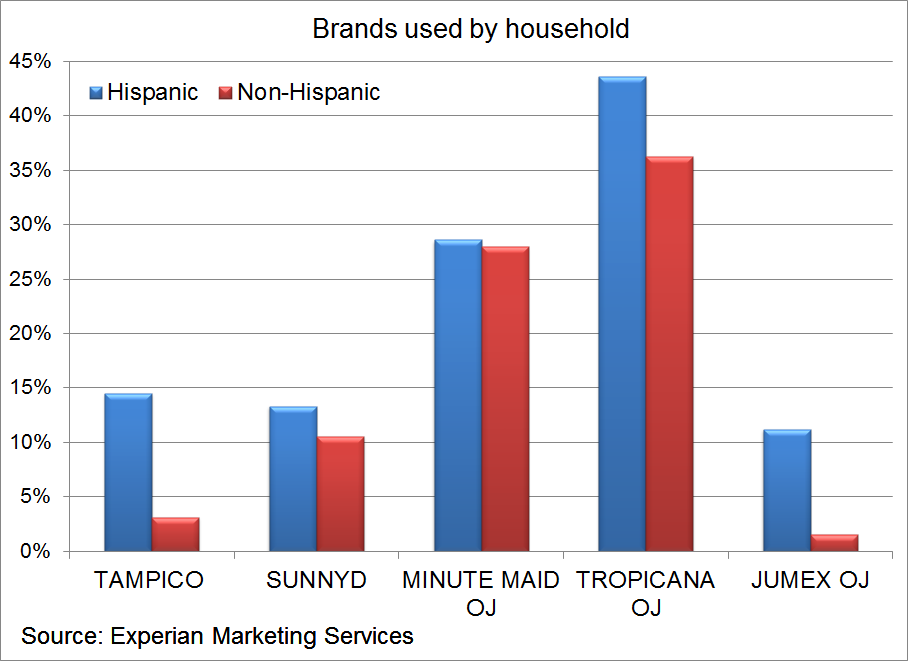
To obtain a quantitative picture I examined data from the Experian Marketing Services Simmons National Hispanic Consumer Study that was collected in the twelve months ending on November 30, 2012.  The results I obtained provide an interesting perspective on the use of these products according to the chart below.


First I need to clarify I decided to compare Tampico and Sunny Delight with Minute Maid and Tropicana because these are large orange juice brands, and also included Jumex because the brand has its origin in Mexico and is well known by Latinos of Mexican origin.


The chart shows that even though Tampico and Sunny Delight are used by Hispanics to a larger extent than by other consumers, the prevalence of the use of those brands is relatively low when compared with major US brands like Minute Maid and Tropicana. Jumex orange juice is used at about the same rate as the Tampico and Sunny Delight beverages. It is salient to notice that Tampico and Jumex have a very prevalent Latino constituency. That may be explained by the affinity of the Tampico brand, since Tampico is a port in Mexico, and by the heritage of Jumex whose name comes from the roots “jugos” juice, and “mexicanos” Mexican.


Interestingly, Hispanics over-index non-Hispanics in the use of all the brands. I was expecting that they would over-index more markedly in their use of the less expensive beverages but that is not the case. Given their family orientation and their larger household size, Latinos consume more of these beverages regardless of their pricing or quality. Many have argued that Hispanics are likely to purchase their preferred brands or more expensive brands for their family even if their incomes are lower. These findings may provide a partial indication of that possibility.


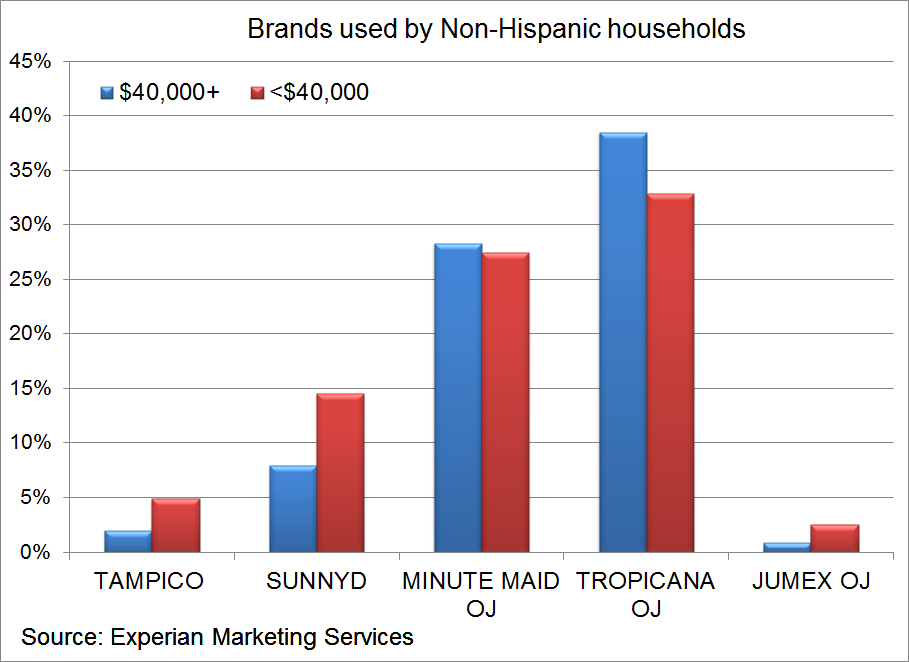
Out of curiosity I decided to check on income levels by use of these brands to ascertain whether or not income is associated with their use, for Hispanics and non-Hispanics. The charts below show the results.


As can be seen there is a tendency for those with lower incomes to be more likely to use Tampico and Sunny Delight, as well as Jumex orange juice regardless of their Latino heritage. And in the case of Minute Maid and Tropicana the difference by income levels is small but somewhat slanted towards higher incomes, particularly in the case of Tropicana. What seems outstanding (thanks William Biggs) is that those in the lower income categories use the premium OJ brands much more, in general, than they use the lower priced products. It can be concluded then that lower income is somewhat of a driver in the use of fruit beverages like Tampico, Sunny Delight, and Jumex OJ, but marginally the opposite in the use  of major brand orange juices. Lower price points are more appealing to some of those with lower incomes, and perhaps these consumers justify their choices by attributing higher juice content to beverages that do not have such.

It stands out that even those with lower incomes are more likely to consume premium brand orange juice, than the less expensive counterparts. Thus the selectivity of diluted drinks and less expensive brands may be particular to some who knowingly find them appealing, or who do not know what the nature of the product is.


Clearly, if Latino consumers and non-Latino consumers of lower incomes and large families see a large container of an orange drink and believe it contains a large amount of juice and then compare the price with actual 100% juice products, they are likely to opt for the larger and less expensive product. But what if they compared labels carefully?


In a competitive market there is room for juice brands to more directly  and aggressively compete with products that have a small percentage of juice content by educating consumers as to what the differences are. Clearly, the less expensive products also have some benefits as they are enriched with vitamins.  If a brand has a true advantage it should exploit it to the benefit of their bottom line and their consumer base.


At any rate, there is ample room for marketers to better understand the consumer behavior of Latinos to more successfully market to and educate them. Latinos generally want the best for their families, and highlighting product differences for them may be helpful and also profitable.


The data used here is from Experian Marketing Services’ Simmons National Hispanic Consumer Study of adults 18+  and was collected from October 24, 2011 to November 30, 2012. The sample of Hispanics contains 8,521 individuals and the non-Hispanic sample has 17,043 people.

Tuesday, March 19, 2013

The Mystery of Bleach, Brand Loyalty, and The Latino Story

Spring is here and cleaning is in the minds of many. For years I have heard that bleach is an important cleansing agent in Hispanic households.  When visiting Latino households I regularly smell bleach in the kitchens and bathrooms.  

Using data from Experian Marketing Services’ Simmons National Hispanic Consumer Study that was collected in the twelve months ending on November 20, 2012, I found that 87% of Hispanic adults live in households that use bleach while only 82% of non-Hispanic adults live in households that use bleach. That represents an index of 105 for Latinos compared with an index of 99 for non-Latinos.

Interestingly, then, the attitudes expressed by Hispanics during my many years of doing research seem to be reflected in quantitative data. Bleach is an important part of the cleaning and disinfecting routine of Hispanics, and to a larger extent than anyone else.

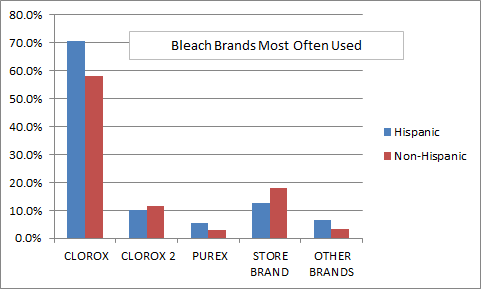
Also, we all have heard about how brand loyal Latinos are. Because of a weak economy and other factors I suspected that private label and less expensive products would be most popular at this time. To my surprise Clorox is the brand of bleach most likely to be used by Latinos, even though it is a more premium brand. The following chart reports the brands used “most often” in Hispanic and non-Hispanic households.


Clearly, brand loyalty is alive and well among Latinos.  How else would one explain that Clorox bleach is their preferred brand? When doing qualitative research with Hispanics I frequently hear comments regarding the importance of staying with brands that have shown their efficacy over time.  In particular, Hispanics seem to be more brand loyal when it comes to products that are more central to the wellbeing of their families. This is good news for the Clorox company and an interesting challenge to alternative bleach manufacturers. This is a category where there is ample opportunity to grow among Hispanics.

Clorox 2 is a different type of product as it is not an oxidant, instead of bleach it uses oxygen as a cleaning agent. Interestingly, this product does not do as well among Hispanics, at least not yet.

At any rate, the story told here serves as a brand loyalty case study and a reminder of the value of cleanliness that Latinos hold dear. This also serves as a reminder that cultural values for product usage can be very powerful in determining consumer behavior.

The data used here is from Experian Marketing Services’ Simmons National Hispanic Consumer Study and was collected from October 24, 2011 to November, 2012. The sample of Hispanics contains 8,521 individuals and the non-Hispanic sample has 17,043 people.


Wednesday, October 31, 2012

Hispanic Attitudes and Behaviors by Socioeconomic level: Implications for Marketers

When talking about US Hispanics marketers seldom explore socioeconomic level as it relates to their attitudes and behaviors.  For me this is a most interesting relationship because if, for example, Latinos hold cultural attitudes in the same esteem regardless of their social standing, then one may conclude that one marketing approach may reach diverse types of Hispanics.
What should the marketer tell Hispanic consumers when selling a new Toyota Camry? Or what should the marketer tell Latinos when selling diapers? Should the communication and positioning approaches used be equally crafted to reach the Hispanic that can afford a new relatively expensive car, or a more common product like diapers?
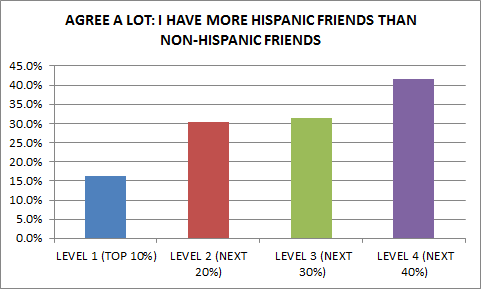
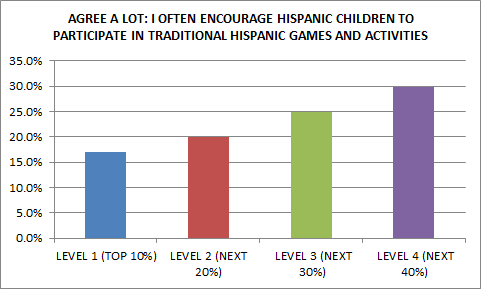
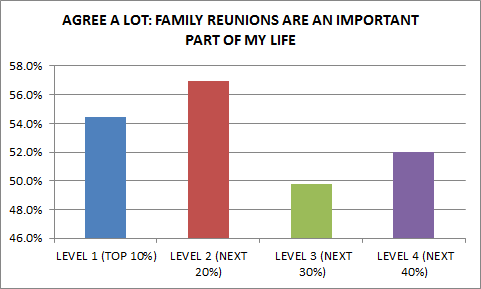
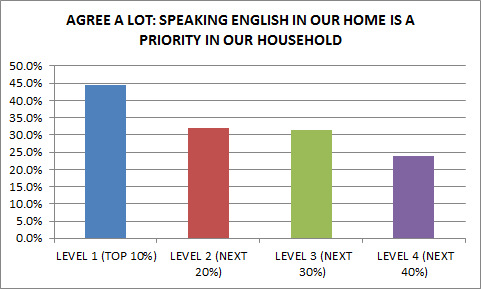
Using data from the Experian Simmons National Hispanic Consumer Study that was collected in the twelve months ending on June 1, 2012, I created crosstabulations of the TGI Socio Economic Scale in the Experian Simmons database by those “agreeing a lot” with cultural attitudes and behaviors that will be specified below.  The TGI Socio Economic Scale is a composite of education, ownership of selected household durables, mobile phone ownership, credit card ownership, usage of Internet and air travel. The scale results in four levels of socio-economic standing: The top 10% of the population, the next 20% of the population, the next 30% of the population, and finally the remaining 40%.
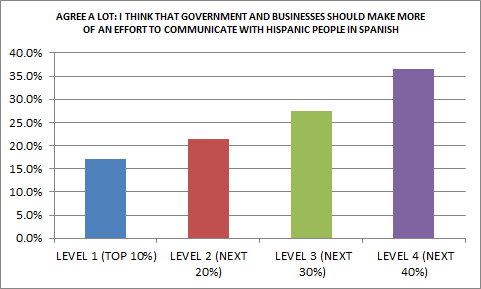
The bar charts below report the percentage of Latinos in each of the Socio Economic Level that stated they “agree a lot” with each of the cultural statements.
The way to read these results is, for example:  Of those Latinos that are in the lowest 40% of the TGI Socio Economic scale, 30% “agree a lot” with “I often encourage Hispanic children to participate in traditional Hispanic games and activities,” and 25%  those in the next higher 30% level state they “agree a lot” with the statement.  Twenty percent in the next higher level and only about 16% in the highest Socio Economic level similarly “agree a lot.”   Meaning that strong agreement with the statement is heavily concentrated in the lower socioeconomic classes. There is a monotonic trend that indicates that as Socio Economic Level rises, attitudes and behaviors endorsing Latino cultural elements decrease. There are other attitudes and behaviors that do not conform with the above trend, for example:


The cultural value of being gregarious and enjoying family and extended family appears to be consistent across Socio Economic Levels, and to an even higher extent at the upper levels of the Socio Economic scale.  In general, however, the percentages are very high and they speak more readily about how certain cultural values persist even as people become wealthier and more educated. It appears, then, that some values and behaviors decline as Hispanics climb the social ladder and others persist regardless. This highlights the complexity of the Hispanic market. Further, those higher in the Socio Economic scale are more likely to endorse values of US society as reflected in the chart below regarding the priority of speaking English in the household.


The findings are consistent and surprising, in my opinion.  Those who are less affluent and less formally educated are the largest share of those indicating they engage in culturally related behaviors as well as holding attitudes and beliefs that are culturally based. Nevertheless there appear to be values that survive Latino prosperity like the value for family get togethers. It may be that those better off have more family around to get together with and that those less well off tend to be more geographically separated because of lack of economic resources.

These findings corroborate what our book “Hispanic Marketing: Connecting with the New Latino Consumer” says about how lower socioeconomic classes are more likely to be attached to their culture to a larger extent. It is also likely that having roots, of any kind, is more important to those who have not fared as well in society. Nevertheless, this data shows that there are exceptions and that more affluent Latinos are likely to endorse US values to a larger extent. That may not be too surprising but certainly the trend points to the importance of Socio Economic Level considerations in marketing to Hispanics.

Another factor to point out is that recency of immigration to the US should be correlated with Socio Economic Level. That may also explain to some extent why lower levels endorse cultural attitudes and behaviors to a larger extent.

The consistencies are important and we will report some more of these in future postings. The trends have powerful implications for those who for example plan business to business campaigns, or plan approaches geared to the more affluent. In a business to business setting, if targeting relatively well to do Hispanic business owners a culturally based approach may not be as relevant as when targeting Latino employees of that business.

Three trends were highlighted here. Specific cultural attitudes and behaviors that differentiate Latinos of diverse levels and that tend to be more strongly endorsed by those in the lower 40%; Other more general cultural attitudes and behaviors that seem to be relevant to all Hispanics; And, a tendency for the better off to endorse US values to a larger extent.

Marketers should, in my opinion, pay close attention to these findings. Marketing in culture may render more robust results when campaigns are directed to the lower socioeconomic strata. It appears that cultural heritage loses some prevalence as Latinos become increasingly affluent. Thus, having a campaign in Spanish with Latino themes for better off Hispanics may not be as productive as once thought.

The data used here is from the Experian Simmons National Hispanic Consumer Study and collected from April 25, 2011 to June 1, 2012. The sample contained 8252 Latinos.

Monday, October 8, 2012

Mobile Latinos

I was quite impressed when Max Kilger, Chief Behavioral Scientist for Experian Simmons, talked to my graduate Hispanic Marketing Communication class about new data findings regarding mobile technology use by Latinos.  I was particularly impressed because the sample that Experian Simmons uses yielded similar results to the ones I have been obtaining with the sample provided to Florida State University by Research Now. Cross-validation of results is reassuring.  Basically, Hispanics are eager users of mobile technology.

Here are some of the findings reported by Dr. Kilger to my class:

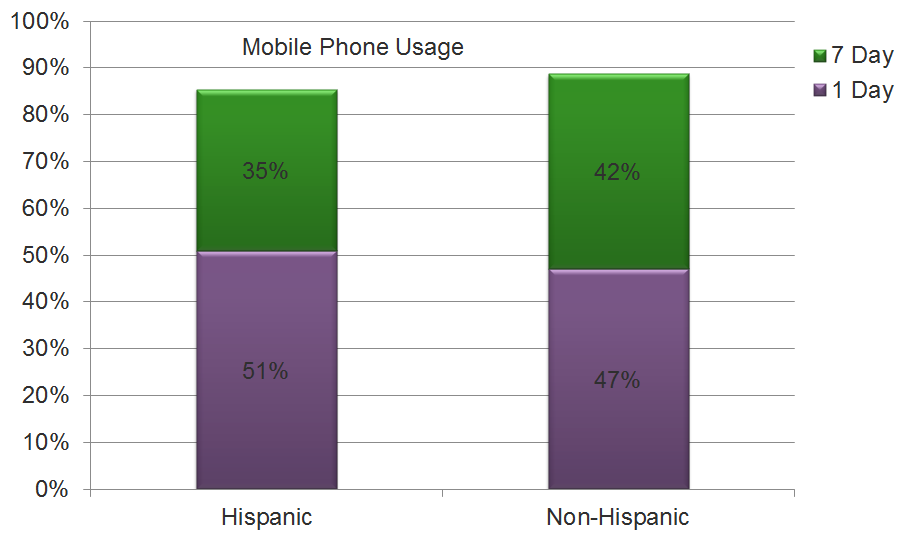
First, the percentage of use of mobile phones by Hispanics and non-Hispanics over a 7 day period is almost the same for Hispanic and non-Hispanics, with non-Hispanics having a 4 percentage point lead as seen in the chart below.  The Latino percentage of mobile use in one day, however, is about 4 percentage points higher.


Clearly, the small differences highlighted are interesting but almost trivial.  What matters here is that Hispanics are eager users of mobile phones, at least as much as the rest of the market combined. In prior blog postings I have presented data which shows that Hispanics, African Americans, and Asians use their mobile phones about double the amount of time as their non-Hispanic White counterparts. That suggests that when looking at all non-Hispanics combined it is likely that minorities are the ones responsible for much of the usage.

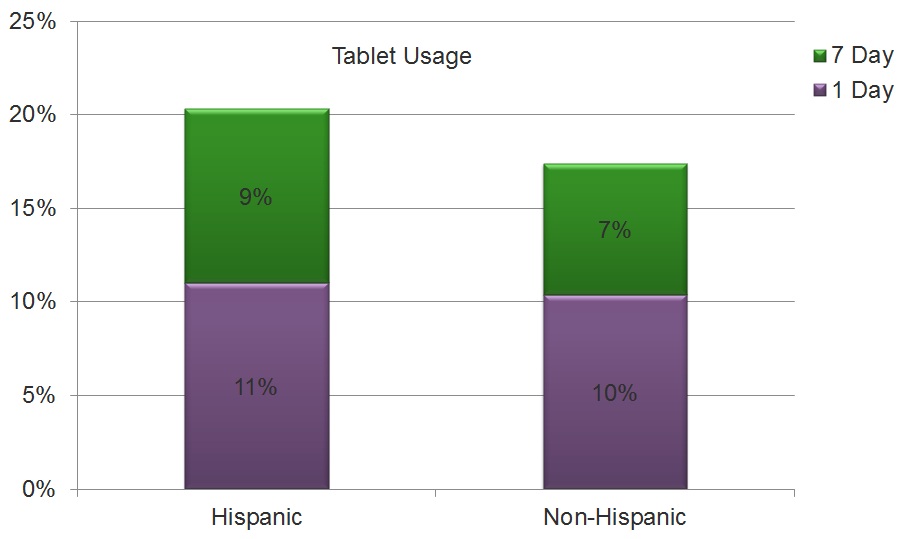
The next chart is more dramatic, not so much in terms of actual differences but in the fact that Latinos are eager to adopt new technologies and that when they adopt them they use them more. Here is the trend in terms of Tablet use.


While the penetration of tablets among Hispanics is not yet as high as among other cultural groups, Latinos who have them are more likely to use them. That comes as no surprise given the findings I have reported in the past couple of years. Technologies that allow for more fluid interpersonal communication and mobility have shown to be very attractive to Hispanics. My interpretation is that this is due to the eagerness that Latinos have to be connected. New technologies appear to be in fact “technologies of liberation” for Latinos.  Liberation in the sense that the constraints impeding interconnection among Hispanics are being removed by these electronic machines.


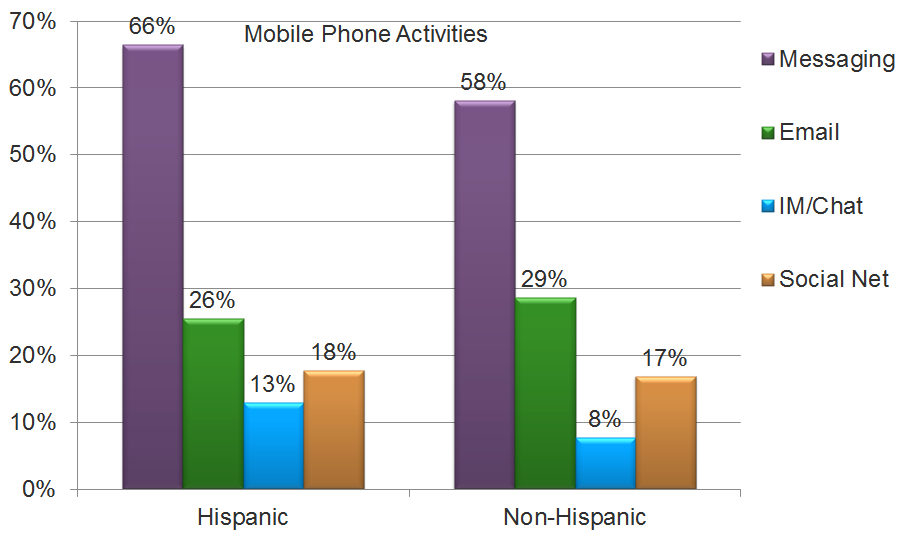
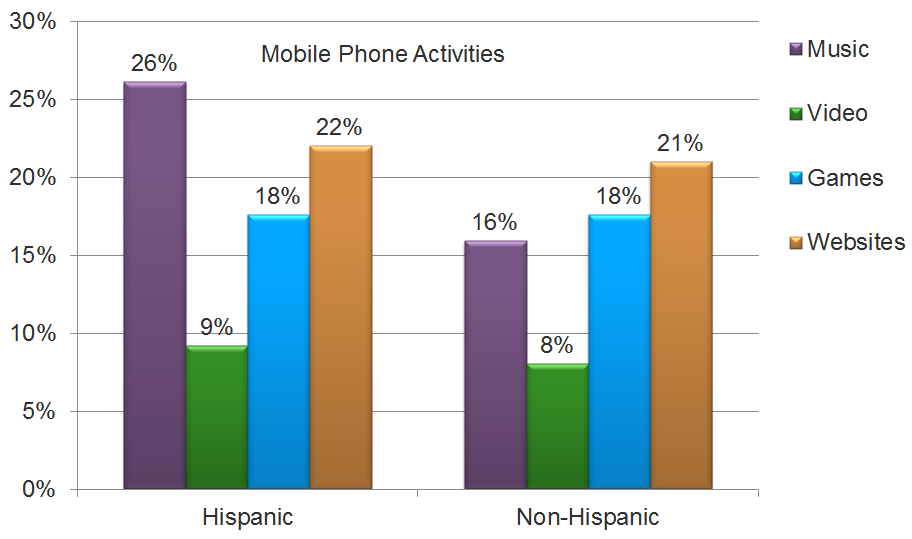
Another two charts that impressed me have to do with activities that Latinos engage in on their mobile phones.


Perhaps not surprisingly, Hispanics overindex in their use of text messaging, IM/Chat, and to a smaller degree in social networking.  My guess is that if these data were broken down further by cultural group we would see that minorities in general overindex in social networking as we have seen with our FSU data before.  That Latinos engage in mobile phone listening to music to a larger degree than anyone else confirms their attraction to music as part of their cultural existence.


It would be most interesting if the Experian Simmons data were broken down by different cultural groups so that comparisons could be made in more detail. Comparing culturally diverse groups among themselves can be illuminating for segmentation purposes.

My students and I were gratified to see that the Experian Simmons data supported the results we had found with the data from Research Now, and this confirmation lends credibility to the fact that Latinos are eager technology users who lead in many digital domains.

The data from which the above results are reported is from the Simmons Connect Study with a cross-platform sample of Hispanics of over 7,000 respondents.

Monday, September 17, 2012

Cultural Attitudes and Language Preference of Hispanics: Marketing Implications

Do attitudes towards Latino culture change depending on the language preference of Hispanics? This is a question that has importance to marketers and service providers.  If cultural attitudes differ for those who prefer to speak English and those who prefer to speak Spanish then one can conclude that language preference is also an indicator of how close one is to one’s own culture. If on the contrary, cultural attitudes do not differ or differ to a small extent between English and Spanish preferred Latinos, then one can conclude that the overall Latino culture persists regardless of current language preference.

Using data from the Simmons National Hispanic Consumer Study that was collected in the twelve months ending on March 16, 2012, I created crosstabulations of language preference by cultural attitudes among Hispanics. Language preference was gauged as the language the respondent prefers to speak in general and the response categories were Only English, Mostly English but Some Spanish, Mostly Spanish but Some English, and Only Spanish. For this analysis I collapsed Only and Mostly English and Only and Mostly Spanish to form the preferences for English or Spanish.

Cultural attitudes were measured with a Likert type scale “Agree a lot,” Agree a little,” “Neither agree nor disagree,” “Disagree a little,” and Disagree a Lot.”  The items to agree or disagree with were:  

  • I believe it is important to teach Spanish to Hispanic Children as a way to help preserve Hispanic culture
  • I have more Hispanic friends than non-Hispanic friends
  • I make an effort to have my personal appearance reflect that I am Hispanic/Latino
  • Speaking English in our home is a priority in our Household
  • Speaking Spanish in our home is a priority in our Household

The two agree response categories in the scale were added up to have an overall agreement percentage.  The following chart shows the average percentages for those who prefer to speak English and those who prefer to speak Spanish for each of the attitudes.


The reader can see that generally speaking those who prefer to communicate in English exhibit a lesser priority in endorsing items that reflect a cultural attachment.  In particular, and in a somewhat obvious way, those who prefer to speak in English express that Speaking English at home is more of a priority for them than for their Spanish preferred counterparts. That trend is strongly reversed for those who prefer to speak Spanish as they indicate a very strong priority for Spanish to be the language of the home.

What is counterintuitive and revealing is that a large majority of those who prefer to speak English indicate that teaching Spanish to Children is a way to help preserve Hispanic culture. To me that means that preferring to speak English does not necessarily mean that the Spanish language is not highly thought of.

That those that prefer Spanish have more Hispanic friends than those who prefer English is not surprising.  The social networks of those who prefer English are likely to be wider and more diversified. Those who prefer Spanish are likely to live and work in conditions that may be somewhat  more segregated.

While a Latino personal appearance is not highly important in general, those who prefer Spanish endorse it to a larger extent.  And that is not very surprising either, because as one’s circles and circumstances expand one is more likely to also acquire the styles of those varied groups.

The main lesson for marketing, from my point of view is that while language preference does differentiate Latinos’ cultural attitudes, positive attitudes towards cultural elements persist among those who prefer to speak English.  In particular this is true when it comes to the education of children. It is an ambition to have one’s kids learn Spanish as a proxy for preserving the culture.

The moral of the story is that while Hispanics may be acculturating and switching to English as they stay longer in the United States, their loyalty to their heritage appears to persist.  Thus, cultural messages are likely to be a key link to reaching out to Hispanics be they Spanish or English preferred.

The data used here is from the Simmons National Hispanic Consumer Study and collected from January 31, 2011 to March 16, 2012. The sample contained 3,518 English preferred Latinos, and 2,104 Spanish preferred Hispanics.

Friday, September 7, 2012

Political Affiliation and Attitudes of Hispanics

In this heated political season of the Fall of 2012, when the different political parties are trying to get the attention of Hispanics it is of interest to explore how the political affiliation of Hispanics relates to some of their attitudes.

With online data collected by Research Now of Dallas Texas, for the Center for Hispanic Marketing Communication at Florida State University, I explore here a variety of attitudes as they relate to the political affiliation of Hispanic respondents. Affiliation was measured by asking respondents “Could you please tell us your political affiliation?” and the answer categories were Republican, Democrat, Independent, and No Party Affiliation, as well as the opportunity to refuse to answer. The attitude items were statements to which respondents could answer any number from 5 to 0, where 5 meant “Completely Agree” and 0 meant “Completely Disagree.”

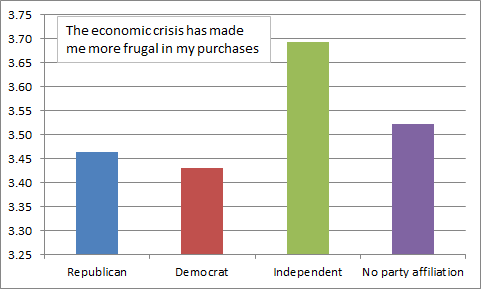
Independent respondents were more likely to state  the economic crisis has made them more frugal in their purchases than other respondents. They were followed by those with no party affiliation. Republicans and Democrats were somewhat less likely to agree with the statement.


Still, in the context of a scale from 0 to 5, there was a general sense that frugality has been a factor in these consumers’ lives.  Perhaps Independent respondents and those with no party affiliation have opted for those responses because they are politically dissatisfied.

Interestingly, when asked about worrying about retirement, the trend is somewhat different.


In the case of worrying about retirement, Republicans and Democrats seem to be more worried than their counterparts. Again, in the context of the scale we used, this is a concern to many Latinos, in general.  

The use of coupons can be construed as an indicator of economic concern.


Here the reader can see a monotonic decline of habitual use of coupons with political affiliation, from Republican to No party affiliation.  Is it the case that those with a party affiliation are somewhat more systematic in organizing their purchases?

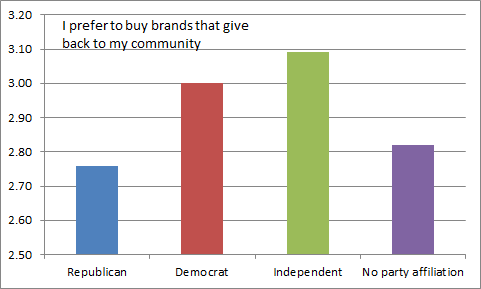
These days it is common for companies to endorse the idea that they need to give back to the communities they benefit from. 


Democrats and Independents are more likely to agree that they favor the companies that give back to the community. This is perhaps associated with socioeconomic status and with a more socially oriented philosophy.

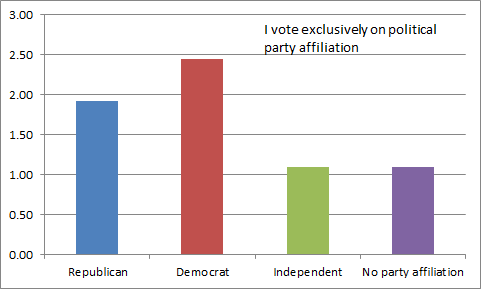
Voting along the lines of political affiliation is obviously more prevalent among Democrats and Republicans. This is perhaps not surprising but the trend confirms that there is a sense of loyalty to the party.


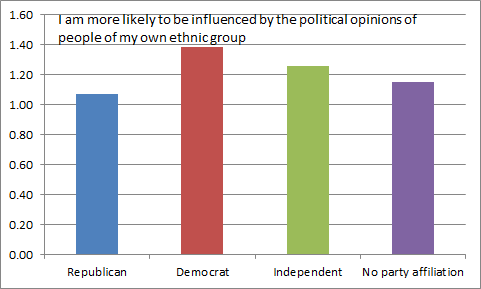
There are many politicians and advertising strategists who believe that to influence Hispanics they need to use Latinos models and that influence is likely to come from other Latinos.


While there are some small differences among affiliations regarding the feeling that one is more influenced politically by others of one’s own ethnic group, the overall level of agreement is very low. This means to me that the influence regarding Latino political behavior is more based on issues and party affiliation than on the ethnicity of influencers.

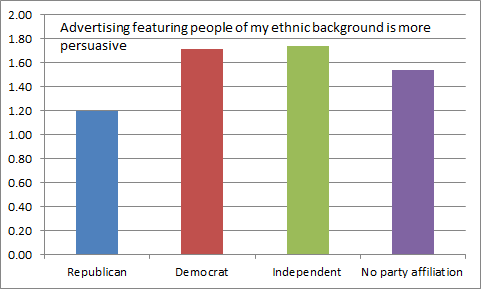
Similarly, regarding advertising, we find that while there are some differences regarding the influence of others who share a Latino ethnicity, overall the ethnicity of the people featured in the ads does not seem to be highly important.


This may be due to the fact that Latinos come in all colors and that the party affiliation and issues are more important than the ethnicity of the characters in ads. Republicans are particularly less likely to be influenced by the ethnicity of the advertising portrayals.

Overall one can conclude that political affiliation does seem to have a relationship with attitudes about the economy, even though everyone seems to be affected by economic conditions  in general. Further, political affiliation seems to be a matter of loyalty particularly for Republicans and Democrats. The ethnicity of influencers, however, does not seem to be that important to these online consumers.

The data for this study was collected by Research Now of Dallas, Texas, thanks to the generous initiative of Ms. Melanie Courtright. Research Now contributed these data to the research efforts of the Center for Hispanic Marketing Communication at Florida State University.  This national sample had quotas for US region, age, and gender to increase representativeness. The distribution of political affiliations was as follows:


Wednesday, September 5, 2012

Language Preference of Hispanics and Perceptions of Financial Well Being: Implications for Marketing

To what extent has the financial situation affected the perceptions of financial well-being of Latinos depending on their language preference? This question has implications because the answer may impact the way in which consumers make purchase decisions.

Language preference among Hispanics has been considered a proxy for acculturation. It is also an indicator of the many aspects of life that impact Hispanics from media preferences to interpersonal interactions. The anti-immigration sentiment prevalent in many circles in the US these days has hurt recent immigrants in particular. In addition, economic circumstances in the past few years are likely to have affected Latinos differentially depending on their integration in the US.

Using data from the Simmons National Hispanic Consumer Study that was collected in the twelve months ended on March 16, 2012, I created crosstabulations of language preference by financial outlook among Hispanics. Language preference was gauged as the language the respondent prefers to speak in general and the response categories were Only English, Mostly English but Some Spanish, Mostly Spanish but Some English, and Only Spanish. For this analysis I collapsed Only and Mostly English and Only and Mostly Spanish to form the preferences for English or Spanish.

The financial outlook dimension was measured with the question: Do you think you are better off or worse off financially now than you were 12 months ago? The response categories were Significantly Worse Off, Somewhat Worse Off, About the Same, Somewhat Better Off, and Significantly Better Off. For the purposes of this analysis I collapsed those who answered significantly and somewhat worse off, and those who answered significantly and somewhat better off to result in three categories: Better Off, About the Same, and Worse Off.

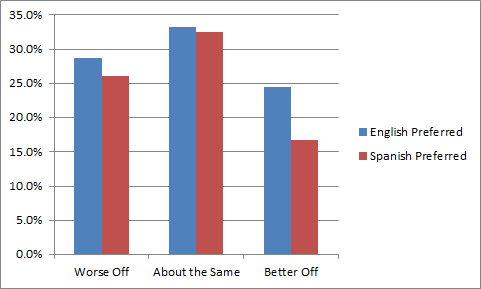
The resulting “average” table is presented below:


The plurality, over 30% of Latinos indicate that their financial situation is about the same as it was 12 months ago. This can mean different things.  It can mean that things have not improved or that things have been as good as they were a year ago. Given the economic situation the US is going through, most likely it means that things have not improved but not gotten worse. Also, the “fatalism” prevalent in the culture may lead many to express that things are the same as usual and that in the average there is no change.

English preferred Hispanics, however, have a much more positive perspective than Spanish preferred Latinos as a substantively larger percentage of them indicate they are better off now than 12 months ago than their Spanish preferred counterparts. This may not be completely surprising since Spanish preferred respondents are more likely to be more recent immigrants and also more likely to suffer the consequences of immigration policies. These more recent immigrants are also more likely to have suffered from lack of work due to the lack of jobs in industries like construction that have traditionally employed many recent immigrants from Mexico and other parts of Latin America.

In a somewhat contradictory fashion, a few more English preferred Hispanics also report being worse off now than Spanish preferred respondents, but the differences between these two groups are very small. What is interesting is that over 25% of Latinos feel things have been worse for them in general. While not surprising, these figures bring home the notion that the economy and immigration related issues are likely to have made life worse for many Hispanics who try hard to make a living for themselves and their families.

The news for marketers are mixed.  The majority of Hispanics feel they are better off or about the same as they were 12 months ago, and that is good news as that means that spending by most Latinos is likely to continue at a sustained pace. The negative news are that a substantial percentage feel the brunt of pervasive immigration and economic conditions and that their spending may be limited by their actual and perceived spending power. This brings about the importance of making politicians aware that the uncertainty of immigration reform needs to be removed for economic growth. The clarification of immigration policies and rules is likely to make the future more predictable and optimistic for many. Also, as in the overall economy, job creation should be a most important priority.

The data used here is from the Simmons National Hispanic Consumer Study and collected from January 31, 2011 to March 16, 2012. The sample contained 3,518 English preferred Latinos, and 2,104 Spanish preferred Hispanics.

Friday, July 13, 2012

Taxes, Convenience, and Multicultural Purchases Online

Many local merchants and multiple brick and mortar retailers complain that online merchants have an unfair advantage because many of them do not charge State and local taxes to purchasers. That is an interesting empirical question, particularly in the context of our multicultural society.

Are consumers more likely to buy online to save on taxes, or are they more attracted to online retailers because of convenience?  That is the key question guiding this study.

In the Spring of 2012, at the Center for Hispanic Marketing Communication of Florida State University, in collaboration with Research Now, we collected data for our yearly Multicultural Marketing Study.  We asked consumers to tell us how much they agree or disagree with the following statements:

- I purchase products online to save the money I would have to pay for State taxes
and
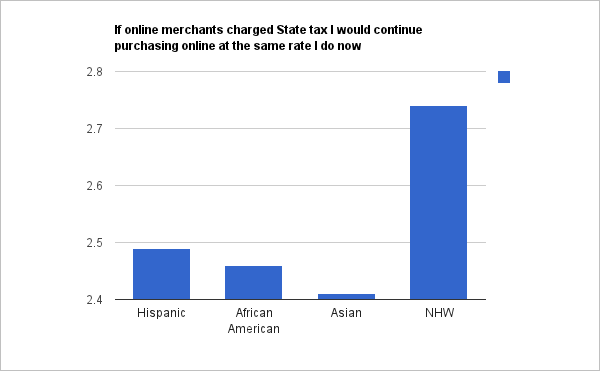
- If online merchants charged State tax I would continue purchasing online at the same rate I do now

Respondents could agree or disagree on a scale that went from completely disagree (0) to Completely agree (5).

Interestingly, across all respondents the average agreement with the first statement was 2.42 and 2.5 with the second statement, almost exactly in the middle of the scale. These overall trends appear to indicate that paying or not paying State taxes when shopping online is not a major consideration for shopping online. These findings tend to negate politicians’ and brick and mortar merchant arguments that advocate that local merchants would fare better if State taxes were imposed on online merchants.  

The breakdown by major ethnic groups reveals some interesting but mild differences.


Statistically, Asians agreed the most with “I purchase products online to save the money I would have to pay for State taxes.”  Hispanics were second and African Americans and Non-Hispanic Whites were least likely to agree with the statement. Still the differences are relatively small. Frugality may account for some of these differences.  Still, even the largest mean of 2.8 for Asians is still relatively small in the context of the scale and seems to indicate that saving on State taxes is not a major motivation for purchasing online.

The distribution of means for the second statement shows a contrasting pattern:


Even though the differences here are again relatively small, the tendency for non Hispanic Whites to agree more strongly with the statement “If online merchants charged State tax I would continue purchasing online at the same rate I do now” indicates cultural differences in the perception of value and saving on taxes. There was not statistically significant difference among Asians, Hispanics, and African Americans.

In sum, Asians seem to be somewhat more motivated by tax savings when purchasing online, and non Hispanic Whites appear to be more indifferent to online purchase taxation. Still, the main finding is clearly that overall, the impact of State taxing of online purchases is not likely to make a major difference.  Convenience appears to be a major motivation for making online purchases. The cost of fuel and the amount of time that it takes to shop in brick and mortar shops does not appear to compensate for State taxation.  It is unfortunate that brick and mortar businesses may not count on State taxation of line purchases to strengthen their businesses to any large extent. Perhaps the biggest lesson for marketers is that regardless of online taxation brick and mortar merchants need to transition to having a presence online.  Also, the results of this research do point to cultural differences in perceptions of online purchase taxation that can be of interest to marketers in their positioning of their offerings.

The data for this study was collected by Research Now of Dallas, Texas, thanks to the generous initiative of Ms. Melanie Courtright. Research Now contributed these data to the research efforts of the Center for Hispanic Marketing Communication at Florida State University. This online survey included the responses of 936 Asians, 458 African Americans, 833 Hispanics, and 456 non Hispanic Whites. This national sample had quotas for US region, age, and gender to increase representativeness.

Friday, April 8, 2011

Latinos Are Digital Innovators

We just finished collecting data for our multicultural marketing study (Florida State University's Center for Hispanic Marketing Communication with the collaboration of DMS Insights). The suprise, again this year, 2011, is that once Latinos are online they are more likely than other cultural groups to innovate in the digital space.

In this new study we found that Hispanics in general and Asians are more likely to have a blog than anyone else. Perhaps even more surprising is that Latinos who prefer to answer in Spanish are more likely than anyone else to have a website of their own.

We have found this tendency over the past 5 years, and it continues. It would have been expected that over time, members of other cultural groups would catch up and even out the field. That has not been the case. What that tells us is that Latinos are truly engaged with online technology.

The reasons for these trends are most likely related to the collectivism of these consumers. They want to share their experience with others who are important to them. These findings have strong implications for marketers. If Hispanics are online leaders, who do you approach to disseminate the news about your products? Latinos are the arrowheads into a new era of virtual experience. Their behavior is particularly interesting because traditional marketing stereotypes have usually placed Hispanics as laggards in the digital space. They are not. They are innovators who strongly engage with new media because allows them to have a voice and a forum for their points of views, images, and ideas. Blogs and personal websites constitute a newly discovered freedom of expression and sharing. Latinos are at the vanguard of taking advantage of this freedom. Marketers should take note of this important trend when planning how to get their products and services in the new and changed multicultural environment.

Have a Blog


Have a Website

The data for this study was collected during March 2011. The online sample was comprised of 500 respondents per segment, for a total of 2,500, based on quotas by gender, age, and geographic location. DMS Insights managed the sample and data collection. This study was conducted by the faculty and students of the graduate Multicultural Marketing Communication course offered by FSU this Spring.