Showing posts with label culture. Show all posts

Wednesday, November 20, 2013

Beyond Tacos, Guacamole, and Hugs: El Dia de los Muertos

Latino influence in the US keeps growing one cultural example at a time. The Wall Street Journal published on Friday November 1, 2013 an article entitled "No Bones About It, Day of the Dead Is Finding New Life." The article talks about a trend among non-Hispanics, particularly in areas of heavy Latino presence like California and Texas, who now set up altars to their dead relatives in different locations. An interesting example is that of a non-Hispanic woman in Oceanside, California, who created an altar to her father in the trunk of his car.

I am surprised as I thought that this particular ritual would not transfer from the population of Mexican origin to non-Hispanics.  I had the impression that spiritual rituals tend to be more strongly culture bound and related to deeply ingrained beliefs and emotions.  Emotions that are derived from people's upbringing and sense of self.

But there it is! Not only has hugging become popular (see a prior blog post), but now more spiritually oriented beliefs are transcending their origin. The Day of the Dead celebrated on All Saints Day, has its roots in cultural beliefs that talk about the skies opening on that day so the souls of the dead pour back to earth to spend time with loved ones. Then, the loved ones left behind celebrate the life of the departed with lively parties at cemeteries, homes, and other locations.

In Google.com/trends one can see that the highest number of searches for both "dia de los muertos" and "day of the dead" happened in 2013 in the United States and that the States where those searches originated most prominently were California, New Mexico, and Texas. Clearly these searches may have been originated mostly by Latinos, nevertheless, why would 2013 be the highest incidence year when immigration from Mexico and Latin America is lower than in many prior years? It is likely that these searches originate from many non-Hispanics who are embracing the celebration.

At the Center for Hispanic Marketing Communication at Florida State University, where many of the students are non-Hispanic, Dr. Sindy Chapa erected an altar in the memory of her father as shown below.
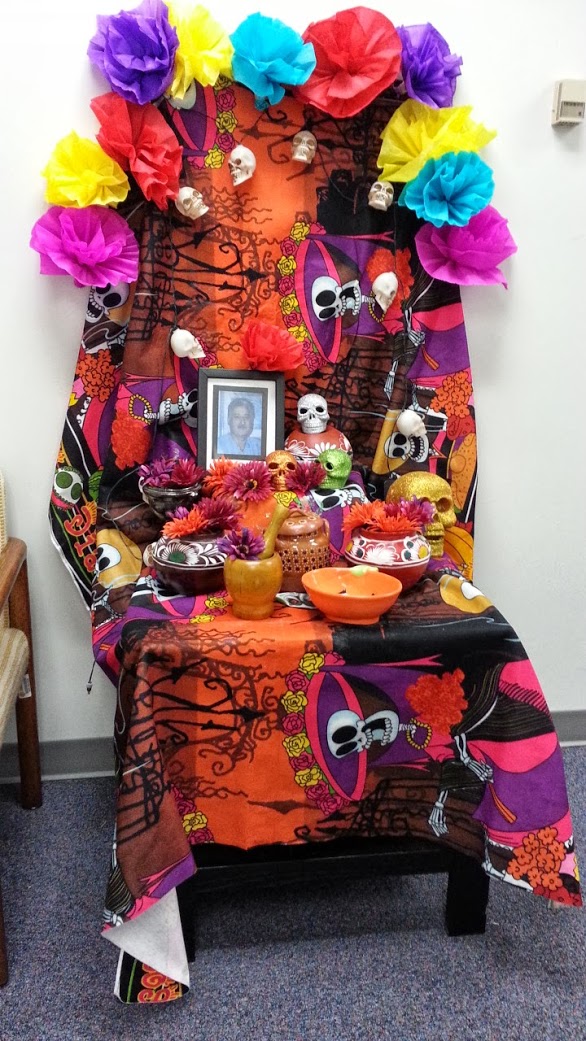


Museums around the US have had exhibits of altars for dia de los muertos both to celebrate the culture and to show the folkways of mesoamerica. From Oakland, California, to El Paso, Texas, even to the Idaho Historical Society, museums have in one way or another presented exhibits to mark the celebration.

Skelita Calaveras the Monster High doll created for Dia de Los Muertos has been a great success for Mattel, and the doll has been searched by name extensively in US States with strong Latino presence. As marketers realize the importance of Latinos to their bottom line, almost by accident they also educate the rest of the population about Latino cultural features.

What do all these stories and anecdotes tell us? As Hispanics acculturate they also spread the allure of their customs and beliefs. Acculturation is a two way street in which we learn from each other and find aspects of the culture of others attractive and meaningful. When cultural influence goes beyond the material aspects to the intangible and spiritual, one witnesses a societal transformation that should make marketers think more about culture and the future of marketing.

Wednesday, October 2, 2013

Bringing the Zappos Culture to Your Branches

If you're going to learn, learn from the best!  

Zappos went from a struggling start-up in 2000 to being acquired by Amazon for $1.2 billion in 2009.  And the driver to their success?  An unmatched dedication to customer service fueled by a relentless focus on a positive corporate culture.

"If we get the culture right, then everything else, including 
the customer service, will fall into place."
Tony Hsieh, 
CEO, Zappos

Hsieh is a genius.  It works for Disney, it works for Ritz-Carlton and it will work for you!  Focus on the culture.  Your competition can copy products and beat your price.  They can build more branches or out-tech you.  But if your culture rocks, they cannot take that.

We need more retail strategy in banking and the bank or credit union in your market that differentiates on culture will win the market share.  Here's how the best in the biz has done it:

ZAPPOS FAMILY CORE VALUES
1. Deliver WOW through service: To WOW, you must differentiate yourself, which means doing something a little unconventional and innovative. You must do something that's above and beyond what's expected. And whatever you do must have an emotional impact on the receiver.
2. Embrace and drive change: If you are not prepared to deal with constant change, then you probably are not a good fit for the company.
3. Create fun and a little weirdness: We don't want to become one of those big companies that feels corporate and boring. We want to be able to laugh at ourselves. We look for both fun and humor in our daily work.
4. Be adventurous, creative and open-minded: Over time, we want everyone to develop his/her gut about business decisions. We want people to develop and improve their decision-making skills. We encourage people to make mistakes as long as they learn from them.
5. Pursue growth and learning: We believe that inside every employee is more potential than even the employee himself/herself realizes. Our goal is to help employees unlock that potential. 
6. Build open and honest relationships with communication: Strong, positive relationships that are open and honest are a big part of what differentiates Zappos from most other companies. Strong relationships allow us to accomplish much more than we would be able to otherwise.
7. Build a positive team and family spirit: The best leaders are those who lead by example and are both team followers as well as team leaders. We believe that, in general, the best ideas and decisions are made from the bottom up.
8. Do more with less: While we may be casual in our interactions with each other, we are focused and serious about the operations of our business. We believe in working hard and putting in the extra effort to get things done.
9. Be passionate and determined: We value passion, determination, perseverance, and the sense of urgency.
10. Be humble: We believe that no matter what happens we should always be respectful of everyone.

Think of the power and freedom of these values.  Every single employee understands what is expected of them, every day - in customer and internal interactions.  In recruiting and hiring, candidates and employers know if Zappos is the right fit.  If you want to wear a suit and tie, fill out TPS reports all day and disappear into the woodwork to pick up a weekly check ... Zappos is not for you.  


So it's easy, right?  Just add these 10 values to your employee manual and voilĂ , your world will change overnight.

No so much.  What makes the Zappos brand and culture so powerful is that you CAN NOT simply slap anyone's logo on it and make it work.  Are you prepared to shave the heads of your employees?  Are you ready to have a record-long 10 hour service phone call to get it right for the customer?  Will you hire a corporate life coach?  Will your culture support a daily photo game where staff match employee photos to names so they get to better know each other?  Zappos did!  The Family Core Values are not just words on paper, but demonstrated every single day.

When you sit down to define who you are, make sure that it is unique to you.  Something that defines who you are and aspirationaly what you want to be.  And above all, it needs to be centered around the people who walk into your doors, click your website and call you every day.


Folks, this stuff works!

Zappos list of awards:

  • J.D. Powers Customer Service Champion, 2011
  • WGSN Global Fashion Awards - Outstanding Customer Service, 2010
  • CMG Vision Award, 2010
  • Innovation All-Star, Fast Company, 2010
  • NRF Innovator of the Year, 2009 & 2010


We bring these marketing philosophies to credit unions and community banks nationwide, and would love to bring them to your institution too. Contact us to see how.

With more than 265,000 visits worldwide, we hope that you enjoy this blog.  If you find it helpful, please share it with your colleagues. Also, check out our YouTube Channel for short video blogs about financial marketing.  

MarketMatch is also a nationally and internationally requested speaker. Contact us to bring our marketing ideas to your next conference.

937-426-9848
Follow me on Twitter @egagliano


Tuesday, October 23, 2012

Everything's Changing ... Nothing's Off Limits.


I love it when they “get it!”

Our industry is in a critical time.  With changes in banking, nothing is off limits any more:
  • Stricter regulations
  • Expanding competitive channels
  • Technology changing at warp speed
  • Consumers changing the way they, well, “consume”
  • People communicate and learn in new ways
Often, we need to adapt to survive.

We met, last week, with an institution that understands just that.  Anytime we get a call to discuss branding, we need to first understand the caller’s definition of the word.  Are they looking to simply change their name and logo, or do they REALLY want to rebrand?

After meeting with these folks, they get it! 

“We know that everything needs to change … nothing is off limits.”

What’s in a Name?
We have crafted the brands for many credit unions and banks from all over the country, but we’ve only changed the name of about 2.  In fact, we rarely recommend trashing years, or decades of awareness with a rename, unless:
  • There is a negative perception of the name in the marketplace.  We sometimes see this with credit unions who are still named after their core SEG – usually a company who has no corporate affiliation with the CU, but has enormous impact over the brand.
  • The name is limiting.  A “Teachers” Credit Union with a community charter, for instance.  Or a community bank named after a small town long before they expanded into several new markets. 

It’s a Cultural Thing
The brand is not simply your name and logo, but EVERY aspect of the customer/member experience.  It’s the way someone feels when they walk into your front door … more importantly, how they feel when they walk out.

The brand isn’t a snappy tag line or a great color palette, it’s emotion.  It’s touchy feely.  It’s a cultural thing.

Extreme Makeover
In our meeting last week, the CEO got it.  He knew that everything is changing … so everything had to change.  

They DO need a name change.  They DO have a perception issue.  They DO need to do a better job at the point of sale.  They DO need to update the look of their branches.  They DO need to define and better understand who they are and where they’re going.  And we can help!

For more ramblings on branding, check out these links:


With more than 140,000 visits worldwide, we hope that you enjoy this blog.  If you find it helpful, please share it with your colleagues.  Also, check out our YouTube Channel for short video blogs about financial marketing.  

We bring these marketing philosophies to community banks and credit unions nationwide, and would love to bring them to your institution too.  Contact us to see how.

MarketMatch is also a nationally and internationally requested speaker.  Contact us to bring our marketing ideas to your next conference.
-------------------------------------------------------------------------------

MarketMatch is a marketing firm, dedicated to the credit union and community banking community.  We utilize knowledge-based strategies to help you FOCUS on the right story that will generate the greatest  MOMENTUM and prove the best RESULTS with our written ROI Guarantee.


Monday, September 17, 2012

Cultural Attitudes and Language Preference of Hispanics: Marketing Implications

Do attitudes towards Latino culture change depending on the language preference of Hispanics? This is a question that has importance to marketers and service providers.  If cultural attitudes differ for those who prefer to speak English and those who prefer to speak Spanish then one can conclude that language preference is also an indicator of how close one is to one’s own culture. If on the contrary, cultural attitudes do not differ or differ to a small extent between English and Spanish preferred Latinos, then one can conclude that the overall Latino culture persists regardless of current language preference.

Using data from the Simmons National Hispanic Consumer Study that was collected in the twelve months ending on March 16, 2012, I created crosstabulations of language preference by cultural attitudes among Hispanics. Language preference was gauged as the language the respondent prefers to speak in general and the response categories were Only English, Mostly English but Some Spanish, Mostly Spanish but Some English, and Only Spanish. For this analysis I collapsed Only and Mostly English and Only and Mostly Spanish to form the preferences for English or Spanish.

Cultural attitudes were measured with a Likert type scale “Agree a lot,” Agree a little,” “Neither agree nor disagree,” “Disagree a little,” and Disagree a Lot.”  The items to agree or disagree with were:  

  • I believe it is important to teach Spanish to Hispanic Children as a way to help preserve Hispanic culture
  • I have more Hispanic friends than non-Hispanic friends
  • I make an effort to have my personal appearance reflect that I am Hispanic/Latino
  • Speaking English in our home is a priority in our Household
  • Speaking Spanish in our home is a priority in our Household

The two agree response categories in the scale were added up to have an overall agreement percentage.  The following chart shows the average percentages for those who prefer to speak English and those who prefer to speak Spanish for each of the attitudes.


The reader can see that generally speaking those who prefer to communicate in English exhibit a lesser priority in endorsing items that reflect a cultural attachment.  In particular, and in a somewhat obvious way, those who prefer to speak in English express that Speaking English at home is more of a priority for them than for their Spanish preferred counterparts. That trend is strongly reversed for those who prefer to speak Spanish as they indicate a very strong priority for Spanish to be the language of the home.

What is counterintuitive and revealing is that a large majority of those who prefer to speak English indicate that teaching Spanish to Children is a way to help preserve Hispanic culture. To me that means that preferring to speak English does not necessarily mean that the Spanish language is not highly thought of.

That those that prefer Spanish have more Hispanic friends than those who prefer English is not surprising.  The social networks of those who prefer English are likely to be wider and more diversified. Those who prefer Spanish are likely to live and work in conditions that may be somewhat  more segregated.

While a Latino personal appearance is not highly important in general, those who prefer Spanish endorse it to a larger extent.  And that is not very surprising either, because as one’s circles and circumstances expand one is more likely to also acquire the styles of those varied groups.

The main lesson for marketing, from my point of view is that while language preference does differentiate Latinos’ cultural attitudes, positive attitudes towards cultural elements persist among those who prefer to speak English.  In particular this is true when it comes to the education of children. It is an ambition to have one’s kids learn Spanish as a proxy for preserving the culture.

The moral of the story is that while Hispanics may be acculturating and switching to English as they stay longer in the United States, their loyalty to their heritage appears to persist.  Thus, cultural messages are likely to be a key link to reaching out to Hispanics be they Spanish or English preferred.

The data used here is from the Simmons National Hispanic Consumer Study and collected from January 31, 2011 to March 16, 2012. The sample contained 3,518 English preferred Latinos, and 2,104 Spanish preferred Hispanics.

Monday, February 6, 2012

Multicultural Marketing and the Super Bowl 2012

Marketers seem to be missing the ball. Madison Avenue and its chronic lack of cultural awareness and representation are evident in the 2012 Super Bowl ads. Blacks and Hispanics can only be seen in the background and as factory or service workers of some type. An online car seller shows a Black buyer a a main character, and a car ad shows a couple of Inuits as main characters, other than that it looks like non-Hispanic Whites own the show along with multiple dogs and polar bears.

Listen, I love non-Hispanic Whites, dogs, polar bears, and most other interesting and cute characters.  That is not the issue.  The issue is that minorities are about 40% of the total population in the US and they are almost invisible and stereotyped in the most prominent ad event in the United States. And I am not asking for fair representation. That is not the issue either.  I am advocating for business sense. How can emerging minorities identify with brands if they are not seen associated with them? And, how can they be compelled if the cultural values of these minorities are not represented?

As I was enjoying the Super Bowl ads it came to mind how our industry is still incredibly naive about what is driving the economy and innovation in this great Country. Emerging minorities are driving technology adoption and have larger families. I am mystified as to how can advertising firms miss the changing cultural environment of the US.  I thought I would share my surprise.

Saturday, September 24, 2011

Music: MP3s and CDs in the Multicultural Marketplace


Are ethnic groups in the US society equally acquiring MP3s and physical CDs, or are there differences in their rate of adoption? That was a question we asked in the FSU’s Multicultural Marketing Study conducted in collaboration with DMS Insights the Spring of 2011.

We phrased the survey questions “How often do you do each of the following?” and the response options were “Never,” “Sometimes,” and “Very Often,” for each of purchasing MP3s online and purchasing physical CDs.

 At first I aggregated “Sometimes” and “Very Often” for both products and the results show an increasing tendency of the use of MP3s purchased online for African Americans, Asians, Hispanics who prefer English, and Hispanics who prefer Spanish, with the latter 3 groups showing a stronger tendency for MP3s to catch up to CD’s.


The differences in the purchase of physical CDs among these groups are not as dramatic as the differences for MP3s. Clearly, CDs are an established and declining category while MP3s are a growing innovation. Then I compared the differences for only the “Very Often” category.


This analysis is more striking because it shows that Hispanics who prefer English appear to be the most aggressive ethnic group replacing CDs. This seems like a historical innovation breakthrough. Non-Hispanic Whites are also more actively replacing CDs but their overall levels of purchase are lower. Hispanics who prefer Spanish are at parity in their “Very Often” purchase of MP3s and CDs, and given the trend they may soon follow the pattern of their English preferred counterparts.

 What these findings point to is a continuous trend on the part of emerging minorities to innovate to a larger extent than the established non-Hispanic White majority. This musical category, however is quite interesting since music is so central to the lives of minorities in reinforcing their ethnic ties.

These trends lead me to ponder why companies like Apple and Amazon do not pay more attention to the tastes and interests of these minorities since they are the ones innovating precisely at the core of their business. Why are they not advertising more with an emphasis on ethnic music and with messages directly related to the cultures of central to their selves? Perhaps, as usual, change comes very slowly, and I wonder, when will they realize who their core customers are?

The data for this study was collected during March 2011. This online sample was comprised of 500 respondents per segment, for a total of 2,500, based on quotas by gender, age, and geographic location. DMS Insights managed the sample and data collection and they graciously contributed their effort to the academic program of the Center for Hispanic Marketing Communication at Florida State University. This study was conducted by the faculty and students of the graduate Multicultural Marketing Communication course offered by FSU.

Wednesday, July 13, 2011

Social Networking Sites is Where the Action is for Hispanics and Emerging Minorities

The new town center and “plaza” is online and it is very relevant to today’s marketers in the new global village. In March 2011 we asked consumers to “please tell us how important to you the following reasons are for using social networking sites like Facebook or Twitter?” Respondents answered on a 5 point scale from “not at all important” to “extremely important.”

The two reasons for using social networking sites that stood up most significantly were: “Keeping up with new trends,” and “asking friends and relatives about their opinions on products to buy.” The graphs below summarize the aggregated percentages for the top two points of the 5 point scale.

Keeping up with New Trends

NHW stands for non-Hispanic White, AA for African American, A for Asian, HE for Hispanics who responded in English, and HS for Hispanics who responded in Spanish to the survey.


Asking Friends and Relatives about Their Opinions on Products to Buy

NHW stands for non-Hispanic White, AA for African American, A for Asian, HE for Hispanics who responded in English, and HS for Hispanics who responded in Spanish to the survey.


Minorities in general are more likely than non-Hispanic Whites to say they use social networking sites for keeping up with new trends and for interacting with friends and relatives about their opinions on products to buy. Latinos who answered in Spanish to the survey are more likely than anyone else to endorse these reasons.

There are several important implications of these findings. First, as we have seen in other results from similar surveys, emerging minorities are more engaged with the new media and are likely to use it as a source of information for their lifestyle and consumer behavior. This speaks strongly to the importance that marketers need to place in being where these consumers are, i.e., social media. Brands that facilitate interaction seem likely to have an advantage as that plays directly to what is important to these consumers.

Further, Latinos who prefer Spanish are even more engaged with social networking sites for obtaining guidance and knowing about things like fashion. While Spanish dominant Hispanics have lagged in the adoption of online technologies, they are now fast adopting them and once they adopt these technologies they seem to strongly depend on them. The synergies of social media and traditional electronic and print media are likely to be important and should be capitalized upon to create conversations and discussions. The virtual social world is opening enormous possibilities to people, and it is creating a new system of influence. Growing minorities appear to be eager to break traditional barriers.

Opinion leaders among these emergent minority groups are very likely to have an impact on their followers who share their background, but also on others who frequent social media sites. Thus, these minorities are not only finding a town center or “plaza” online but are likely to also be affecting a larger social milieu because of the very public nature of social media.
Figuring out the role of social media is still an ongoing challenge for marketers. They should start paying close attention to what is happening in the virtual marketplace. Understanding flows of influence in online networks can be crucial for the marketing of the future.

The data for this study was collected during March 2011. This online sample was comprised of 500 respondents per segment, for a total of 2,500, based on quotas by gender, age, and geographic location. DMS Insights managed the sample and data collection and they graciously contributed their effort to the academic program of the Center for Hispanic Marketing Communication at Florida State University. This study was conducted by the faculty and students of the graduate Multicultural Marketing Communication course offered by FSU.