Showing posts with label insights. Show all posts

Thursday, September 5, 2013

Measure & Optimize for Offline Sales with AdWords Conversion Import

Potential buyers have increasingly turned to the web as the first step in their purchase decisions.  So for years, digital marketers in insurance, auto sales, and other high consideration industries have been using AdWords to build awareness and generate leads. These leads have been handed to sales reps, who then help customers complete the purchase process.

In AdWords, you’ve been able to see which keywords lead to higher or lower lead volumes, and to optimize for a cost per lead goal. But there's been no easy way to measure and optimize in AdWords for events that happen beyond the website, like a customer order taken over the phone by your sales team.

New Conversion Import Feature

The new AdWords conversion import feature can help you measure and optimize for the complete end-to-end purchase process. Now you can upload your offline conversion events into AdWords and see how clicks on your ads led to sales made in the offline world such as over the phone or via a sales rep.

Click image to enlarge

And since your offline conversion events will be incorporated into your existing AdWords conversion data, tools such as Search Funnels, Automated rules and Flexible bid strategies can leverage that data.

How you might use the conversion import feature

Let’s see how importing conversions can help a small business measure and optimize for the entire customer journey, from online leads to offline sales.

Isabelle designs, builds and sells high-end custom furniture. She uses AdWords to drive prospective customers to her website, where they can submit their contact information and request a sales call. AdWords Conversion Tracking can measure these raw lead submissions, but since most of them won’t result in a sale, she optimizes her campaigns on raw submitted leads; not actual sales.

Now that she’s able to import her offline conversion data (including sale value), Isabelle can better understand which keywords drive the most profitable sales. With a more accurate ROI picture, Isabelle can better manage her bids and budget.

How to get started

For step by step directions to get started, check out this article on how to import your offline conversions.

Several software solution providers, including Marketo, Mongoose Metrics and SugarCRM have also posted guides on integrating with this new feature.  In addition, we have published a guide for integrating with Salesforce.com’s Sales Cloud.

More to come

As we mentioned last week, with the launch of cross-account conversion tracking and Search Funnels, we’re working on tools like the conversion import feature to help you measure your customer’s complex path to purchase.

Our product roadmap has lots of improvements and new features aimed at providing a more complete picture of your customers' journey and more accurate measure of ads effectiveness across devices and across channels. Stay tuned!

Posted by Jon Diorio, Product Management Lead, AdWords Reporting & Insights

Wednesday, June 5, 2013

The Juice Mystique: Hispanic and Non-Hispanic Consumption of Orange Juice Brands and Drinks

I have spent quite a few years asking consumers about their consumption of orange juice and juice drinks. In visiting stores that cater to Latinos in Texas and California I tend to see large displays of shelf stable drink products like Tampico and Sunny Delight. Over the years I have heard Hispanic consumers state that these products have high percentages of juice in them, as high as 80% and sometimes even higher. Which is surprising because the actual juice content is low.  I was not sure about the extent to which the consumption of these juice beverages was higher or lower than popular orange juice brands.


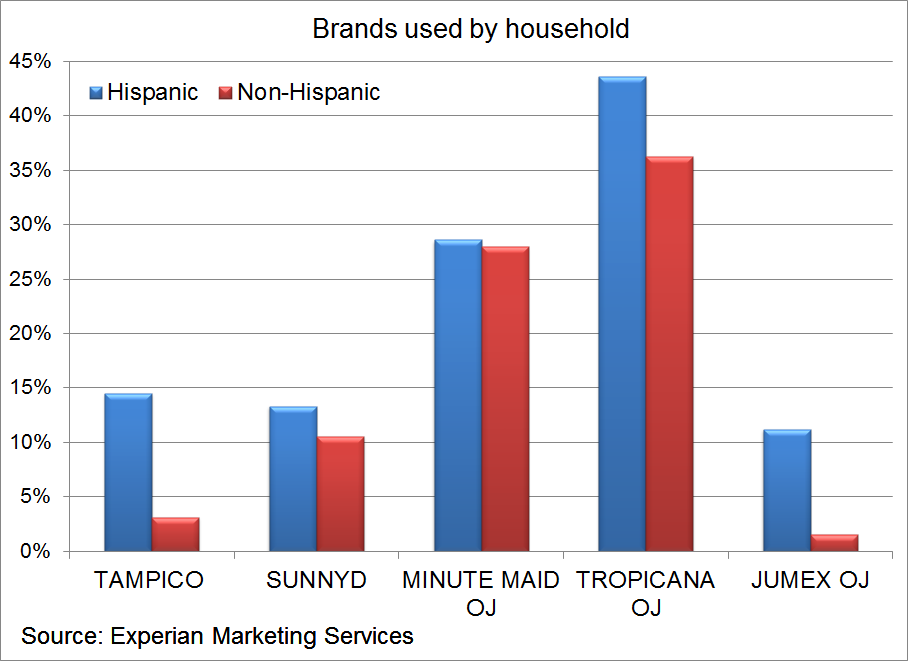
To obtain a quantitative picture I examined data from the Experian Marketing Services Simmons National Hispanic Consumer Study that was collected in the twelve months ending on November 30, 2012.  The results I obtained provide an interesting perspective on the use of these products according to the chart below.


First I need to clarify I decided to compare Tampico and Sunny Delight with Minute Maid and Tropicana because these are large orange juice brands, and also included Jumex because the brand has its origin in Mexico and is well known by Latinos of Mexican origin.


The chart shows that even though Tampico and Sunny Delight are used by Hispanics to a larger extent than by other consumers, the prevalence of the use of those brands is relatively low when compared with major US brands like Minute Maid and Tropicana. Jumex orange juice is used at about the same rate as the Tampico and Sunny Delight beverages. It is salient to notice that Tampico and Jumex have a very prevalent Latino constituency. That may be explained by the affinity of the Tampico brand, since Tampico is a port in Mexico, and by the heritage of Jumex whose name comes from the roots “jugos” juice, and “mexicanos” Mexican.


Interestingly, Hispanics over-index non-Hispanics in the use of all the brands. I was expecting that they would over-index more markedly in their use of the less expensive beverages but that is not the case. Given their family orientation and their larger household size, Latinos consume more of these beverages regardless of their pricing or quality. Many have argued that Hispanics are likely to purchase their preferred brands or more expensive brands for their family even if their incomes are lower. These findings may provide a partial indication of that possibility.


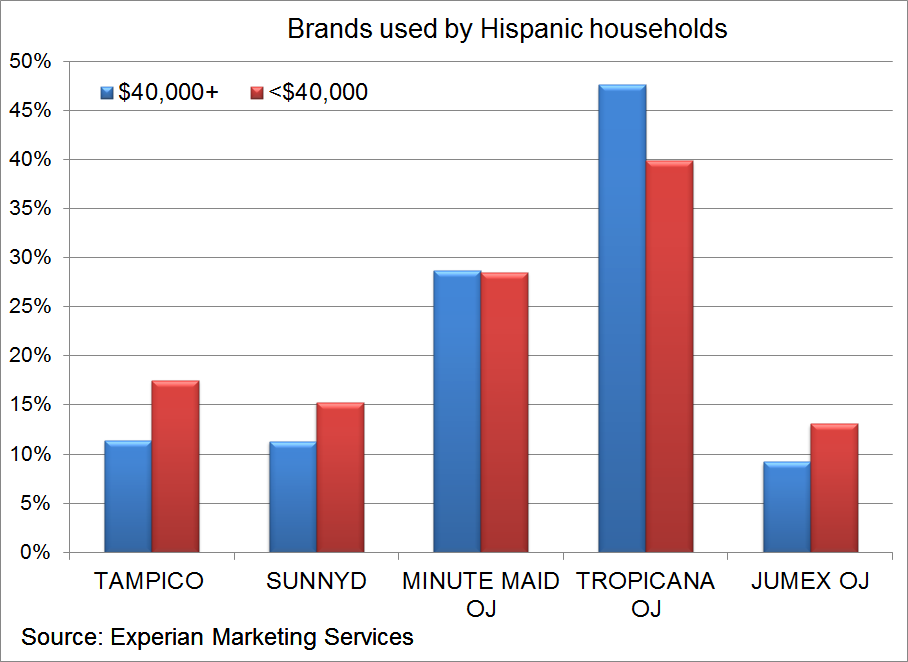
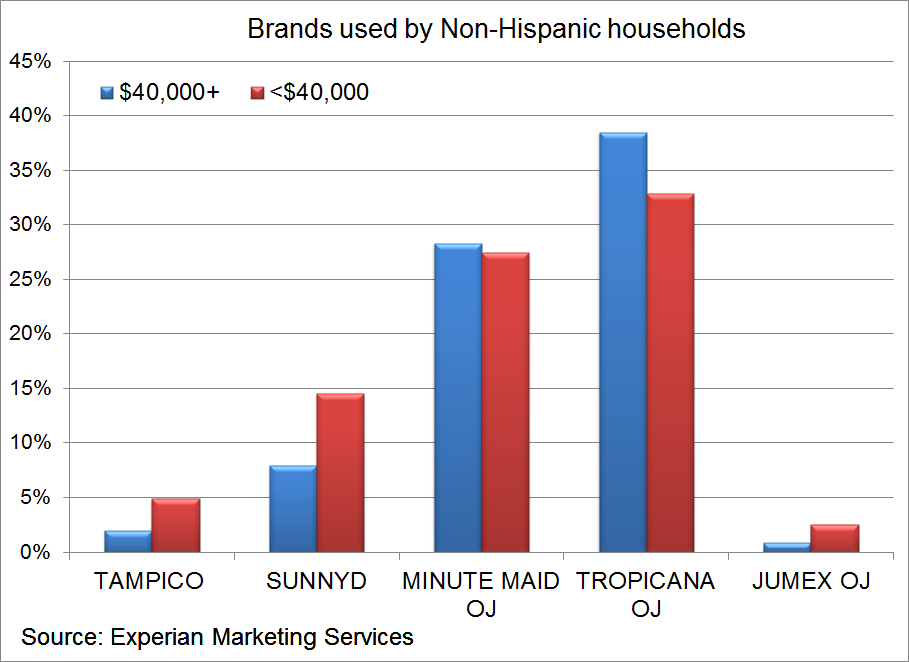
Out of curiosity I decided to check on income levels by use of these brands to ascertain whether or not income is associated with their use, for Hispanics and non-Hispanics. The charts below show the results.


As can be seen there is a tendency for those with lower incomes to be more likely to use Tampico and Sunny Delight, as well as Jumex orange juice regardless of their Latino heritage. And in the case of Minute Maid and Tropicana the difference by income levels is small but somewhat slanted towards higher incomes, particularly in the case of Tropicana. What seems outstanding (thanks William Biggs) is that those in the lower income categories use the premium OJ brands much more, in general, than they use the lower priced products. It can be concluded then that lower income is somewhat of a driver in the use of fruit beverages like Tampico, Sunny Delight, and Jumex OJ, but marginally the opposite in the use  of major brand orange juices. Lower price points are more appealing to some of those with lower incomes, and perhaps these consumers justify their choices by attributing higher juice content to beverages that do not have such.

It stands out that even those with lower incomes are more likely to consume premium brand orange juice, than the less expensive counterparts. Thus the selectivity of diluted drinks and less expensive brands may be particular to some who knowingly find them appealing, or who do not know what the nature of the product is.


Clearly, if Latino consumers and non-Latino consumers of lower incomes and large families see a large container of an orange drink and believe it contains a large amount of juice and then compare the price with actual 100% juice products, they are likely to opt for the larger and less expensive product. But what if they compared labels carefully?


In a competitive market there is room for juice brands to more directly  and aggressively compete with products that have a small percentage of juice content by educating consumers as to what the differences are. Clearly, the less expensive products also have some benefits as they are enriched with vitamins.  If a brand has a true advantage it should exploit it to the benefit of their bottom line and their consumer base.


At any rate, there is ample room for marketers to better understand the consumer behavior of Latinos to more successfully market to and educate them. Latinos generally want the best for their families, and highlighting product differences for them may be helpful and also profitable.


The data used here is from Experian Marketing Services’ Simmons National Hispanic Consumer Study of adults 18+  and was collected from October 24, 2011 to November 30, 2012. The sample of Hispanics contains 8,521 individuals and the non-Hispanic sample has 17,043 people.

Tuesday, October 2, 2007

Literature Insights for Hispanic Marketing

I am happy to announce that the Florida State University Center for Hispanic Marketing Communication released today a paper by Holly McGavock with my collaboration. This paper shows how insights from popular Latin American and US Hispanic literature can inspire marketing and advertising. This is an important first effort at systematizing the link between popular culture and marketing to US Hispanics. The full paper can be found at http://hmc.comm.fsu.edu/.

In McGavock’s words “Marketing messages are designed to travel to the consumer‘s heart and mind. Today, marketing communication is found everywhere, from subway walls to cell phones to internet sites to the television programs and movies we see on a daily basis. Consumers have learned, for the most part, how to tune out messages which don‘t appeal to or connect with them. Marketing, then, is becoming a much more sophisticated practice which requires practitioners to have an intimate knowledge of their consumers in order to connect with them on a deeper level. This is further evidenced by the increased presence of account planners in advertising agencies, whose job it is to find the insights in market research which help creatives make advertising which breaks through the clutter to reach consumers.

The same concept also applies to Hispanic marketing. For many years advertisers were able to sell their products simply by translating ―general market‖1 advertisements into Spanish and advertising on Spanish-language television networks. However, as spending in Hispanic marketing has grown, this market too has grown cluttered with advertisements, leading Hispanics in the US to feel overwhelmed by the number marketing messages and available information sources. Account planners are now popping up in the major Hispanic advertising agencies across the US. Their goal, like the goal of those in the general market, is to understand consumers and translate that understanding into insightful communication with consumers.

Much research has been done regarding the character, values and beliefs of US Hispanics. However, the search for insights requires looking for new and non-traditional sources of information. The culture of a people manifests itself in many different areas, all of which are of interest to marketers looking to understand consumers. Culture manifests itself in, among other things, traditions, clothes, music and literature. A closer examination of the literature of a people can reveal much about its culture. Furthermore, literature has the advantage of allowing the reader to experience the story as if he or she were actually a part of it. “