Showing posts with label hispanic. Show all posts

Monday, November 25, 2013

Online Courses on Hispanic and Multicultural Marketing Open to All This Spring 2014

Register by December 1, 2013. 


fsu1.gifThe Center for Hispanic Marketing Communication at Florida State University offers the following online courses Spring 2014:

  • Hispanic Marketing Communication (graduate)
  • Hispanic Marketing Communication (undergraduate)
  • Account Planning (undergraduate)
  • Multicultural Marketing Communication (graduate)

These courses can be taken by themselves or as part of the undergraduate or  graduate certificate in Multicultural Marketing Communication. The links provided above lead to the certificate requirements that include descriptions of each one of the courses.


 Hispanic Marketing: Connecting with the New Latino ConsumerThe courses start on January 6th and run until May 2nd, 2014.  Professionals, interested individuals, and students at other universities, who would like to participate in the Certificate programs or just by taking one or two of the courses are encouraged to apply. Online discussion boards allow for the exchange of ideas and  networking opportunities. The courses are asynchronous so students can work when their schedules allow.


For admission requirements CLICK HERE.   For more information about admissions please write or call: 

Anthony McDonald     
abmcdonald@fsu.edu             


The application deadline is December 1, 2013, so act soon.


Watch this video for more information   CLICK HERE.

Visit the Center's site at http://hmc.comm.fsu.edu 


Friday, October 25, 2013

Focus Groups: In the Search of Cultural Meaning

I have conducted about 5,000 qualitative sessions during my career in market research.  Most of these sessions have been focus groups and a substantive number have been ethnographies. In our 2012 book "Hispanic Marketing: Connecting with the New Latino Consumer" (Routledge) we discuss focus groups with Latinos in much detail and clarify many common concerns marketers have in conducting them. In this opportunity I am reflecting on the focus group as one of the most misunderstood versions of qualitative research. Here I intend to talk about the essence of focus groups and how to make them work for cultural marketing.

A focus group is not a question and answer session.  For that you can simply interview people individually in person, online, or on the phone.  The focus group is a focused discussion to understand how people think and feel about ideas.  It is an opportunity for understanding how meaning is created collectively during human interaction.  

This type of interaction has great value because it reveals cultural meanings that are not obvious and cannot be asked directly. One cannot expect people to tell you why they prefer a product or idea just by asking a direct question because the context of the situation is not a realistic consumer behavior opportunity. But asking the group to discuss brand "X" is likely to reveal inner feelings, attitudes, and values. Thus, focus groups are not for finding out why people use a particular brand on an individual basis but to find out how the group talks about a brand.

But a key aspect of moderating a focus group is that the moderator must be a pretty silent person in the process.  One asks "please talk about brand X" and then one stops talking.  Silence produces discussion. One can also say, "interesting...  I would like to understand better how you feel... please tell me more about brand X," and again remain silent and nodding.  The richness of meaning derived from such an activity cannot be underestimated. 

I understand that many research departments and clients are likely to be anxious about spending money without having a long questionnaire as a discussion guide for the focus groups, but that is because many do not understand what focus groups are for.  They are for generating group discussion. If discussion and symbolic interaction is not the goal, then simply do individual interviews and save some money.

Besides brands there are many other aspects around which a focus group can be centered.  For example, a discussion on the importance of one's health.  As respondents discuss the issue, the observers and moderator infer the meaning of health and capture important insights that can be used to market products and services. Generally these are likely to be culturally laden insights that can be used for brand positioning purposes. 

Actually, on many occasions focusing on an aspect related to the brand as opposed to the brand itself can  be richer in delivering cultural insights. Thus discussing health can be richer than discussing "HMO plan X." This is because properties of the brand are more relevant to consumers and they can more readily engage in a meaningful discussion. The aim of the focus group is to uncover the meaning of health, in this instance.

There are those who hold stereotypes about focus groups because of their personal experiences. A poorly trained moderator can readily damage a focus group by not knowing how to establish a warm and comfortable personal relationship with respondents. A lot of the chemistry of focus groups has to do with the warm-up and the bonding phase.

Another myth is that focus groups do not tell the truth because one individual biases the others.  Clearly, this has to do with respondent selection, the establishment of focus group procedures, and group process management.  But most importantly, when one expects a focus group to answer a barrage of questions, one is bound to have more social influence of one respondent over the others because the focus group is being rushed and not carefully prompted to engage in concentrating on an issue. 

Further, social influence is part of social life and a discussion will reveal patterns of interaction that can be very valuable in suggesting marketing approaches. One way of getting group participants to focus before coming in contact with each other is to give them the assignment to do something about the issue they will focus on. That preempts much of the concern about social influence as people have been focusing on the issue.

I will write more about focus groups and other research approaches.  Here my main aim is to clarify that focus groups are for discussion focused on an issue or set of issues, they are not question and answer sessions. A moderator needs to be a social scientist by training, a group facilitator, understand cultural trends, and enjoy people profoundly.  

Focus groups are for uncovering cultural meaning in the course of symbolic interaction.

Friday, August 23, 2013

Fashion, Style, and Culture: The Case of US Latinos

Retailers often talk about how Hispanics are different in their approach to dress, clothing, and fashion. There has been coverage in the press about how some shopping centers are morphing themselves into Latino shopping centers to better serve their local communities and stay in business.

From casual observation I know that Hispanics dress up to go out on the weekends and kids are very well dressed to go to church and other activities, even when going on airplanes. The attention to dress and detail to style is apparent in a great number of cases. Many Latinos spend much of their leisure time in stores and malls enjoying their free time with their families and becoming informed about fashion and style. I have observed the more sensual approach to dressing by both Hispanic men and women. What are the attitudes that underlie this attention to style and fashion?

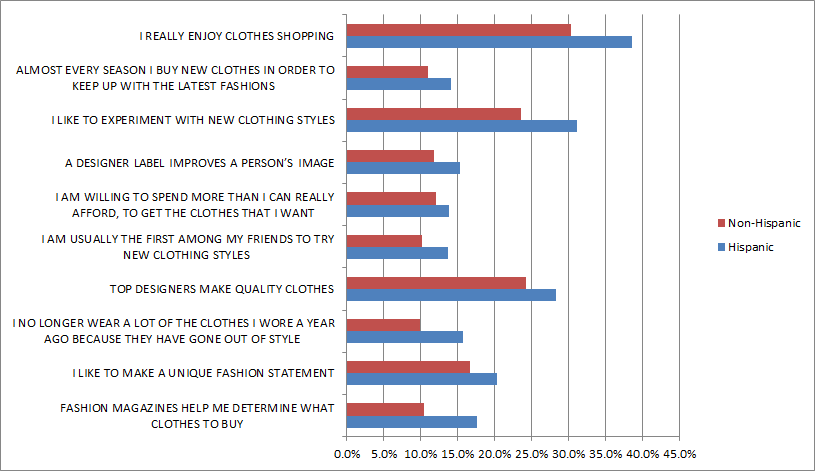
To answer the above question, I used the data from the Experian Marketing Services Simmons National Hispanic Consumer Study, that was collected between January 30, 2012 and March 13, 2013. The chart below shows differences in “any agree” (agree a lot plus agree a little) with the attitudinal statements about style and fashion with which Latinos were more likely to agree:


As observed above, Hispanics are more likely than non-Hispanics to be feel they are opinion leaders about clothes and fashion. They also are more likely to trust top designers and to trade up to newer designs faster than non-Hispanics.

Latinos are more likely to be influenced by fashion magazines and most importantly, Latinos enjoy more the activity of shopping for clothes. And Hispanics are also more experimental in the approaches to clothing and style.

What does these trends tell us? I think that Latinos are now influencers in fashion that need to be carefully watched as their tastes and preferences evolve. Marketers need to be pay attention to these trendsetters as their numbers and influence increases in the US.

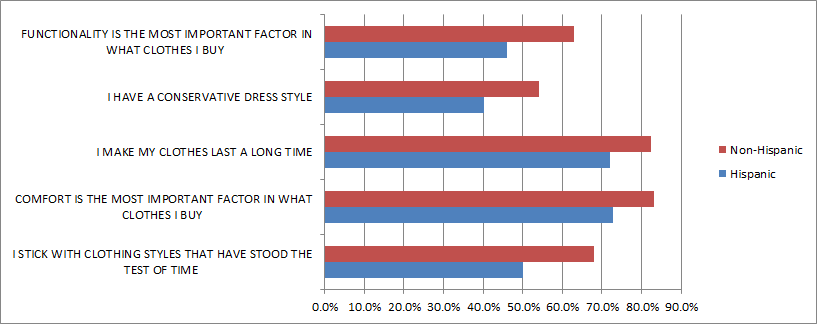
Further, the eagerness these Hispanic consumers show to be in style, corroborates that merchandising for them is not necessarily the same as what is traditionally done for the rest of the population. Interestingly, the contrast of the attitudes on which non-Hispanics exceed Hispanics are interesting as documented in the chart below:


As can be seen non-Hispanics are the ones who are more likely to express conservative style and clothing attitudes. This trend adds evidence to the observation that Latinos are more likely to lead in dress, fashion, and style.  In terms of profitability and trend making marketers need to be be aware of the differences that Latinos represent for the future of their brands and retailing activities.

Clearly, examining the trends in the charts above suggests that conservatism is in general a more pervasive trends that leadership and innovativeness.  The percentages of conservative attitudes are higher. Still, where Hispanics excel is in having larger minorities that express an eagerness to change and innovate regarding style.

What can marketers do? Include more Latinos/Latinas in their approaches to marketing, regardless of whether or not their approach is a “Total Market” or more targeted approach. The voice of Hispanics needs to be over-represented in strategies that are forward looking. Further, Latinos need to be considered as opinion leaders and co-opted to represent your brands as they are more likely to genuinely embrace innovation and change.

The moral of the story is that there is no general market and that Latinos are shaping marketing futures.

The data used here is from Experian Marketing Services’ Simmons National Hispanic Consumer Study of adults 18+ -and was collected from January 30, 2012 to March 13,, 2013. The sample of Hispanics contains 7,982 individuals and the non-Hispanic sample has 16,870 people.

Thursday, August 1, 2013

Hispanic and Multicultural Marketing Online Courses from Florida State University Starting August 2013


This Fall Florida State University offers the following Hispanic and Multicultural marketing online courses:

  • Hispanic Marketing Communication - Undergraduate
  • Multicultural Marketing Communication - Undergraduate
  • Account Planning (with multicultural emphasis) - Graduate 

These courses are open to anyone in the United States or internationally. The undergraduate courses can be taken by anyone with an interest in the subject. The graduate course requires that the student has completed an undergraduate degree in any discipline.

These courses can be taken by themselves or can be taken as part of our undergraduate or graduate certificates in Multicultural Marketing Communication. The courses are part of the Center for Hispanic Marketing Communication, founded by Dr. Felipe Korzenny.

The courses start the last week in August and end the first week in December.  They are asynchronous so the student can take the courses at their own pace, and without a rigid schedule. Discussion boards online create ample opportunities for learning, besides the assignments and readings. This is a great forum for those already working to discuss Latino Marketing issues they encounter and to find new solutions. Groups of company employees can take a course and use it as a the focus of discussion in a seminar they may organize internally. Others, who are on their own may find these courses as a great networking opportunity.

Apply now because enrollment is limited and it takes about two weeks to get registered.

To apply and for more information please contact:

The main book for the course is "Hispanic Marketing: Connecting with the New Latino Consumer," By Felipe and Betty Ann Korzenny, Routledge, 2012.  CLICK HERE FOR BOOK DETAILS.  

Thursday, July 25, 2013

The Latino Beer Story in the US

When growing up in Mexico City, I never imagined that Corona Extra would become the international prestige beer par excellence. Please do not take me wrong, I am proud that a Mexican beer brand has become so prestigious and popular around the world, but those early experiences were quite contrasting.

Corona Extra, along with Victoria, Sol, and a few other “low-end” brands, were the cheap beer brands that were consumed by people with scarce resources. These brands were popular at lunchtime at construction sites as workers would gather to eat tortillas, hot peppers, and other foods and drink those beer brands. The brands that at the time were considered prestigious in Mexico were Bohemia, Dos Equis, Modelo, and a few others.

Well, now Corona is seen as a prestige brand even among Mexicans, both in Mexico and in the US. I have heard consumers say that they feel proud that a Mexican beer brand has become the coveted brand of well to-do people in the US and in other places around the world. Because of this association the brand has acquired the connotation of national pride, and consequently Mexicans have increased their consumption. Clearly, it is not only those of Mexican origin, but many Latinos from different origins also share this affinity with Corona Extra, even though the largest share of Hispanics in the US is still Mexican, by far.

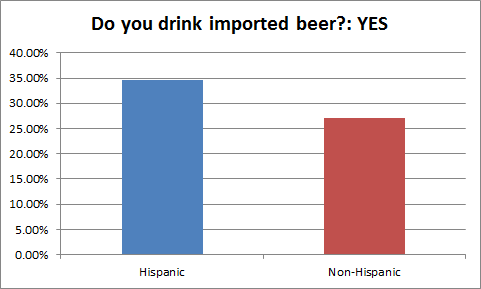
To quantify some of my impressions, I used the data from the Experian Marketing Services Simmons National Hispanic Consumer Study, adults 21+, that was collected between January 30, 2012 and March 13, 2013. Hispanics over-index versus non-Hispanics (123 vs. 96) in their drinking of imported beer. The percentages of those stating they drink imported beer are in the chart below:


And the consumption of imported beer tends to be largely in its “regular” or full calorie version.
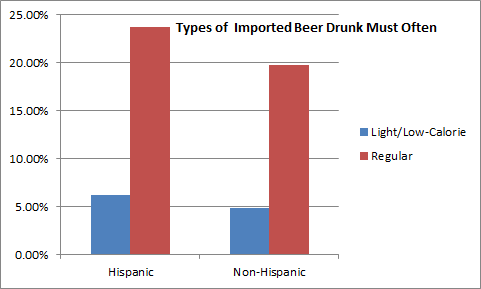


Regular beer has a fuller flavor and that seems to be the preference of Latinos and non-Latinos alike. So, then, what about domestic beer consumption? The following chart provides the distribution for regular domestic beer and light/low-calorie.
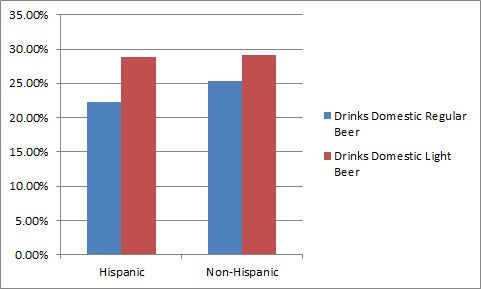


As can be seen, when it comes to domestic brands, light/low-calorie brands have an advantage over regular beer brands. This may be explained by the higher cost of imported beer in the US: if the consumer is going to splurge, it may as well be for the full-flavor version of their preferred imported brand. That domestic brands are more likely to be consumed in general is not surprising because of their price point. Still, Latinos are more likely to drink beer from other countries than their non-Hispanic counterparts.

Now, going back to the initial question. How is Corona Extra doing along with some of the other larger imported beer brands? The chart below presents those brands that have a 2% or larger share of being the imported brands “most often” consumed among either Hispanics or non-Hispanics.
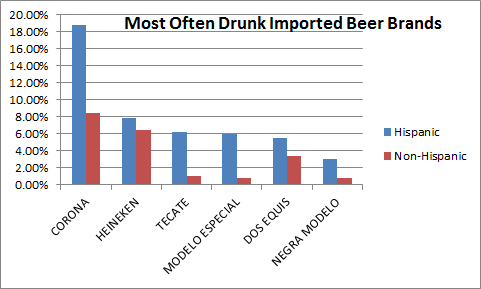


This is confirmatory of my qualitative observations. Corona is by far the largest import “most often” drunk by Hispanics followed by Heineken and other popular Mexican brands. Interestingly, non-Hispanics, who made the Corona brand popular, do not match the enthusiasm of Latinos for the brand.

Another consideration here is that advertising and marketing seem to work well. As the reader can intuitively confirm, those brands with more advertising and promotional efforts do better in the preference of consumers. This is not surprising but should serve as a reminder to marketers on how important it is to continue connecting with consumers in order to keep their preference. That Hispanics drink more of even Heineken (a Dutch brand) provides an indication of how important is the brand-consumer connection and in a cultural way. Heineken, not being a Latin American brand, has been proactive in attracting Latinos with culturally relevant messages. And by the way, please consider the notion that all marketing is cultural, because we are all acculturated in a particular cultural context and our tastes, preferences, and even dreams are shaped by that culture.

The domestic beer brands most often consumed by Latinos and non-Hispanics are also the ones that advertise the most: Budweiser, Bud Light, Coors, Coors Light, Miller, and Miller Lite. Here, however, there is a different story that I will detail at a future time.

The data used here is from Experian Marketing Services’ Simmons National Hispanic Consumer Study of adults 21+ -and was collected from January 30, 2012 to March 13,, 2013. The sample of Hispanics contains 7,425 individuals and the non-Hispanic sample has 16,278 people.

Friday, May 10, 2013

Brands Make a Difference: Latinos Over Index in the Hair Styling Product Category


I have been conducting ethnographic interviews with Hispanics in the last several months and have visited many homes and talked to many Latino women. I have looked at their bathrooms and bedrooms and have seen many of the products these families use for styling their hair. I got the impression they are very much into the hair style product category, but qualitative observations can only go so far in terms of making generalizations about the population.  

To check my impressions I looked at data from the Experian Marketing Services Simmons National Hispanic Consumer Study that was collected in the twelve months ending on November 30, 2012, and confirmed that my impressions were on the right track.

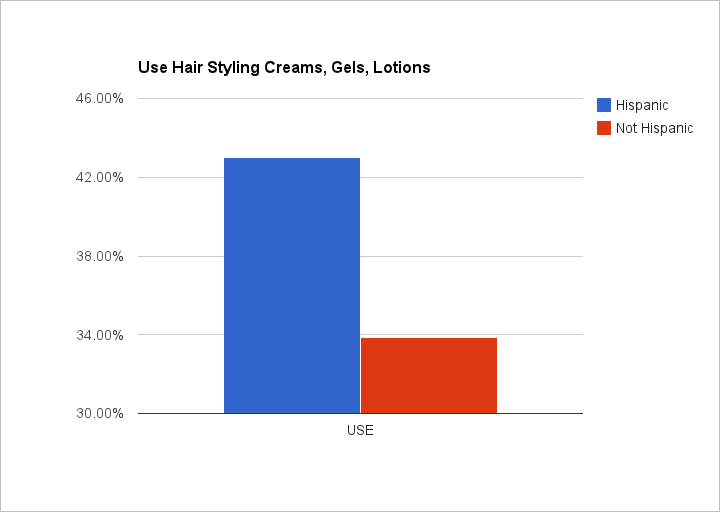
As can be seen in the chart below, 43% of Latinos use hair styling products while only 34% of non-Hispanics use them.


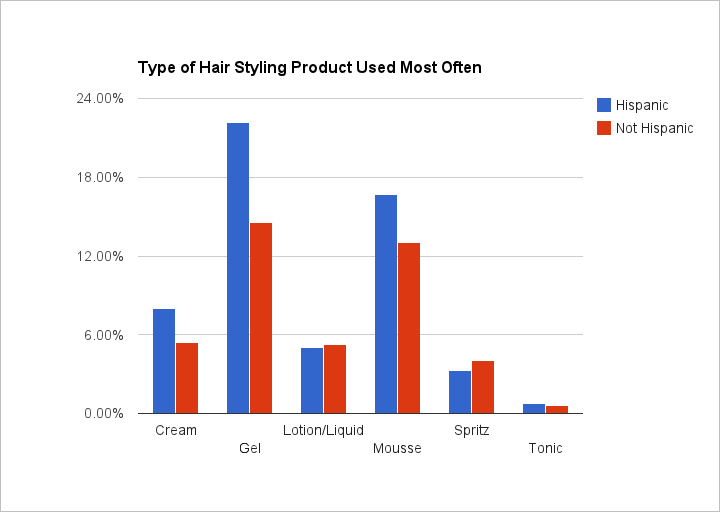
Clearly, there are several reasons why this may be the case, including the fact that Latino adults have a median age that is about 10 years younger than the overall population. Also, we have discovered over the years that Latinos enjoy being well groomed in their everyday life. Further, their grooming customs come from their countries of origin where cultural patterns are strongly ingrained. Now, are all hair styling products equally used? As can be seen below there are products that are more heavily used than others.


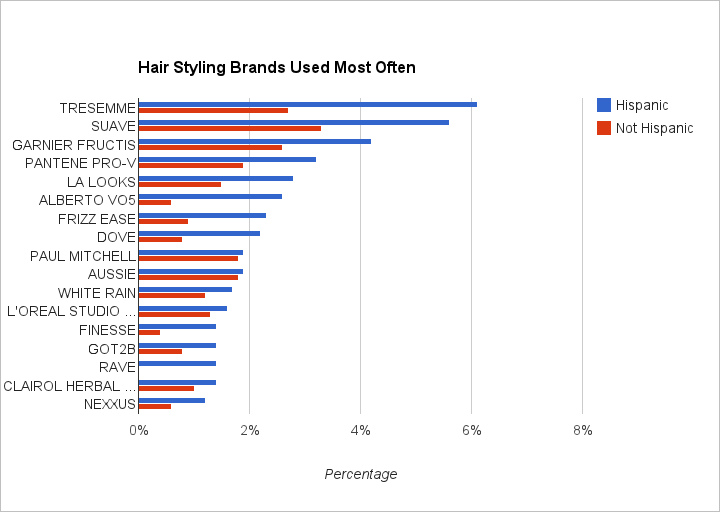
Gel and mousse are by far the most popular hair styling products among Hispanics, and in general their use is in line with the overall population pattern of usage. Nevertheless, Latinos over-index quite dramatically in the both categories. But what brands are more popular? As can be seen in the chart below, consumers are quite divided among the different brands they use most often and the chart only includes the brands that have more than 1% usage among adult Hispanics. Still each for each of the top brands, Latinos exceed their non Latino counterparts. There are cases in which usage is triple among Hispanics, such as in the case of Alberto V05, and double such as in the case of Tresemme, or substantially higher like in the case of Suave.


The lesson I learn is that some of these brands may capitalize on making a serious effort to further their share among Hispanics. Particularly promising are brands with Latin American heritage and with names that are culturally compatible, like Tresemme, Alberto VO5, Suave, and Pantene.  In the age of social media, and knowing that Hispanics are particularly keen in the use of this technology, reaching out to Latinos with brand experiences that are appealing, informative, and seductive can render a large return on relatively modest investments.

Large media, like television, can also make a major difference with advertising  and branded entertainment. Ultimately any brand that makes a serious effort can find creative ways to connect culturally, for example, by attaching symbolic handles to their brands that Latinos can relate to.

The data used here is from Experian Marketing Services’ Simmons National Hispanic Consumer Study of adults 18+  and was collected from October 24, 2011 to November 30, 2012. The sample of Hispanics contains 8,521 individuals and the non-Hispanic sample has 17,043 people.

Tuesday, February 26, 2013

Children’s Influence in the Multicultural Marketplace

For many years I have conducted qualitative research with Latino women and have generally found that they are very willing to yield to their children’s requests for purchases, even if these are non-essential.  I have had the suspicion that this is particularly true of Hispanic women in comparison to other mothers but have not had the quantitative data to explore this idea.

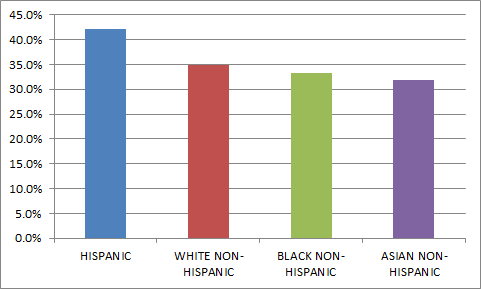
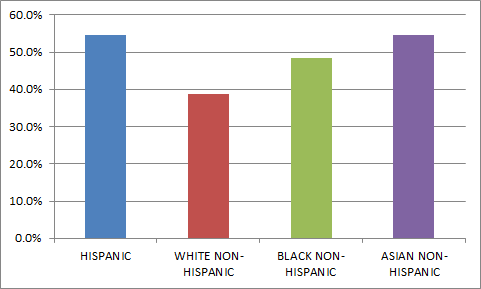
Using data from Experian Marketing Services’ Simmons National Hispanic Consumer Study that was collected in the twelve months ending on August 31, 2012, I created crosstabulations with self identification as Hispanic/Latino, Asian, African American/Black, or White by those who agreed a lot or a little (combined) with the statement “I find it hard to resist my children’s requests for non-essential purchases” and “I enjoy shopping with my children.” The results for both have striking similarities, not surprisingly, perhaps, as seen in the charts below:

I Find it Hard to Resist My Children’s Requests for non-Essential Purchases


I Enjoy Shopping with My Children

Hispanics are quite a bit more likely to enjoy shopping with their kids and also to yield to their requests.  They are followed by Asians who show a similar pattern when it comes to enjoying the shopping experience with their kids, but not so in yielding to their requests for non-essential purchases.  Perhaps the Asian approach to child rearing, which is known to be stricter, accounts for their lack of yielding.  Non-Hispanic Whites and African Americans are less likely than Latinos to enjoy the shopping experience with kids and yielding to their children.

The meaning of these findings is likely to relate to the way in which these consumers interpret their relationship with their children.  In particular, I have heard Hispanics many times articulate the notion that they want their kids to have what they did not have as children.  They have also indicated they feel guilty for not doing the absolute best they can for their kids.

Hispanics are at a stage in their immigration and economic development where pleasing their children and families in general is a luxury they could not afford before. What they do in life is for their children and want them to be happy as they grow up.  They seem to place a very strong value in their sense of fulfillment. Perhaps Whites have become habituated to living in a culture of abundance where kids can wait to fulfill their desires and where shopping represents labor rather than fun.

This data shows that it is not just a stereotype but an actual trend that Latinos shop in family groups and have fun doing so.  Asians show a more complex pattern in which they enjoy the shopping experience with kids, but are strictest in pleasing kids as compared with anyone else.  The implications for marketers are that Latino children in particular can be important influences in the decision making regarding purchases of products and that they cannot be ignored in the overall communication and placement plan.

As we have discovered in other pieces of research, collective decision making is more prevalent among Latinos than among other groups. Thus, the different parts of the decision making process need to be taken into consideration.

The data used here is from Experian Marketing Services’ Simmons National Hispanic Consumer Study and was collected from August 1, 2011 to August 31, 2012. The sample of respondents with children at home contained 2,955 Latinos/Hispanics, 3,645 non-Hispanic Whites, 552 non-Hispanic African American/Black, and 253 non-Hispanic Asians.

Wednesday, January 30, 2013

How Should Brands Give Back in a Multicultural Market?

Marketers frequently ask how their brands can give back to a community to create good will and enhance their brand's position. The answer to the question is complex, but one of the ways of trying to address it is by asking consumers of different cultural and acculturation backgrounds how they rate different actions that brands can take in order to give back.

In 2012 with the cooperation of Research Now and the leadership of +Melanie Courtright, we again collected an online national sample composed of Hispanics and Asians born in the US and those born abroad, in addition to African Americans and Non-Hispanic Whites. We used the country of birth as a proxy for acculturation to see if technology adoption varied accordingly.

We asked respondents to rate different actions that companies can take to give back as follows:
“When a brand gives back to a community, which of the following are most and least important contributions from your perspective? Please rank in order, from 1, most important, to 5, least important, each of the following items.”

The following chart shows the total across all respondents (indicated by the blue bars) and for each of the culturally unique groups (indicated by the colored lines) for the rank of “Most Important” in regard to the following possible brand actions:

  • Provide jobs
  • Give scholarships
  • Help clean the environment
  • Keep jobs in the local community, and
  • Employees get free time to do community service


The rank shown is just the “Most Important” for each of the items. The totals for each culturally unique or acculturation group add to slightly more than 100% because each item was rated independently.

The first surprise is that the differences across culturally unique and acculturation groups is relatively small and that these cultural groups agree on the priority of the items.  The number one priority across the board is that the most important contribution that brands can make is to provide jobs to the community, followed by keeping jobs in the local community. It is perhaps not surprising that these two items have the highest priority given the economic downturn that most Americans have experienced in the recent past.

At a distance the next two priorities for brands are to help clean the environment and give scholarships. This does not necessarily mean that these are not important brand contributions, but that jobs are a more prevalent contribution at this time.

Interestingly, giving employees free time to do community service was ranked as top by the smallest proportion of respondents in each cultural group. This is perhaps due to the lack of visibility that such action may have as a contribution.

What are the lessons from these findings?

  1. Cultural groups and those at different levels of acculturation tend to agree on approaches that brands need to take to give back to the communities where they operate. Clearly, the implementation of providing jobs has to be by cultural group in order to satisfy the expressed sentiment of these consumers. Creating jobs is not enough but creating jobs that satisfy these segments individually.
  2. At times of economic distress there are actions that consumers feel are important but they subside to the more pressing issues of the time. While cleaning the environment and giving scholarships are important, jobs take preeminence in economic downturns.
  3. Marketers are encouraged to emphasize how their brands contribute to employment of these different cultural groups with specific emphasis on the local community.

The data for this study was collected by Research Now of Dallas, Texas, thanks to the generous initiative of +Melanie Courtright. Research Now contributed these data to the research efforts of the Center for Hispanic Marketing Communication at Florida State University (+Hispanic FSU). This online survey included the responses of 936 Asians (398 US born), 458 African Americans, 833 Hispanics (624 US born), and 456 non Hispanic Whites. This national sample had quotas for US region, age, and gender to increase representativeness.

Tuesday, December 4, 2012

Language Preference for Television Watching by Latinos of Different Socioeconomic Levels

It has been of interest to me to explore how socioeconomic level relates to different consumer and media behaviors of Latinos in the United States. As media outlets become more abundant and as Latino growth shifts to births as opposed to sheer immigration, it is relevant to learn more about how to target Hispanics of different socioeconomic levels. In this particular instance, I am exploring the television watching behavior of Latinos according to their language of preference depending on their socioeconomic level.

Using data from the Experian Simmons National Hispanic Consumer Study that was collected in the twelve months ending on August 31, 2012, I created crosstabulations of the TGI Socio Economic Scale in the Simmons database by preference to watch television “Only in English,” “Mostly in English but Some in Spanish,” “Mostly in Spanish but Some in English,” and “Only in Spanish.” The television language preference variable in the analysis combined those who watch “Only in English” and “ Mostly in English but Some in Spanish” in one group, and those who watch in “Only in Spanish” and “Mostly in Spanish but Some in English” in another group.   Respondents stated their preference when reacting to the statement “When you watch television do you prefer to watch television programs...” The TGI Socio Economic Scale is a composite of education, ownership of selected household durables, mobile phone ownership, credit card ownership, usage of Internet and air travel. The scale results in four levels of socioeconomic standing: The top 10% of the population, the next 20% of the population, the next 30% of the population, and finally the remaining 40%.

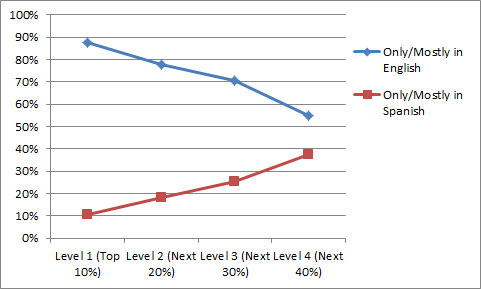
The following line chart illustrates the trends uncovered:


As can be observed, the lowest socioeconomic level of Latinos is more likely than anyone else to prefer watching television in Spanish, although a substantive percentage of them also indicate preferring only English or mostly English television exposure. The percentages of Hispanics at this lowest level are more equally divided among language preferences than for any other socioeconomic level. Those in Level 3 are more polarized than the lowest level as their percentages are more divided between the two languages. The polarization increases at Levels 1 and 2 as they are more dramatically divided and in the large majority they prefer television exposure in the English language.

Overall, there is a tendency for those better educated and more affluent to prefer television in the English language and for those who are in the lower levels to be more oriented to the Spanish language. It is also likely that those in the higher socioeconomic levels are more acculturated into the US. The tendencies are almost linear and monotonic.


These trends point to the dynamics of the Latino market and its complexity.  While the preference to watch programming in the Spanish language continues to be important for a substantive portion of the Latino population, it is not a uniform tendency.  This is clearly due to the fact that with so many channels in English, Latinos simply find more offerings in English than in Spanish.  It is likely that the diversity of content in English drives some of these trends.  Those more affluent can be expected to have more choices of channels for the enjoyment of television programming and that may explain some of these preferences. Also, at the lower levels there are those who have been born in the United States that share their socioeconomic level with newer immigrants.  That makes for an interesting mix of acculturation stages that affect television language preferences.

Further, as Latinos become more able to appreciate content in English, their content horizons seem to expand. Socioeconomic status and bilingualism and English fluency are related.

Marketers can take from these findings important lessons and cautions:

1. Media planning is not straightforward.  Socioeconomic level plays a role and thus different types of products may do better on English language television platforms, and others on Spanish.

2. A mix of language television platforms may be appropriate for many advertising campaigns as television language preferences, particularly at Levels 3 and 4, are more divided. They represent 70% of the Latino population.

3. Language preference for television watching may not be indicative of assimilation but of content availability and content preferences.  Thus cultural insights should likely drive marketing and advertising campaigns.

This data confirms the diversity and complexity of the Latino market and the importance of sophisticated media planning efforts.

The data used here is from the Experian Simmons National Hispanic Consumer Study and was collected from August 1, 2011 to August 31, 2012. The sample contained 8120 Latinos.

Wednesday, November 14, 2012

Multicultural Technology Leadership: Tablets and Blogs

Over the past several years we have measured technology use and adoption at the Center for Hispanic Marketing Communication at Florida State University. We have consistently found that emerging minorities tend to lead in most areas of technology adoption. In 2012 with the cooperation of Research Now and the leadership of Ms. Melanie Courtright, we again collected an online national sample composed of Hispanics and Asians born in the US and those born abroad, in addition to African Americans and Non-Hispanic Whites. We used the country of birth as a proxy for acculturation to see if technology adoption varied accordingly.

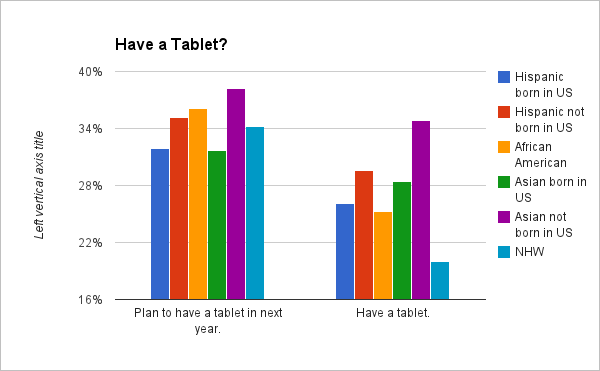
Tablets are creating chaos in the computer industry because consumers are adopting them and discarding laptops, desktops, and netbooks. The following chart shows how adoption of tablets varies of by cultural group and by place of birth.


As can be seen, Asians born abroad exhibit the largest penetration of tablet current ownership and also their projected ownership in the next year. Their affluence and technological savvy may account for this trend. Hispanics not born in the US are the second group in their ownership of tablets, and their minority counterparts follow them closely. Non-Hispanic Whites, however, lag substantially. This speaks of the technology eagerness of minorities and their leadership in technology adoption.  The differences, however, appear to vanish when looking at aspirations for the next year. Thus, minorities innovate but tablets are becoming very desirable overall.

Having a blog should be a good indicator of innovativeness in web communications. The following chart illustrates the penetration of blog ownership in different cultural groups.


Current blog ownership is highest among Asians, followed by Hispanics. African Americans and Non-Hispanic Whites lag. Tendencies for the next year vary and highlight that those not born in the US are more interested in having a blog, both Latinos and Asians. African Americans also show the aspiration to have a blog in a year in sharp contrast to their current blog ownership. Non-Hispanic Whites seem less eager to have a blog now and in the future, and interestingly Asians born in the US are at the same level as Non-Hispanic Whites in their future blog ownership.

Overall, these trends are puzzling and definitely should ignite the imagination of technology marketers. The relative popularity of blogs and their future growth indicate the social eagerness of minority groups. Culturally, blogs provide an outlet for creativity, expression, and a voice that minorities did not have before.  Marketers can take advantage of this eagerness by using these growing blogs as advertising venues for reaching out to minority networks, for example.

The phenomenal adoption of tablets and their appeal for the near future are more striking.  Mobile advertising will become increasingly powerful and tablets will be the new platform for communication. That minorities are leading now should give food for thought to marketers that are trying to predict future trends and understand where their brands will be in the near future.

The data for this study was collected by Research Now of Dallas, Texas, thanks to the generous initiative of Ms. Melanie Courtright. Research Now contributed these data to the research efforts of the Center for Hispanic Marketing Communication at Florida State University. This online survey included the responses of 936 Asians (398 US born), 458 African Americans, 833 Hispanics (624 US born), and 456 non Hispanic Whites. This national sample had quotas for US region, age, and gender to increase representativeness.

Thursday, August 23, 2012

Multicultural Video Consumption by Mode of Delivery


How is the amount of time spent watching video divided among streaming, DVD’s, and broadcast/satellite/cable among the different cultural groups in the US?  Here we present some of the data collected by Research Now for the Florida State University Multicultural Marketing study of 2012 that answers that question.

We asked our online sample of respondents to tell us “in an average week, approximately how many hours do you spend...?” for multiple activities. The respondents were divided into those born in the US and those born abroad because that could have an impact on the language they select for their video exposure.

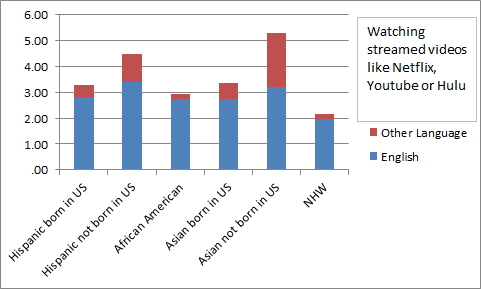
Below is the chart detailing the number of weekly hours spent watching streamed videos by different cultural groups. As can be seen streaming is most popular among Hispanics and Asians not born in the US and least among non-Hispanic Whites. Asians not born in the US report more than five hours per week watching these videos, followed by Latinos not born in the US with almost five hours per week. It may be that these groups, because of their bilingualism add more content to their routines.


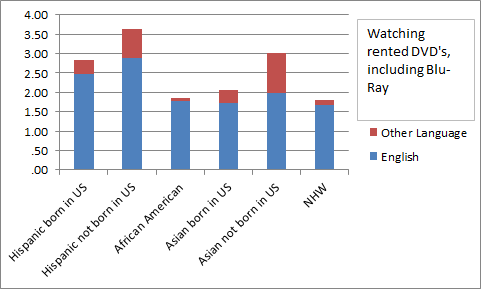
As seen in the chart below, watching rented DVD’s presents a similar pattern, but the number of hours allocated to this video delivery mode is lower and Hispanics born abroad have the highest tendency to rent DVD’s. In general, Hispanics and Asians are generally more likely to rent DVD’s than anyone else.  Perhaps the heritage of countries of origin and the availability of certain types of content account for these differences.

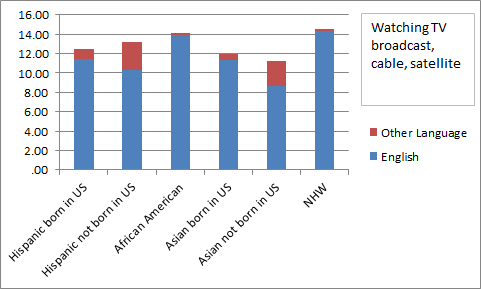
Watching TV via broadcast, cable, and satellite is still the dominant mode of video consumption as can be seen below.  

It is interesting to note, however, that those more likely to stream and rent are those less likely to watch TV in more traditional ways.  Asians and Hispanics are less likely to watch broadcast than their African American and non-Hispanic White counterparts.

These results imply that changes in video watching routines vary by cultural group and by place of birth, with the obvious implication for language preferences. Video providers like Netflix and Hulu that favor streaming are likely to be more attractive to Hispanics and Asians, particularly those born abroad. Traditional video providers like Comcast, Dish Network, and broadcast may do well in anticipating the transition that is taking place by putting more of their content online, in particular if they wish to survive in a much more competitive environment. In this new environment emerging culturally diverse groups appear to be taking the lead in enjoying newer modes of delivery.  

Cable and satellite companies may not only want to make their content available online but also they may want to reconsider how subscribers buy their content. The greater ability to choose provided by streaming and the fading DVD’s mode is not as available in cable and satellite since these companies require the purchases of large bundles of programming.

All in all, the competitive world of online video delivery seems to be hot and worthy of much attention.

The data for this study was collected by Research Now of Dallas, Texas, thanks to the generous initiative of Ms. Melanie Courtright. Research Now contributed these data to the research efforts of the Center for Hispanic Marketing Communication at Florida State University. The distribution of the sample is as follows:
This national online sample had quotas for US region, age, and gender to increase representativeness.