Showing posts with label multicultural marketing. Show all posts

Monday, August 6, 2012

Hispanic Affluence by State - Implications for Marketing

The American Community Survey (ACS) of the US Census Bureau provides important insights into the lives of Americans. Friends of mine frequently ask me about the level of affluence among US Hispanics. Those households with incomes of $75,000 or higher are generally considered to be affluent. What states have higher percentages of affluent Latinos?  How do Latinos compare with the overall population in terms of affluence across States?

In order to try to answer these questions I obtained 5 year estimates from the ACS (2006 - 2010) for household income and compared Hispanics with the overall population by State, then created an index of Latinos as a percentage of the overall population in terms of household income. The latter index I thought would help us visualize which States have a larger gap as compared with others.

The following Table contains the States, including the District of Columbia and Puerto Rico, with the lowest disparities in terms of the percentages of Latino households with incomes of $75K+, compared with the corresponding percentages for the overall population for each State.  The last column represents an index of disparity.  The larger the index the better, comparatively, Hispanics do in that State.  The index was created by dividing the Latino percentage over the overall percentage of those with household incomes of $75K +.


The above table shows that the States with lower disparities of percentages of households with incomes of $75K per year or more are either those that have generally lower incomes, or those that have unusual economies with higher incomes overall such as Alaska, and Hawaii. Regardless of overall economic trends in these States, it is interesting to observe that Hispanics are generally doing quite well across the board as the proportion of affluent Latinos suggests that generally about 25% of their households earn significant incomes.

The table below shows the States with the largest disparities.


The States with the largest disparities between Latinos and the overall population show a trend similar to that in the above table. In States with higher proportions of high earner households overall, Latinos tend to do proportionally less well, for example California, Arizona, Delaware, Texas and Utah. At this lower end of the disparity distribution, however, even those States that have lower proportions of affluent households also show a sharp contrast when compared with their Hispanic household component. These States are exemplified by Alabama, South Carolina, Tennessee, Montana, Kansas, Arkansas, Oklahoma, and Idaho.

The big lesson is that generally speaking Hispanics seems to be doing quite well in terms of having a relatively high representation of high earning households overall.  There are gaps that are due to economic conditions and opportunities but for marketers, the lesson is clear. High earning Latino households are abundant and their significant presence points to their potential for enhancing the bottom line of many marketers that realize their potential. Be these opportunities cars, homes, recreational vehicles, vacations, travel, education, restaurants, etc. savvy marketers can start taking action when they see that they may not be culturally addressing an important part of the potential customer base.

Friday, July 13, 2012

Taxes, Convenience, and Multicultural Purchases Online

Many local merchants and multiple brick and mortar retailers complain that online merchants have an unfair advantage because many of them do not charge State and local taxes to purchasers. That is an interesting empirical question, particularly in the context of our multicultural society.

Are consumers more likely to buy online to save on taxes, or are they more attracted to online retailers because of convenience?  That is the key question guiding this study.

In the Spring of 2012, at the Center for Hispanic Marketing Communication of Florida State University, in collaboration with Research Now, we collected data for our yearly Multicultural Marketing Study.  We asked consumers to tell us how much they agree or disagree with the following statements:

- I purchase products online to save the money I would have to pay for State taxes
and
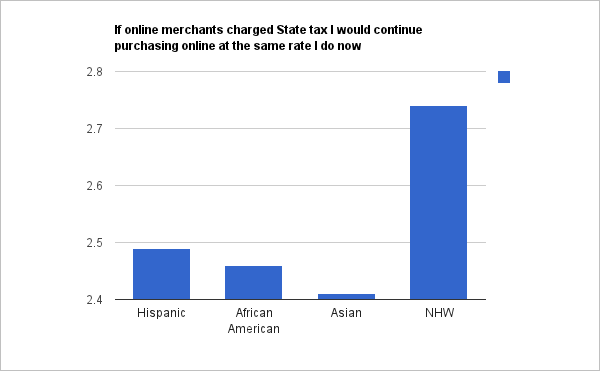
- If online merchants charged State tax I would continue purchasing online at the same rate I do now

Respondents could agree or disagree on a scale that went from completely disagree (0) to Completely agree (5).

Interestingly, across all respondents the average agreement with the first statement was 2.42 and 2.5 with the second statement, almost exactly in the middle of the scale. These overall trends appear to indicate that paying or not paying State taxes when shopping online is not a major consideration for shopping online. These findings tend to negate politicians’ and brick and mortar merchant arguments that advocate that local merchants would fare better if State taxes were imposed on online merchants.  

The breakdown by major ethnic groups reveals some interesting but mild differences.


Statistically, Asians agreed the most with “I purchase products online to save the money I would have to pay for State taxes.”  Hispanics were second and African Americans and Non-Hispanic Whites were least likely to agree with the statement. Still the differences are relatively small. Frugality may account for some of these differences.  Still, even the largest mean of 2.8 for Asians is still relatively small in the context of the scale and seems to indicate that saving on State taxes is not a major motivation for purchasing online.

The distribution of means for the second statement shows a contrasting pattern:


Even though the differences here are again relatively small, the tendency for non Hispanic Whites to agree more strongly with the statement “If online merchants charged State tax I would continue purchasing online at the same rate I do now” indicates cultural differences in the perception of value and saving on taxes. There was not statistically significant difference among Asians, Hispanics, and African Americans.

In sum, Asians seem to be somewhat more motivated by tax savings when purchasing online, and non Hispanic Whites appear to be more indifferent to online purchase taxation. Still, the main finding is clearly that overall, the impact of State taxing of online purchases is not likely to make a major difference.  Convenience appears to be a major motivation for making online purchases. The cost of fuel and the amount of time that it takes to shop in brick and mortar shops does not appear to compensate for State taxation.  It is unfortunate that brick and mortar businesses may not count on State taxation of line purchases to strengthen their businesses to any large extent. Perhaps the biggest lesson for marketers is that regardless of online taxation brick and mortar merchants need to transition to having a presence online.  Also, the results of this research do point to cultural differences in perceptions of online purchase taxation that can be of interest to marketers in their positioning of their offerings.

The data for this study was collected by Research Now of Dallas, Texas, thanks to the generous initiative of Ms. Melanie Courtright. Research Now contributed these data to the research efforts of the Center for Hispanic Marketing Communication at Florida State University. This online survey included the responses of 936 Asians, 458 African Americans, 833 Hispanics, and 456 non Hispanic Whites. This national sample had quotas for US region, age, and gender to increase representativeness.

Sunday, August 14, 2011

Online Courses on Multicultural and Hispanic Marketing Communication

Starting the last week in August The Florida State University will offer for the first time, online, a course on Multicultural Marketing Communication. It is available to anyone interested in continuing education or just for the sake of learning. Students in academic programs can get academic credit and those not in academic programs get a certificate of completion. The course is asynchronous, so students can participate when they have the time. Click here for more details.

Also starting the last week in August is our well known online course on Hispanic Marketing Communication now using our new book "Hispanic Marketing: Connecting with the New Latino Consumer." This course is also available to anyone interested. Click here for further details.

We have also added to our online course rotation Account Planning in the Summer. For inquiries about any of our courses and to register please contact: Inquiries@campus.fsu.edu


Thursday, February 4, 2010

Cultural Marketing For The 2010's

The decade of the 2010's will require more cultural sensitivity than ever before. Not that cultural sensitivity was not needed much earlier in the US and around the world, but conditions are ripe now for understanding how culture can enhance profits and better marketing.

Cultural marketing is not something nice to do to show good citizenship. Cultural marketing is a profit making enterprise. Let me explain. If we accept that emotion is at the core of selling, advertising, and marketing, then culture is a shortcut for reaching the emotions of many people at the same time. Culture consists of objective and subjective designs for living that are passed from generation to generation. The components of culture are what we are raised with in our early years. We are taught what is right and wrong and what is good and bad. When we are enculturated we are given lessons that become warm feelings that generally persist until we die.

The beliefs, feelings, and values that encompass subjective culture are shared by many people in our culture. That is why marketing to Hispanics as a culture makes sense. It is not so much because of the external manifestation of culture like food and dress, but because Hispanics share so much in common because of historical roots that overlap with religion and language.

Marketing to Hispanics as a culture is a way of connecting with these consumers at deeper levels. It is a way of communicating why a product or idea makes sense from the perspective of the consumer and evoking the deepest emotions that become ingrained in the process of enculturation.

Clearly, the same can be said about almost any other cultural group. Marketing to a culture in cultural terms is about touching those cords that have been instilled in us since childhood. While I understand that eventually marketing will be a one-on-one relationship, cultural marketing is a good interim way to bridge the gap between marketing to the masses (as if they ever existed), and understanding the individual's values and deep rooted perceptions of the world at the most personalized level.

Cultural marketing is a shortcut that minimizes the trajectory and produces results. It needs to be authentic and honest because it is about relationships. It requires that the marketer understands the culture. It is not a matter of making a gesture, it is an endeavor of commitment and dedication. Cultural marketing is not about obvious portrayals of families, soccer, or salsa music but about understanding the underlying perceptions that members of a culture share. While portrayals of soccer, families, and salsa music can be very important as tactical elements, underlying subjective elements of the culture can provide true insights for positioning and strategy.

Cheers to all for the 2010's and the challenge of doing cultural marketing right.

****************************************************************
By the way Cesar Melgoza and I will be doing a Webinar on this topic if you are interested:

"Why In-Culture Marketing is Critical to the Long Term Success of Any American Enterprise" on February 11th, 2010 1:00-2:00 p.m. EST.

Understand why marketing to high-growth segments such as Hispanics, Asians and African Americans is key to securing growth for corporations across industries. Get facts and figures that impact corporate strategy at all levels of management and see why in-culture marketing should be mandatory for most corporations. All proceeds will be donated to FSU’s Center for Hispanic Marketing Communication.

To register or for more information visit http://www.geoscape.com/college_of_business.aspx

Thursday, October 30, 2008

Using Social Media to Understand Social Influence

Social media, or social networking as it is commonly known, is powerful beyond what anyone can imagine by looking at the surface of it. Those of you who have studied social networks can relate to this. Imagine being able to identify those who are opinion leaders, bridges between communities, leaders, and isolates, by looking at their social media behavior.

Social media is about influence and power. Who contacts you the most? How many people contact you? How central are you in your network? What are the topics of conversation in your network?

The metrics that can be derived from studying modern networking sites can be a goldmine for marketers. What are some applications?

  • Who is credit worthy?
  • Who is an opinion leader?
  • Who influences whom?
  • What are topics about which different individuals influence others?
  • The strenght of community bridges to pass ideas along to other communitities
How many times do we wonder where to place a message so that it has impact? Social networks are more powerful than "one-way" media because they reflect communication behavior. Social media marketing is about communities that go beyond geography.

The moral of the story is that there is a lot to come when it comes to network metrics.

Monday, August 18, 2008

Use of Social Networking Sites Among Diverse Cultural Groups in the US

Social Media Marketing depends on the popularity of social networking sites. In the study referred to in my prior Blog we also asked our large multicultural sample of respondents to "please indicate the social networking sites you visit regularly." We listed MySpace, HI5, QuePasa, Habbo, Orkut, FaceBook, Friendster, Bebo, Classmates, WindowsLSpaces, Xanga, Flixter, Tagged, Netlog, Reunion, Broadcaster, Cyworld, MyHeritage, Friends, Reunited, Linkedin, BlackPlanet, and SecondLife. We also provided the option "none."

The chart below illustrates the preponderance of use of MySpace and FaceBook among these emerging minorities:
The first observation is that Non-Hispanic Whites, as in the prior blog, show a lower incidence in visiting these sites regularly when compared with the other cultural groups. Interestingly both popular sites fare best among Hispanics who prefere English and Asians than among anyone else. Hispanics who prefer Spanish and African Americans, however, are still more likely to visit these sites than Non-Hispanic Whites. Again, it is emerging minorities that are leading the future of the digital era in the United States.

The following Chart illustrates that culturally targeted sites do better among specific cultural groups:


Sites that have a preponderance of particular cultural groups, or who target specific cultural groups appear to do well with them. The International Site HI5 and QuePasa do realtively well with Hispanics who prefer Spanish. Friendster, populated by a larger number of Asian Americans does relatively well with Asians as compared with other cultural groups. African Americans are more frequently regular visitors of Black Planet. Thus, cultural targeting seems to have great potential among those who strongly identify with their culture. Interestingly, none of these sites seemed to do particularly well with Hispanics who prefer English or with Non-Hispanic Whites. In the case of Hispanics who prefer English this may be because there are few sites specifically catering to them.

Perhaps even more surprising is that members of all of these online cultural groups visit social networking sites with regularity as the following chart shows:
This last chart illustrates that very few individuals in any of these groups use none of the social networking sites we listed in the questionnaire. This emphasizes the importance that this new social medium has for most online consumers.
Social networking is growing fast and becoming very popular among most Americans. Emerging minorities, however, are leading the trend. Social Media Marketing efforts can capitalize on this knowledge to establish their brands and territories in these social circles.

The moral of the story is: Go market where people are associating with others, and become part of their socio-cultural identity. As culture is rooted in social interaction, brands can become part of these complex patterns of interaction.

Friday, January 25, 2008

Identifying the core of the new and emergent multicultural society

You have probably heard the expression "I am not from here or there," or in Spanish "no soy de aquí ni soy de allá." The core of the emergent multicultural society in the United States is composed of people who are not from here or from there. Most members of this emergent society, of most cultural minority backgrounds, do not fully share the cultural experience of their heritage, and they do not fully feel part of the traditional "American society." Thus, the cultural ambivalence they experience. It is being in between worlds, and in a synergistic way combining them.

Interestingly when members of these different cultures share the experience of "not being from here or there" they have something in common. It is a sense of being different, or sharing difference. That is what anthropologists (Ruth Hill Useem) have called third culture kids. Third culture because it is not the first culture or second culture that prevail in their minds, but the third culture of the experience of being different and mixing aspects of both.

The richness of the experience of being different appears to be the common denominator of diverse cultural groups in the US. In an interesting way, a country of immigrants has the intrinsic quality of deriving from a "third culture." Perhaps this heritage has been taken for granted in common discourse, and new emergent "minorities" are becoming the core of a new era in which being different is what makes us similar, one more time in history.

Not being from there or from here is perhaps the core of a brave new world.