Showing posts with label market research. Show all posts

Wednesday, June 5, 2013

The Juice Mystique: Hispanic and Non-Hispanic Consumption of Orange Juice Brands and Drinks

I have spent quite a few years asking consumers about their consumption of orange juice and juice drinks. In visiting stores that cater to Latinos in Texas and California I tend to see large displays of shelf stable drink products like Tampico and Sunny Delight. Over the years I have heard Hispanic consumers state that these products have high percentages of juice in them, as high as 80% and sometimes even higher. Which is surprising because the actual juice content is low.  I was not sure about the extent to which the consumption of these juice beverages was higher or lower than popular orange juice brands.


To obtain a quantitative picture I examined data from the Experian Marketing Services Simmons National Hispanic Consumer Study that was collected in the twelve months ending on November 30, 2012.  The results I obtained provide an interesting perspective on the use of these products according to the chart below.
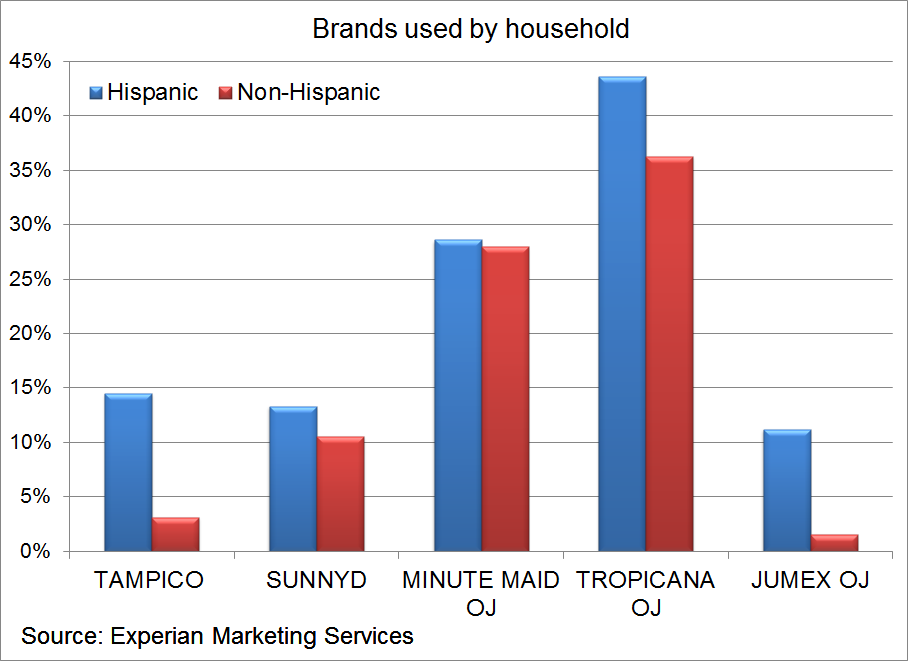


First I need to clarify I decided to compare Tampico and Sunny Delight with Minute Maid and Tropicana because these are large orange juice brands, and also included Jumex because the brand has its origin in Mexico and is well known by Latinos of Mexican origin.


The chart shows that even though Tampico and Sunny Delight are used by Hispanics to a larger extent than by other consumers, the prevalence of the use of those brands is relatively low when compared with major US brands like Minute Maid and Tropicana. Jumex orange juice is used at about the same rate as the Tampico and Sunny Delight beverages. It is salient to notice that Tampico and Jumex have a very prevalent Latino constituency. That may be explained by the affinity of the Tampico brand, since Tampico is a port in Mexico, and by the heritage of Jumex whose name comes from the roots “jugos” juice, and “mexicanos” Mexican.


Interestingly, Hispanics over-index non-Hispanics in the use of all the brands. I was expecting that they would over-index more markedly in their use of the less expensive beverages but that is not the case. Given their family orientation and their larger household size, Latinos consume more of these beverages regardless of their pricing or quality. Many have argued that Hispanics are likely to purchase their preferred brands or more expensive brands for their family even if their incomes are lower. These findings may provide a partial indication of that possibility.


Out of curiosity I decided to check on income levels by use of these brands to ascertain whether or not income is associated with their use, for Hispanics and non-Hispanics. The charts below show the results.
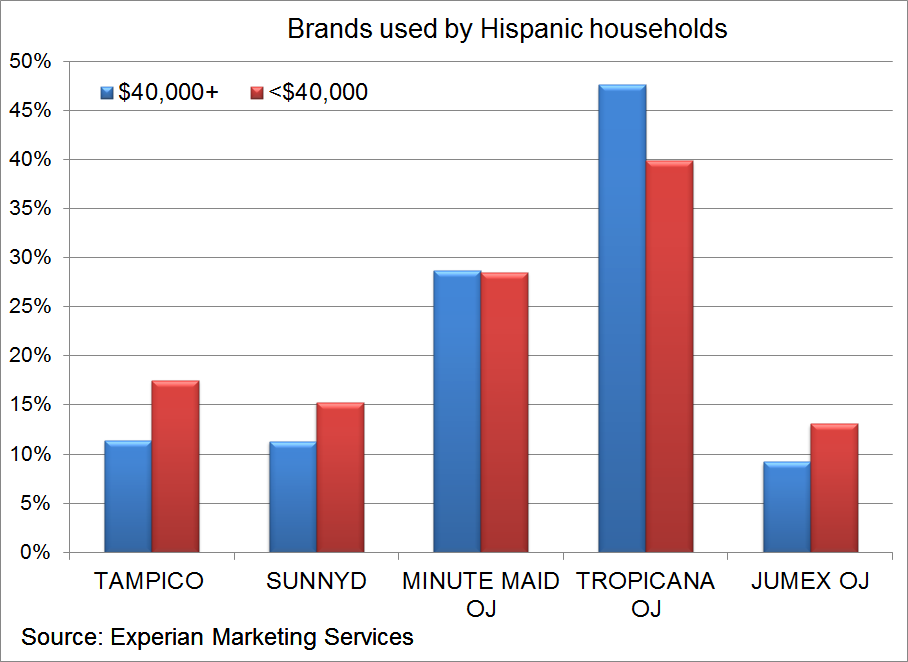
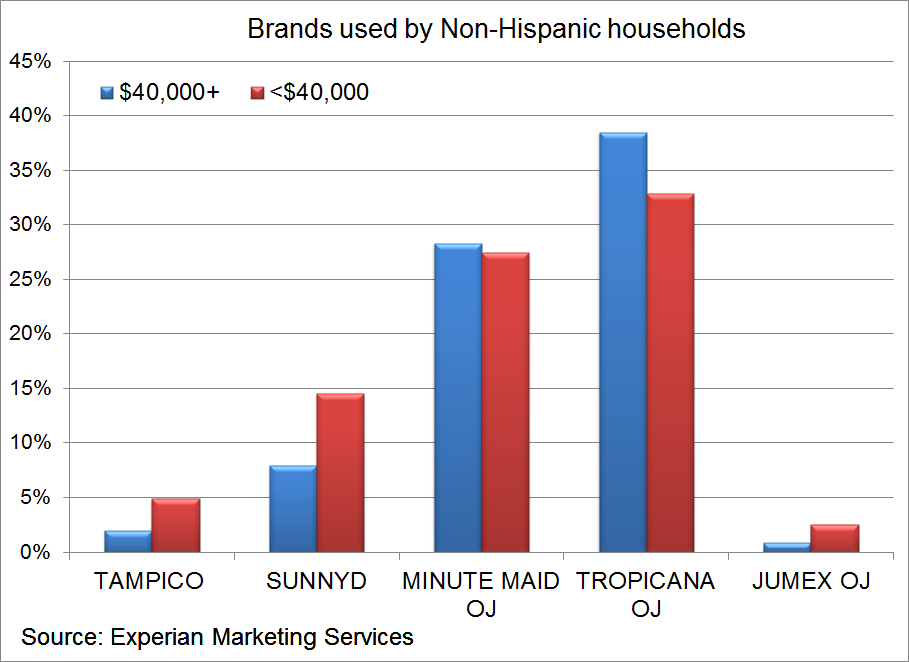


As can be seen there is a tendency for those with lower incomes to be more likely to use Tampico and Sunny Delight, as well as Jumex orange juice regardless of their Latino heritage. And in the case of Minute Maid and Tropicana the difference by income levels is small but somewhat slanted towards higher incomes, particularly in the case of Tropicana. What seems outstanding (thanks William Biggs) is that those in the lower income categories use the premium OJ brands much more, in general, than they use the lower priced products. It can be concluded then that lower income is somewhat of a driver in the use of fruit beverages like Tampico, Sunny Delight, and Jumex OJ, but marginally the opposite in the use  of major brand orange juices. Lower price points are more appealing to some of those with lower incomes, and perhaps these consumers justify their choices by attributing higher juice content to beverages that do not have such.

It stands out that even those with lower incomes are more likely to consume premium brand orange juice, than the less expensive counterparts. Thus the selectivity of diluted drinks and less expensive brands may be particular to some who knowingly find them appealing, or who do not know what the nature of the product is.


Clearly, if Latino consumers and non-Latino consumers of lower incomes and large families see a large container of an orange drink and believe it contains a large amount of juice and then compare the price with actual 100% juice products, they are likely to opt for the larger and less expensive product. But what if they compared labels carefully?


In a competitive market there is room for juice brands to more directly  and aggressively compete with products that have a small percentage of juice content by educating consumers as to what the differences are. Clearly, the less expensive products also have some benefits as they are enriched with vitamins.  If a brand has a true advantage it should exploit it to the benefit of their bottom line and their consumer base.


At any rate, there is ample room for marketers to better understand the consumer behavior of Latinos to more successfully market to and educate them. Latinos generally want the best for their families, and highlighting product differences for them may be helpful and also profitable.


The data used here is from Experian Marketing Services’ Simmons National Hispanic Consumer Study of adults 18+  and was collected from October 24, 2011 to November 30, 2012. The sample of Hispanics contains 8,521 individuals and the non-Hispanic sample has 17,043 people.

Monday, October 8, 2012

Mobile Latinos

I was quite impressed when Max Kilger, Chief Behavioral Scientist for Experian Simmons, talked to my graduate Hispanic Marketing Communication class about new data findings regarding mobile technology use by Latinos.  I was particularly impressed because the sample that Experian Simmons uses yielded similar results to the ones I have been obtaining with the sample provided to Florida State University by Research Now. Cross-validation of results is reassuring.  Basically, Hispanics are eager users of mobile technology.

Here are some of the findings reported by Dr. Kilger to my class:

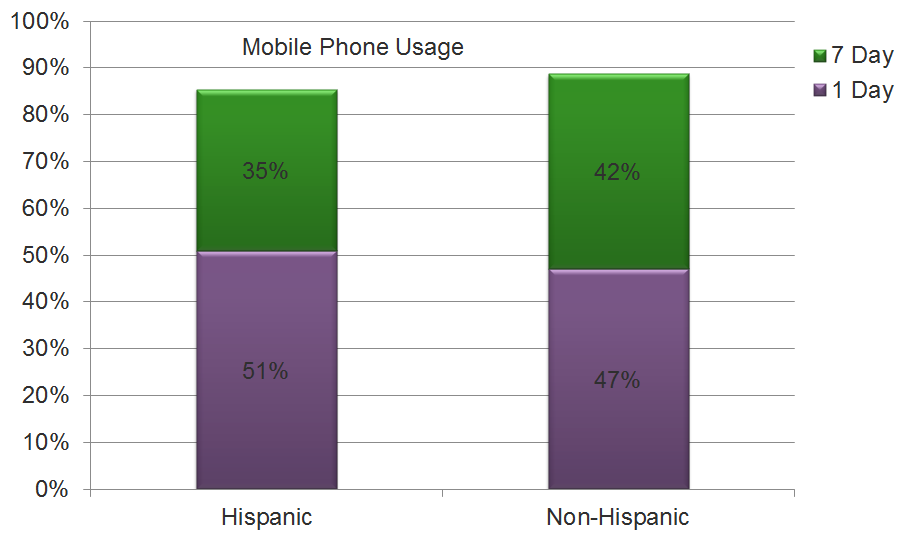
First, the percentage of use of mobile phones by Hispanics and non-Hispanics over a 7 day period is almost the same for Hispanic and non-Hispanics, with non-Hispanics having a 4 percentage point lead as seen in the chart below.  The Latino percentage of mobile use in one day, however, is about 4 percentage points higher.


Clearly, the small differences highlighted are interesting but almost trivial.  What matters here is that Hispanics are eager users of mobile phones, at least as much as the rest of the market combined. In prior blog postings I have presented data which shows that Hispanics, African Americans, and Asians use their mobile phones about double the amount of time as their non-Hispanic White counterparts. That suggests that when looking at all non-Hispanics combined it is likely that minorities are the ones responsible for much of the usage.

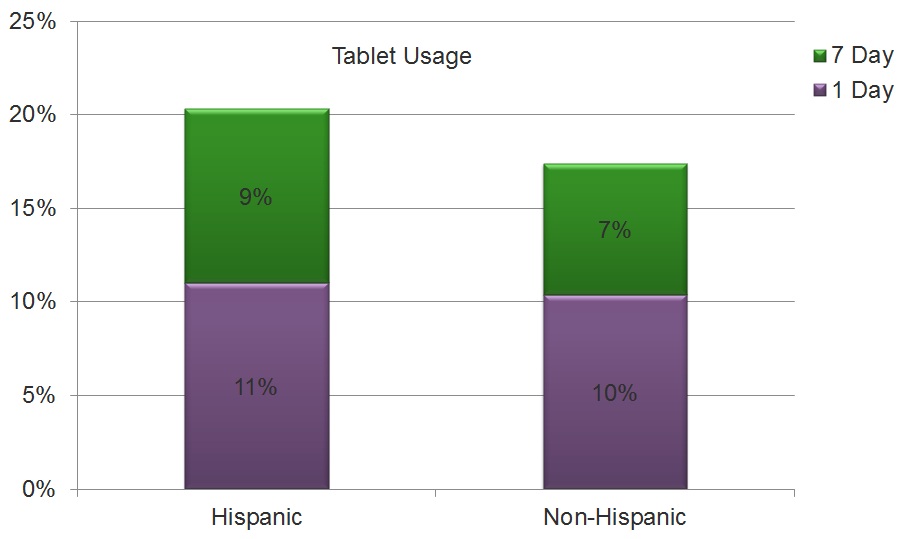
The next chart is more dramatic, not so much in terms of actual differences but in the fact that Latinos are eager to adopt new technologies and that when they adopt them they use them more. Here is the trend in terms of Tablet use.


While the penetration of tablets among Hispanics is not yet as high as among other cultural groups, Latinos who have them are more likely to use them. That comes as no surprise given the findings I have reported in the past couple of years. Technologies that allow for more fluid interpersonal communication and mobility have shown to be very attractive to Hispanics. My interpretation is that this is due to the eagerness that Latinos have to be connected. New technologies appear to be in fact “technologies of liberation” for Latinos.  Liberation in the sense that the constraints impeding interconnection among Hispanics are being removed by these electronic machines.


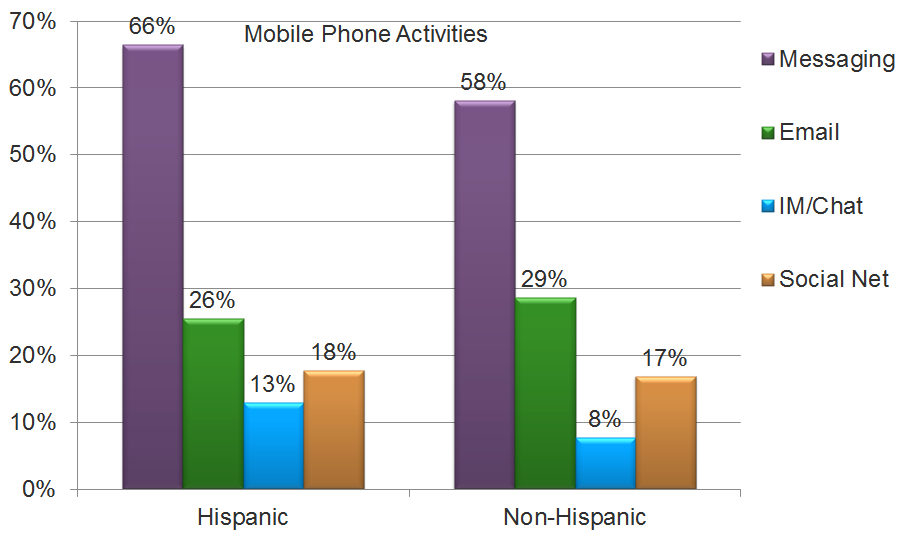
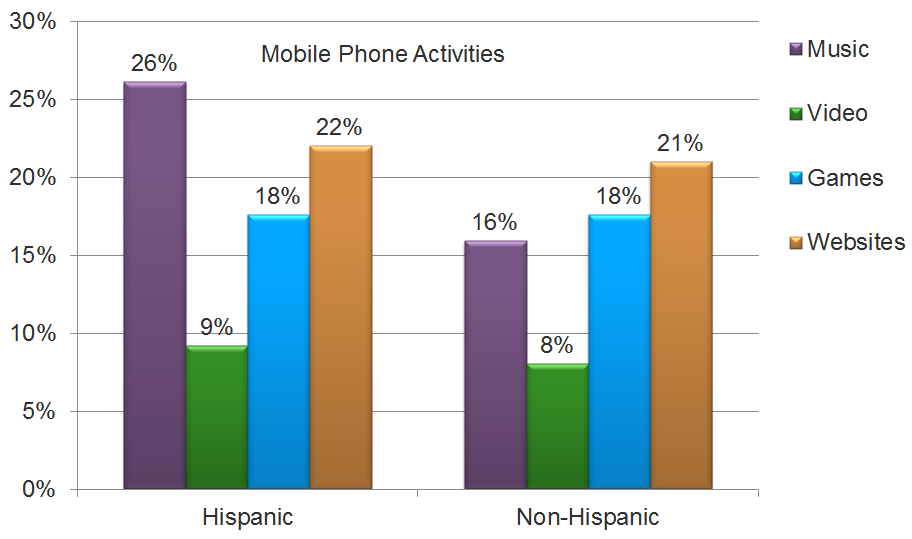
Another two charts that impressed me have to do with activities that Latinos engage in on their mobile phones.


Perhaps not surprisingly, Hispanics overindex in their use of text messaging, IM/Chat, and to a smaller degree in social networking.  My guess is that if these data were broken down further by cultural group we would see that minorities in general overindex in social networking as we have seen with our FSU data before.  That Latinos engage in mobile phone listening to music to a larger degree than anyone else confirms their attraction to music as part of their cultural existence.


It would be most interesting if the Experian Simmons data were broken down by different cultural groups so that comparisons could be made in more detail. Comparing culturally diverse groups among themselves can be illuminating for segmentation purposes.

My students and I were gratified to see that the Experian Simmons data supported the results we had found with the data from Research Now, and this confirmation lends credibility to the fact that Latinos are eager technology users who lead in many digital domains.

The data from which the above results are reported is from the Simmons Connect Study with a cross-platform sample of Hispanics of over 7,000 respondents.

Friday, September 7, 2012

Political Affiliation and Attitudes of Hispanics

In this heated political season of the Fall of 2012, when the different political parties are trying to get the attention of Hispanics it is of interest to explore how the political affiliation of Hispanics relates to some of their attitudes.

With online data collected by Research Now of Dallas Texas, for the Center for Hispanic Marketing Communication at Florida State University, I explore here a variety of attitudes as they relate to the political affiliation of Hispanic respondents. Affiliation was measured by asking respondents “Could you please tell us your political affiliation?” and the answer categories were Republican, Democrat, Independent, and No Party Affiliation, as well as the opportunity to refuse to answer. The attitude items were statements to which respondents could answer any number from 5 to 0, where 5 meant “Completely Agree” and 0 meant “Completely Disagree.”

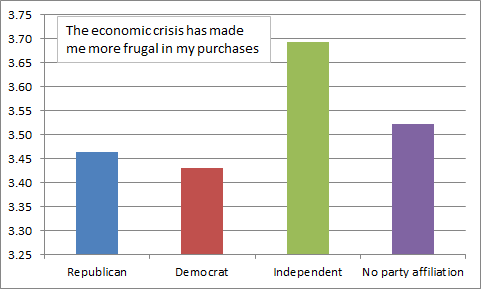
Independent respondents were more likely to state  the economic crisis has made them more frugal in their purchases than other respondents. They were followed by those with no party affiliation. Republicans and Democrats were somewhat less likely to agree with the statement.


Still, in the context of a scale from 0 to 5, there was a general sense that frugality has been a factor in these consumers’ lives.  Perhaps Independent respondents and those with no party affiliation have opted for those responses because they are politically dissatisfied.

Interestingly, when asked about worrying about retirement, the trend is somewhat different.


In the case of worrying about retirement, Republicans and Democrats seem to be more worried than their counterparts. Again, in the context of the scale we used, this is a concern to many Latinos, in general.  

The use of coupons can be construed as an indicator of economic concern.


Here the reader can see a monotonic decline of habitual use of coupons with political affiliation, from Republican to No party affiliation.  Is it the case that those with a party affiliation are somewhat more systematic in organizing their purchases?

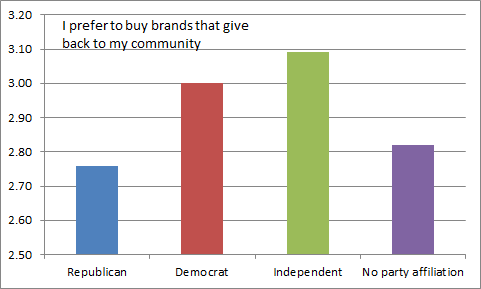
These days it is common for companies to endorse the idea that they need to give back to the communities they benefit from. 


Democrats and Independents are more likely to agree that they favor the companies that give back to the community. This is perhaps associated with socioeconomic status and with a more socially oriented philosophy.

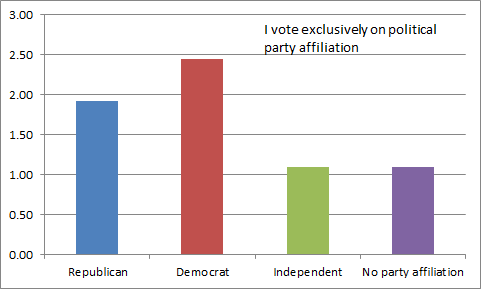
Voting along the lines of political affiliation is obviously more prevalent among Democrats and Republicans. This is perhaps not surprising but the trend confirms that there is a sense of loyalty to the party.


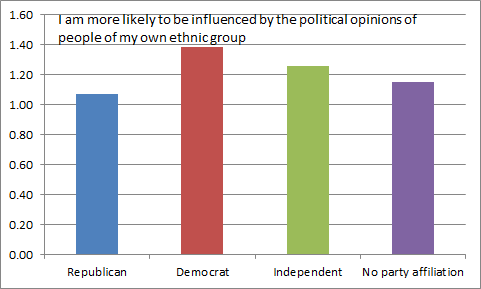
There are many politicians and advertising strategists who believe that to influence Hispanics they need to use Latinos models and that influence is likely to come from other Latinos.


While there are some small differences among affiliations regarding the feeling that one is more influenced politically by others of one’s own ethnic group, the overall level of agreement is very low. This means to me that the influence regarding Latino political behavior is more based on issues and party affiliation than on the ethnicity of influencers.

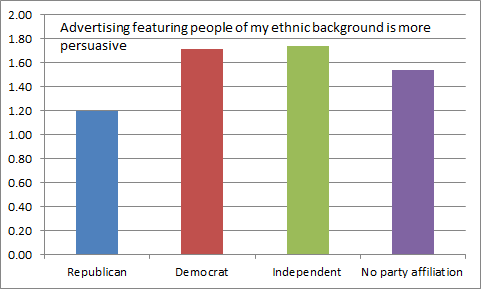
Similarly, regarding advertising, we find that while there are some differences regarding the influence of others who share a Latino ethnicity, overall the ethnicity of the people featured in the ads does not seem to be highly important.


This may be due to the fact that Latinos come in all colors and that the party affiliation and issues are more important than the ethnicity of the characters in ads. Republicans are particularly less likely to be influenced by the ethnicity of the advertising portrayals.

Overall one can conclude that political affiliation does seem to have a relationship with attitudes about the economy, even though everyone seems to be affected by economic conditions  in general. Further, political affiliation seems to be a matter of loyalty particularly for Republicans and Democrats. The ethnicity of influencers, however, does not seem to be that important to these online consumers.

The data for this study was collected by Research Now of Dallas, Texas, thanks to the generous initiative of Ms. Melanie Courtright. Research Now contributed these data to the research efforts of the Center for Hispanic Marketing Communication at Florida State University.  This national sample had quotas for US region, age, and gender to increase representativeness. The distribution of political affiliations was as follows:


Wednesday, May 23, 2012

Google Surveys are Here: Implications for Multicultural Research

Google is my favorite tech company these days. It has created and continues to create solutions that are quite outstanding.  That brings freedom of research and expression to the world, literally.

Recently the company launched Google Surveys. That allows users to:

  • Create a survey online, including graphics
  • Respondents answer questions to get free access to content online, one or two questions at the time, only
  • The content publishers get paid for allowing their viewers to answer questions
  • The survey creator finally gets the data tabulated and graphically displayed, and the data is updated continuously as more people answer

The system of Google Surveys is still being developed and eventually it will become a killer app, I think.  Right now the survey creator or researcher pays 10 cents per response, or 50 cents per response if the responses are from specific targets.  So, if you ask 50 questions from 500 Hispanics it costs you $2,500.  Not that bad although not that inexpensive either compared with companies like Research Now that can do similar work via River methodology at very competitive prices depending on the specifics of the project and include many more questions in one survey.  There are several issues that Google Surveys needs to address before their platform is really useful for multicultural research.  Here is why:


  • The fact that each respondent answers only one or two questions at a time makes correlations and multivariate statistics impossible to conduct.  If you have a survey with 50 questions, you need all 50 responses from each individual to be able to compute statistical associations and other relational analysis.
  • They are currently only targeting English language publishers, thus if the researcher wants to target “other language” respondents that is difficult as the incidence may be too low and the data slow to collect.
  • The cost is not really lower from that of competitors that do target “other language” groups, and who get individual respondents to actually complete an entire, let’s say, 50 question survey at one time. That way the researcher can conduct actual segmentations and other complex data analyses.
  • Also, the target of Google Surveys now are people who visit sites that charge for content. That makes the respondents somewhat idiosyncratic and perhaps not representative of the universe of online respondents.

At this time "Google Surveys" is a useful tool for people who want to know the answer to one or two very specific questions. In multicultural research, we usually need to find relationships between variables from the diverse cultural groups in the US.  Google Surveys does not seem to be ready to address these issues at this time. Nevertheless I am hopeful that they will eventually have a very general and powerful tool.

Thursday, March 1, 2012

Where to Find Your GOLD MINE of Market Data

Where is your richest resource within your company? It’s with your front-line managers and staff. They are the ones who:
  • Best understands your customers’ needs and wants,
  • Know what and where service delivery is inefficient and not working,
  • Have family and friend relationships within the community our customers live in,
  • Possibly have friends or acquaintances that work for the competition.
These are just a few of many reasons why it’s important to engage your frontline personnel in your marketing analysis, planning and implementation. Make your frontline part of your marketing team and you will experience your richest resource – your gold mine of market data.

Best,
Melissa

If you're going to be able to look back on something and laugh about it, you might as well laugh about it now. - Marie Osmond

MarketMatch is a full-service marketing consulting firm, dedicated to the credit union and community banking community.  We utilize knowledge-based strategies to help you FOCUS on the efforts that will generate MOMENTUM and yield the greatest RESULTS for your bottom line.


Saturday, May 28, 2011

Emerging Minorities, Concern for the Environment, and What Marketers Can Do

When I was growing up in Mexico City my father and mother always told me not to keep the faucet running because wasting water was bad. Then they told me not to throw things away because some day I can reuse them. I saved cans, jars, bottles, bags, and was very careful not to leave the faucet running while washing dishes or shaving. And, of course, you would not dream of leaving the lights on when nobody was in a room. That was such a waste of electricity.

Perhaps we were so thrifty because that was the economical thing to do at the time. But we were also frugal because resources were scarce and we did not want to waste them. For example we did not have all the water we needed. They would sometimes cut it systematically at different times during the day. Electricity was a similar problem.

I have noticed that Hispanics coming from Latin America, similar to my youth case, are also frugal with resources even if they have money to buy what they need. I have been curious to know if it is a general phenomenon that Latinos are more concerned with the environment than others.

According to our recent 2011 FSU – DMS Multicultural Marketing study we found that in fact, Hispanics that still prefer to communicate in Spanish are the most concerned with the environment compared to anyone else. Further, minorities are generally more concerned than non-Hispanic Whites after conducting statistical tests of significance. Here are the averages on a scale from 0 to 5 in terms of agreement with the statement: “Humans are severely abusing the environment.”


This belief reflects an attitude of concern for the environment that should be noticed by marketers. Products and messages directed to Latinos and other minorities are likely to have stronger resonance if they address how a company is doing something for the environment, and that their products are green.

It is not intuitive that Hispanics who prefer Spanish are most strongly concerned with the environment. Particularly not to those marketers who do not share their history of environmental chaos and deprivation. Further, Latinos who prefer English, along with African Americans and Asians, share a stronger concern for the environment than their non-Hispanic White counterparts, and that is not intuitive either. It is perhaps that those who have had to live with the consequences of environmental degradation are now turning more conscientious about it.
The lesson of the story is that emerging minorities are likely to embrace green and marketers should make that part of their agenda. Perhaps green is the new “green.”

The data for this study was collected during March 2011. This online sample was comprised of 500 respondents per segment, for a total of 2,500, based on quotas by gender, age, and geographic location. DMS Insights managed the sample and data collection and they graciously contributed their effort to the academic program of the Center for Hispanic Marketing Communication at Florida State University. This study was conducted by the faculty and students of the graduate Multicultural Marketing Communication course offered by FSU this Spring.

Wednesday, May 11, 2011

No One Woke Up This Morning Needing YOUR Checking Account!

I know ... it hurts ... I'm sorry.

What's worse ... no one wants your mortgage ... or your auto loans ... or your CD.

What consumers WANT is:
  • Fewer miles to drive
  • A teller who wants to be there
  • A new home
  • A new car
  • An expert to recommend a way to save money
  • To feel good
So, what are we to do as banks and credit unions? Let's face it, our products aren't cool. No one's going to camp outside your front door for the launch of your new CD rate!

You Have to Differentiate
We may not be the next evolution of the iPad, but we are a necessity. That said, we need to give consumers a reason to consider us over the 6 banks they're going to pass to get to our branch.

What makes you stand out? Is it your convenience? Your personality? Your technology?
  • Scrutinize the competition: Identify their strengths and weaknesses in pricing, convenience, service, products and image. Where do your strengths align with their weaknesses?
  • What does your market NEED: They don't NEED price. If all you have to hang your hat on is a rate, your neighbor can beat it tomorrow (and you'll price yourself out of profitability). But, if lower fees truly are a differentiator, see how this credit union "pulled it off" (literally!!!). The bottom line is, talk to your customer's real needs ... and your product's real benefits.
  • Be different: When my first CEO asked me why he should hire me with ad agency experience and no banking experience, I told him it's because consumers don't understand banking and it's my job to "talk" with these folks. I believe that it's the banks and credit unions who think like retailers that are truly differentiating themselves and gaining market share. Try to appeal to an emotion. After all, we're dealing with our customer's money ... what's more emotional than that!
As you're reviewing your past and future campaigns, keep in mind that the market doesn't want your product ... they want what the product will get them!

Take care,
Eric

Wednesday, November 17, 2010

Is it Time to Relook at Your Brand?

If you haven't reevaluated your brand in the last 24 month, it may be time ... and it doesn't have to eat up your budget.

It's no secret that banking consumers today are not the same as they were before the "banking crisis" (enter ominous music here). The truth is that, for whatever reason, national surveys show bank customer satisfaction with larger banks is down (and credit union's is up).

Thanks to the media, consumers as more educated about banking, their perceptions and expectations have changes, and they are more motivated to make a change (12% fewer customers said that they "definitely will not" switch this year vs. 2007).

You need to make sure your brand still aligns with what consumers know, how they feel, what they expect and what will motivate them to come to you -- all while holding true to your actual identity.

But you won't know what's going on in your market until you ask. I'm not saying that you need to rebrand - but I am saying that you should reevaluate and see if there is any tweaking to do to make you more competitive and a more likely consumer choice.

Take care,
Eric

Thursday, March 25, 2010

All Marketing is Cultural

Many marketers still ask the question: What is different about marketing to Hispanics, Asians, African Americans, etc.? Isn't marketing just marketing?

Marketing is marketing but few marketers consciously realize that what they do is cultural marketing. So when they target women with children, they are really addressing a subculture in the United States.  When they address young people they are addressing another culture within a culture. When they target middle class homeowners they are not just addressing a so called "demographic," they are addressing a culture.

There is little awareness of what a culture is. A culture is a set of designs for living that are shared by many people, and sometimes those designs for living are passed on from generation to generation.

Most advertising would not work if it were not cultural. The marketer attempts to connect with consumers who share something in common, but the "demographic" is not what they share in common, it is the way of being, thinking, doing, valuing, and feeling.

Thus, it should not be surprising that to reach out to Latinos, for example, the marketer needs to understand their culture. And that is profound because it goes to the core of who people are. That is what ethnic marketing consists of. It is the understanding of the culture and the contextual issues surrounding it. It is different because the culture is different, but also because it is a lot harder to market to a different culture than to the one you are part of. See, culture is like water for the fish, we are seldom aware of it. We think a joke is funny just because it is funny. Not so, a joke is funny because it is culturally bound. A joke is funny to a group of people who share a culture, and not to others. An emotional appeal is emotional to those who share a common reaction to that appeal.

When the marketer crosses cultures s/he needs to make many assumptions explicit. There is no more obviousness of water to the fish. The fish needs to become aware of the water in order to succeed. That is what has to happen with marketers. They need to step out of the comfort of their own culture to be effective in another. That is why it is so difficult to do cross cultural marketing.

But, all marketing is cultural, and it is hard for many to realize that. So, now, why do we need to make special efforts to market to Hispanics, African-Americans, Asians, etc.? Because they swim in different waters.

Monday, April 13, 2009

Know Your Customer Now -- They've Changed

So, you've done your due diligence and done a big customer research project within the last year or so, right? You know, it was probably when you did a new branding push or were going through a name change. You really honed in on who your customers were and how they felt about your bank.

So, good for you -- you have a clear understanding of what your customers wanted then. What about now?

A great deal has changed in the last 12 to 18 months in the banking industry, so assume a lot has likely changed with your customers too.

The turmoil in the industry has jumped from Wall Street to the front page of the newspapers and landed smack in the middle of Main Street. Customers can't help but be affected by all they are hearing about the banking industry.

Obviously, many now have questions about the safety and security of their funds. Here's a startling fact from a recent customer research project conducted for one of our banking clients. For the first time ever, safety and soundness and reputation of the bank was selected as more important than location and convenience in determining where to bank.

Not only are more customers focused on the safety of their funds, but many have also seen a dramatic shift in their needs. Suddenly the financial landscape has become very scary and customers who once thought they didn't want a lot of guidance or hand holding from their bank may now be looking for a much more involved financial partner. Are your employees positioned to step from product pushing to the role of an advisor and partner?

Your challenge is to find out what has changed with your customers and prospects today so that you know where and how to spend your limited marketing dollars wisely. Leveraging a small portion of your marketing budget to research so that you are really targeting your messages can offer significant payback in ROI.

I also value the touch point that research gives to the customer. Being contacted to provide feedback lets customers know you value their opinions and are working to meet their needs. It also demonstrates you recognize the significant changes that have taken place in the marketplace and want to remain relevant.

So ask yourself, how well do you really know your customers now? Well, maybe its time to become reacquainted.

Thursday, February 12, 2009

Spring Training

Pitchers and catchers report TODAY!  Soon there will be the smell of fresh-cut grass, the sound of wood cracking against leather and the aroma of hot dogs in the air.

Over the next few weeks, even last year’s All-Stars will be going back to basics:  How do you position your body to turn a double play?  What are the mechanics for a slider?  What is the sign for “steal second”?

What are you doing to get your team ready for Game Day (you know, that day a customer or prospect walks in your front door or calls your office)?


Here are some ideas to get Back to Basics:


Look in the mirror

Have someone from outside the company shop your offices.  Simply have them ask for information on a new checking account and see how your staff handle it.


Scout the competition

Have that same person do the exact same thing at your major competition

  • How did your offices stack up?
  • Was there an emotional difference in how they felt at each office?
  • Most importantly … would they buy from YOU or THEM?


The Golden Rule

Treat EVERYONE who walks into your office as you would treat a guest in your home

  • Look them in the eye
  • Shake hands
  • Walk them from place to place (NEVER just point)
  • If a teller is referring to New Accounts staff, make formal introductions
  • Offer a bottle of water to ANYONE who sits anywhere in your office
  • Before you talk about yourself, ask about them (learn a customer's needs first and focus on the relevant products – don’t information dump)
  • Ask if you can open an account for them today.  They took time out of their day to drive to your office – reward them with a new account.
  • When the conversation is complete, walk them to the door, shake their hand and thank them for coming.

Sounds simple doesn’t it?  What is your staff doing right now?


Make sure your team knows the playbook

If your frontline staff doesn’t have a checking account, online banking, bill pay and debit card with your institution – how can they speak knowledgably about it? 

“I use our online banking and it’s super easy,” is a much more powerful sentence than, “Our online baking is supposed to be pretty easy.”


Getting Back to Basics means that you don’t necessarily need scripts or new procedures.  Simply use common sense, make an effort and have fun.


Enjoy your Spring Training!


Happy Trails,

Eric

Wednesday, January 21, 2009

Brand YOU Day

As marketers, we all understand the importance of branding, but how do you craft YOUR brand as your bank or credit union’s marketing department?

A solid internal brand can transform marketing from the “arts and crafts” department to the strategic thought leaders … from the “ad guys” to an indispensible planning resource … from an expense to a valuable INVESTMENT.

As with any brand, your department’s brand needs to be differentiating, relevant and speak to a need.

Be Differentiating: The Marketing Department should be the ONLY one-stop resource for all information within your market.  Among other things, you should be the expert on:

  • How your current customers perceive and use the bank
  • How potential customers perceive your bank and use their bank
  • What a potential customer looks like and where they live
  • What the competition is doing (or not doing)
  • What the financial trends are in the market

Each planning session, it should be your department that leads the conversation with the management team and the Board on market conditions and a basic SWAT analysis to establish a mind-set and get everyone on the same page.

Be Relevant: Banks are more in the forefront of American’s minds that they’ve been in generations.  And people are crafting their opinion of you and your peers by what they see on CNN and the local news.

The bottom line is that YOU are the sculptor and guardian of your institution’s image.  No one else in the bank, not even the CEO, is as concerned about the perception of your bank as you are.  From the front-line interaction to the sales collateral to the external communication - you are responsible for the customer experience at every touch point.  What could be more relevant?

Speak to a Need: Remember who your internal target audience is … the CEO, CFO and Board.  Of these, most have a finance background and focus.  So, speaking about creative awards will not necessarily address what is important to them.

You need to speak in your target’s language … cold hard numbers!  A solid understanding and sharing of your marketing ROI will go a long way to adding value to your department’s brand.  Consider this … if your CEO has only $1 to invest in the institution, where will they get the best return?  An investment at today’s rates?  More technology, branches or personnel?  Or a sound marketing program that can generate 120% plus ROI?

We just need to take our own medicine and put the same emphasis on our internal brand as we put on our bank’s brand.  Imagine what it could do for your involvement in key decisions, job security and your overall marketing budget.  

As always, please share your thoughts as a comment below.  Or if you think I'm full of it ... please share that too!!!

Take care,

Eric