Showing posts with label marketing. Show all posts

Tuesday, December 10, 2013

S.E.L.L. more with SEM and SEO

"For online advertising, almost half (48%) of consumers surveyed said they trust ads in search engine results, online video ads and ads on social networks. More than four in 10 (42%) trust online banner ads, up from 26 percent in 2007. Forty-five percent of respondents in Nielsen’s 2013 survey believed display ads on mobile phones were credible, and 37% trusted text ads on mobile phones, up from 18% in 2007."
~ Under the Influence: Consumer Trust in Advertising, 09.17.2013
---------------------------------------------------
BrightLocal Local Consumer Review Survey 2013.
Myles Anderson & filed under Online Reviews, Research, 06.25.2013
~ Only 5% of consumers had not used the internet to find a local business in the last 12 months 
(down from 15% in 2012)

~ 37% of consumers used the internet to find local businesses at least one time per month 
(up from 34% in 2012)


Many of us have new customer acquisition at the top of our wish list for 2014.
  • Fact #1: To acquire new folks, you must first have market awareness.
  • Fact #2: Awareness takes money that most of us simply don't have.

That said, strategically, you have to steadfastly stick to two strict disciplines:

1. You DO NOT want everyone in your market. So why pay for media that reaches everyone. Identify as narrowly as possible who you REALLY want to walk through your door and focus your money there. Anyone else will walk in organically.

2. You need to reach your target when they care. It would be great to have the budget for a Nike-style blanket awareness effort, but you don't. 


More and more, a focus on electronic media makes more sense than burning your budget on traditional broadcast and print. A serious evaluation of SEM and SEO can make a huge difference in your marketing results.

Search Engine Marketing - (SEM) allows you to quickly identify and serve text ads to individuals as they are looking for information related to local banking options 

SEM is focused on key words, so you reach your target while they are hunting for what you do - but it goes much deeper. For the most part, you can also target your SEM just like you do direct mail: Regional, demographic, lifestyle, etc.

SEM is typically budgeted on a cost-per-click model, so unlike direct mail, you will not pay for simple exposure, but for actual desired action.


SEO - Having a Search Engine Optimization (SEO) strategy is an essential component in being competitive in the search engine realm and providing your customers with the most timely, accurate information about what you do and what you're about. The goal of SEO is to provide an intuitive user experience by communicating with search engines about your products and services so that you rank well within the search results. 

Proper SEO is not a DIY project. It requires regular analysis of web crawler reports, key word rankings, competitive analysis and content review. It also takes updates of keywords generation and meta data as well as social media integration.

The best part is that both SEM and SEO are budget friendly. With a pay-per-click and super-tight targeting, you can create a SEM plan that fits most any budget. And, while SEO is an ongoing effort, you can reasonably expect to pay just a  few hundred dollars per month for the consultation, reporting, analysis and management

We bring these marketing philosophies to credit unions and community banks nationwide, and would love to bring them to your institution too. Contact us to see how.

With more than 280,000 visits worldwide, we hope that you enjoy this blog.  If you find it helpful, please share it with your colleagues. Also, check out our YouTube Channel for short video blogs about financial marketing.  

MarketMatch is also a nationally and internationally requested speaker. Contact us to bring our marketing ideas to your next conference.

937-426-9848
Follow me on Twitter @egagliano


Wednesday, November 20, 2013

Beyond Tacos, Guacamole, and Hugs: El Dia de los Muertos

Latino influence in the US keeps growing one cultural example at a time. The Wall Street Journal published on Friday November 1, 2013 an article entitled "No Bones About It, Day of the Dead Is Finding New Life." The article talks about a trend among non-Hispanics, particularly in areas of heavy Latino presence like California and Texas, who now set up altars to their dead relatives in different locations. An interesting example is that of a non-Hispanic woman in Oceanside, California, who created an altar to her father in the trunk of his car.

I am surprised as I thought that this particular ritual would not transfer from the population of Mexican origin to non-Hispanics.  I had the impression that spiritual rituals tend to be more strongly culture bound and related to deeply ingrained beliefs and emotions.  Emotions that are derived from people's upbringing and sense of self.

But there it is! Not only has hugging become popular (see a prior blog post), but now more spiritually oriented beliefs are transcending their origin. The Day of the Dead celebrated on All Saints Day, has its roots in cultural beliefs that talk about the skies opening on that day so the souls of the dead pour back to earth to spend time with loved ones. Then, the loved ones left behind celebrate the life of the departed with lively parties at cemeteries, homes, and other locations.

In Google.com/trends one can see that the highest number of searches for both "dia de los muertos" and "day of the dead" happened in 2013 in the United States and that the States where those searches originated most prominently were California, New Mexico, and Texas. Clearly these searches may have been originated mostly by Latinos, nevertheless, why would 2013 be the highest incidence year when immigration from Mexico and Latin America is lower than in many prior years? It is likely that these searches originate from many non-Hispanics who are embracing the celebration.

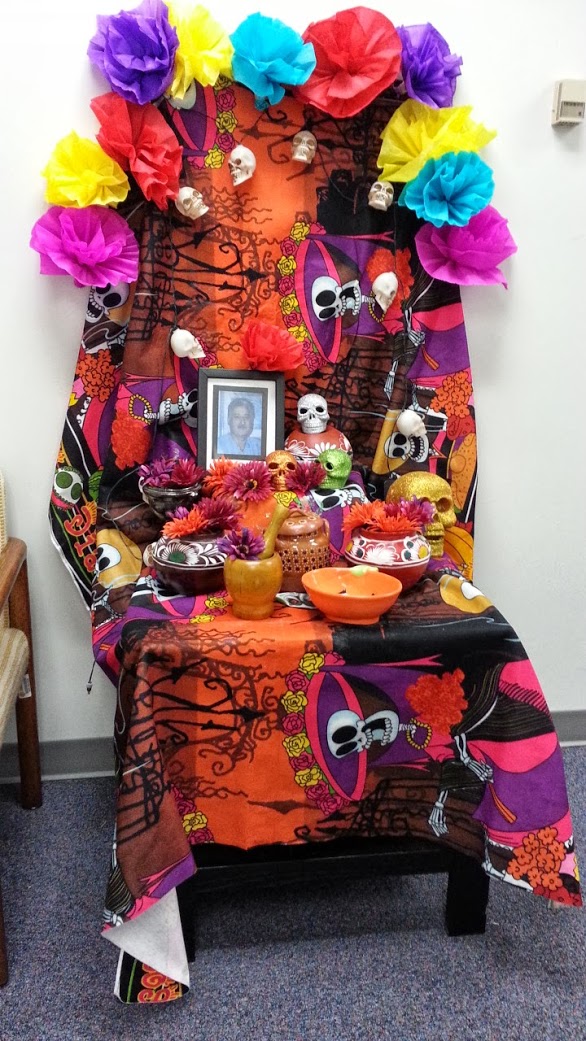
At the Center for Hispanic Marketing Communication at Florida State University, where many of the students are non-Hispanic, Dr. Sindy Chapa erected an altar in the memory of her father as shown below.


Museums around the US have had exhibits of altars for dia de los muertos both to celebrate the culture and to show the folkways of mesoamerica. From Oakland, California, to El Paso, Texas, even to the Idaho Historical Society, museums have in one way or another presented exhibits to mark the celebration.

Skelita Calaveras the Monster High doll created for Dia de Los Muertos has been a great success for Mattel, and the doll has been searched by name extensively in US States with strong Latino presence. As marketers realize the importance of Latinos to their bottom line, almost by accident they also educate the rest of the population about Latino cultural features.

What do all these stories and anecdotes tell us? As Hispanics acculturate they also spread the allure of their customs and beliefs. Acculturation is a two way street in which we learn from each other and find aspects of the culture of others attractive and meaningful. When cultural influence goes beyond the material aspects to the intangible and spiritual, one witnesses a societal transformation that should make marketers think more about culture and the future of marketing.

Thursday, October 24, 2013

The Sound of Music ... and Advertising.

Whether you're Mozart, B.B. King, John Lennon, Hank Williams or Ne-Yo, sitting down to a blank page of music opens up a limitless world of possibilities. Boundless, untapped creativity. The dots you splash on those lines can be the next great ballad or the next great ballet. They can make people laugh, cry, love and dance ... it's totally up to the musician.

That's what I love about what we do. To me, creative is like music.  Eddie Wilson in the movie Eddie and the Cruisers said, "words and music, man - they need each other." I couldn't agree more. But so do words and images.

I share this rant because I just heard about an interesting client conversation. They didn't want to provide too much creative input because they didn't want to stifle the creative process. In essence, they were providing blank sheet music and asking us to write the next great song.

Which is GREAT!!! No creative wants everything dictated to them. BUT...we didn't know if we are writing a love song, pop song, western or jazz.

For advertising, the strategy is like providing the stye to a musician. It provides the ground rules that allow creative to flourish. Yes...creative DOES need rules. Are we writing an eight-bar blues riff? A concerto? Will it be acapella? We at least need to know what instruments to include.

And within each musical style, the creativity is varied by tone. How do we want people to feel. Is it reminiscent? Inspirational? Foreboding? Your advertising creative needs a defined tone too.

You can give 100 musicians the same 8 notes and you'll hear 100 totally different tunes. They just need to select a style and define a tone.

Give 100 writers and designers the exact same well-defined strategy, and you'll get 100 different well-positioned ads. If you truly want to set your creatives free to keep their feet on the ground and keep reaching for the stars, give them the freedom of a tight strategy.

For the cheat sheet to a tight strategy, click here: 


We bring these marketing philosophies to credit unions and community banks nationwide, and would love to bring them to your institution too. Contact us to see how.

With more than 272,000 visits worldwide, we hope that you enjoy this blog.  If you find it helpful, please share it with your colleagues. Also, check out our YouTube Channel for short video blogs about financial marketing.  

MarketMatch is also a nationally and internationally requested speaker. Contact us to bring our marketing ideas to your next conference.

937-426-9848
Follow me on Twitter @egagliano

Thursday, September 19, 2013

Salsa, Tortillas, Dulce de Leche, and now Hugs

I read in the Wall Street Journal (September 14 - 15, 2013*) that hugs are an issue now in the United States as many more people hug than ever before.  My first reaction was that as tortillas overtake white bread and salsa overtakes ketchup, hugs overtake social distance.  Is this the Latino influence? Now the WSJ article talks about how to defend yourself from huggers. That is a serious departure from the nature of hugging in Latin America and other "hugging" regions of the world where the hugging is seen as a welcome sharing of human warmth and reassures people of their relationship.

When I was young, in high-school and then in college in Mexico, every day, I had to hug and kiss many women, which I thought was nice, and hugged many men as well, which I felt were my dear friends. It was routine, the business of social life.  You hug those you care for and those you want to keep as part of your circle of friends.  Also, it felt good. It was reassuring. I felt I belonged.

Hugging feels good.  It releases chemicals in our body that make us feel good. A most interesting substance is oxytocin which contributes to our social happiness and well being. It is known to be released when people touch and hug and helps people bond together.  Hispanics are good at this. I believe this is an important contribution that Latinos and other "hugging" people are making to US society.

Chipotle, mango, salsa, papaya, tortillas, cilantro, yuca, and many other flavors are clearly now part of the mainstream. Also, Latin music and architecture have become part of the American mainstream.  But that is only the part of the culture that is clearly observable.  What about the less observable parts of the culture?  What about the subjective culture composed of values, ideas, attitudes, and ways of thinking? Hugging is part of the subjective culture that is now influencing the United States. Subjective because it emanates from primitive impulses, beliefs, and values that take us back to our origins.

Marketers ought to consider that the most powerful insights come from those attitudes, beliefs, values, and perceptions that are transmitted via our cultural groups but that are hidden from view. Hugging is visible, but not its motives and consequences. Touching produces a different social structure. Marketers can capitalize on those motivations and the effects of touching and hugging (haptics) by establishing connections associated with their brands.

Human contact feels good and makes people happy.  Clearly, it has to be appropriate, but Latin Americans don't worry about that. They know when the toucher is a creep.  In low contact cultures any contact can be misinterpreted.  But in high contact cultures contact means care and affection. As we move into a more touch oriented society in the US, our ways of behaving, thinking, and feeling change as well.

Now that Latinos have influenced the US culture beyond imagination, it is not only with the material things of life where Hispanics are making a statement but also with emotions. While marketers have long thought that differences in culture are apparent in the numerous manifestations we observe, now we need to take notice of the more hidden aspects.

Marketers do not only capitalize on high contact cultures when understanding their motivations and bonding feelings, but they may now have a "total market" approach in their hands. Hugging will likely transcend cultural groups.

The author of the WSJ article was trying to help others with larger personal space needs to defend themselves from the rising tide of huggers. Well, another take on the trend is that it is good for you and potentially excellent for marketers who understand cultural patterns.  

In Hispanic Heritage month let's celebrate hugging and all that comes along with it.

______________________________
*"The Delicate Protocol of Hugging: For fans of personal space, these are difficult times: America has become a nation of huggers" by Peggy Drexler

Thursday, September 12, 2013

Don't Begin Your Next Planning Session Until You Can Do This!

The Super-Duper Credit Union/Community Bank member/customer is family focused. She is a married woman with a good job, but (combined with her husband's income) making just enough to support her family's comfortable lifestyle. She has one or two young children and a husband who likely earns a little more than her. They live in a 2 bedroom home in a middle class neighborhood with lots of swing sets and have been there for 5-10 years.

Retirement seems like a pipe dream. Though they invest a little through their employers, it is not the focus. They are more concerned with meeting monthly bills and still squirreling away some savings for their children's future college bills - who's majority will ultimately be financed through student loans.

Her time is divided by maintaining a career that she is proud of, raising children that she loves dearly, supporting her kid's activities, volunteering for community groups, exercising 3-4 times per week, and trying to salvage a relationship with her husband, family and friends where she can find time. She has replaced time on the phone with her friends with frequent pictures and updates of the kids on Facebook.

Because her husband is "busy earning more," or because she's more responsible, she's in charge of most of the family finances. While she is technologically savvy, she received her first email account when she started her first real job, about 20 years ago. That said, she writes more checks than she probably should but is beginning to see the efficiency of online banking and starting to trust it more. She's certainly not an early adopter of technology - but she LOVES her i-Phone.

Though she and her husband each switch cars every 3-4 years, they do not lease. They want the look and amenities of a BMW or Mercedes without the hefty monthly payments.
---------------------------------------------------

The off-site hotel is set and the golf reservations are made. You know how you'll entertain your Board and they are looking forward to a weekend together. Now, it's time to begin the REAL pre-work to your planning session.


As credit unions and community banks, everything we do is 
built around our members and customers ... EVERYTHING!  

You, of course need to be prepared to talk business: How will we decrease loan loss while still being open enough to grow the portfolio? How will the health care act effect us? How do we increase non-interest income without establishing big-bank fees? Are there new markets that we should look at? Do we want to merge (or be merged)? Are we over or under staffed?

This is all vital to discuss, but before you break into THAT agenda ... think about who you're doing it for.

Can you tell a story like the one above? You need to!

The days of being all things to all people is over. Your margins shrank years ago and have little promise of coming back any time soon. Your marketing budget isn't limitless. You need loans NOW and your 65 plus year old members simply aren't borrowing like you need.

So you need to focus! You need to determine who in your market(s) you are attracting now and who you WANT to attract. You need to understand your best customers and what makes them the best. Then learn everything you can about them. 

When you can tell a story about your customer: where they live, where they work, what they do for fun, what drives them, what they fear, what they care about ... then you can start making strategic decisions on your product suite, pricing, branching, tech investments, your website, and your marketing message.

Related Articles:
The Great Storyteller Gets the Audience
You'll Never Get Everyone to Love You
Mirror Mirror

We bring these marketing philosophies to credit unions and community banks nationwide, and would love to bring them to your institution too. Contact us to see how.

With more than 260,000 visits worldwide, we hope that you enjoy this blog.  If you find it helpful, please share it with your colleagues. Also, check out our YouTube Channel for short video blogs about financial marketing.  

MarketMatch is also a nationally and internationally requested speaker. Contact us to bring our marketing ideas to your next conference.

937-426-9848
Follow me on Twitter @egagliano