Showing posts with label Finance. Show all posts

Wednesday, September 5, 2012

Language Preference of Hispanics and Perceptions of Financial Well Being: Implications for Marketing

To what extent has the financial situation affected the perceptions of financial well-being of Latinos depending on their language preference? This question has implications because the answer may impact the way in which consumers make purchase decisions.

Language preference among Hispanics has been considered a proxy for acculturation. It is also an indicator of the many aspects of life that impact Hispanics from media preferences to interpersonal interactions. The anti-immigration sentiment prevalent in many circles in the US these days has hurt recent immigrants in particular. In addition, economic circumstances in the past few years are likely to have affected Latinos differentially depending on their integration in the US.

Using data from the Simmons National Hispanic Consumer Study that was collected in the twelve months ended on March 16, 2012, I created crosstabulations of language preference by financial outlook among Hispanics. Language preference was gauged as the language the respondent prefers to speak in general and the response categories were Only English, Mostly English but Some Spanish, Mostly Spanish but Some English, and Only Spanish. For this analysis I collapsed Only and Mostly English and Only and Mostly Spanish to form the preferences for English or Spanish.

The financial outlook dimension was measured with the question: Do you think you are better off or worse off financially now than you were 12 months ago? The response categories were Significantly Worse Off, Somewhat Worse Off, About the Same, Somewhat Better Off, and Significantly Better Off. For the purposes of this analysis I collapsed those who answered significantly and somewhat worse off, and those who answered significantly and somewhat better off to result in three categories: Better Off, About the Same, and Worse Off.

The resulting “average” table is presented below:
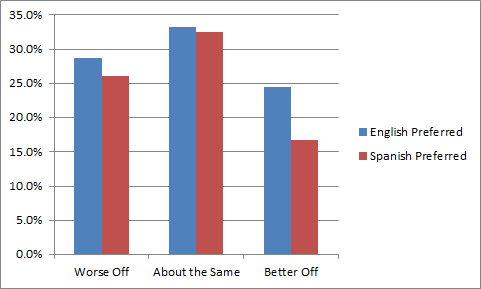


The plurality, over 30% of Latinos indicate that their financial situation is about the same as it was 12 months ago. This can mean different things.  It can mean that things have not improved or that things have been as good as they were a year ago. Given the economic situation the US is going through, most likely it means that things have not improved but not gotten worse. Also, the “fatalism” prevalent in the culture may lead many to express that things are the same as usual and that in the average there is no change.

English preferred Hispanics, however, have a much more positive perspective than Spanish preferred Latinos as a substantively larger percentage of them indicate they are better off now than 12 months ago than their Spanish preferred counterparts. This may not be completely surprising since Spanish preferred respondents are more likely to be more recent immigrants and also more likely to suffer the consequences of immigration policies. These more recent immigrants are also more likely to have suffered from lack of work due to the lack of jobs in industries like construction that have traditionally employed many recent immigrants from Mexico and other parts of Latin America.

In a somewhat contradictory fashion, a few more English preferred Hispanics also report being worse off now than Spanish preferred respondents, but the differences between these two groups are very small. What is interesting is that over 25% of Latinos feel things have been worse for them in general. While not surprising, these figures bring home the notion that the economy and immigration related issues are likely to have made life worse for many Hispanics who try hard to make a living for themselves and their families.

The news for marketers are mixed.  The majority of Hispanics feel they are better off or about the same as they were 12 months ago, and that is good news as that means that spending by most Latinos is likely to continue at a sustained pace. The negative news are that a substantial percentage feel the brunt of pervasive immigration and economic conditions and that their spending may be limited by their actual and perceived spending power. This brings about the importance of making politicians aware that the uncertainty of immigration reform needs to be removed for economic growth. The clarification of immigration policies and rules is likely to make the future more predictable and optimistic for many. Also, as in the overall economy, job creation should be a most important priority.

The data used here is from the Simmons National Hispanic Consumer Study and collected from January 31, 2011 to March 16, 2012. The sample contained 3,518 English preferred Latinos, and 2,104 Spanish preferred Hispanics.

Tuesday, April 24, 2012

Where Does Marketing Fit in the Org Chart?


Ahh …. What to do with Marketing?!?!

Who should you answer to?  Who are your best friends?  What department are you closest aligned with?

As marketers, we’ve all been called “crazy.”  And you know what?  They’re right!  We’re absolutely, out of our mind, certifiable … in one very specific area … we all NEED split personalities.  We must think like a CEO, CFO, Retail Manager, Lender and Commercial & Investments gurus … and still be the Marketer with the great ideas.  We are the one department who needs to be comfortable in EVERYONE’S office and who should visit each office regularly.

CEO
Everything we do as Marketers needs to be aligned with the business objectives of the bank or credit union.  The very first question we should ask in planning is, “what will our institution consider success at the end of the year.”  Then, we need to track and report the progress against those objectives regularly. 

We also need to make sure that the brand we portray is in line with the direction that the Board and CEO have set for the institution.

FINANCE
We need to think like a CFO.  Based on ALCO decisions, what products do we need to be focusing on?  You should be meeting with your CFO during planning to agree on variables to include in ROI analysis.  Then, meeting regularly to discuss any changes in the financial situations of the institution or market.


As Marketers, you should be able to look at your Call Report and make some educated assumptions on direction and easily gain specific tracking data.

RETAIL/OPERATIONS
Marketing must be involved in branch-level training and processes.  How do your campaigns affect the branch delivery?  How can you work together with Operations to streamline processes and improve the customer experience?  What do the branches see that can give you ongoing insight into changes in market conditions, perceptions and needs?  Does the team need more effective tools to facilitate meaningful conversations and better discuss what we have to offer with customers?

Our branches are often Marketing’s greatest allies.  It’s not just our job to drive traffic to them; it’s our job to help maximize every interaction at them.  A close connection with the Operations people will help you to keep your finger on the pulse of the institution.

LENDING
Certainly it’s our job to increase loans with existing customers and drive new interest from potential customers.  But which loans and to what audience?  A close relationship with your Lending Manager will help you to understand who to target.  Who are you likely to approve or deny … and why? 

COMMERCIAL/BUSINESS DEVELOPMENT
Commercial is a personal sell.  The most successful Commercial and BD professionals leverage one-on-one relationships with businesses.  But communication and targeting are still involved.  Marketing can help Commercial in identifying the best companies to pursue, acquiring new business and growing existing business.  We can provide communication campaigns to specific industries or produce materials for one-on-one meetings.

INVESTMENTS
Like Commercial, Investments are a relationship-driven department.  And, like Commercial, the Investment folks should be partnering with Marketing for more efficient growth, segmentation, communication and measurement.

Between regular meetings with the CEO, CFO and the rest of the Senior Management Team and your continued visits to the branches to talk with front-line staff, the Marketing Manager should rarely be found at their desk.  We are literally the tie that binds all of the financial institution’s departments and initiatives. 

Where does Marketing fit in the org chart?  Smack-dab in the middle!  Driving growth everywhere and being included in most major decisions.

-------------------------------------------------------------------------------

MarketMatch is a full-service marketing firm, dedicated to the credit union and community banking community.  We utilize knowledge-based strategies to help you FOCUS on the efforts that will generate the greatest  MOMENTUM for your organization and demonstrate RESULTS with our written ROI Guarantee.

Want to learn more?  Enroll in the MarketMatch eCollege!  Smart online sessions delivered with CFMP credits, tactical advice and a game plan for success!


Wednesday, January 14, 2009

How A Marketer's Life Imitates The High Hurdles

If there's one thing I've learned as an elite high hurdler in USA Track & Field's Masters Division, it's that the fastest or most agile opponent doesn't necessarily win the race.  To be truly successful the hurdler must master the five fundamental skills: speed, agility, flexibility, focus and endurance.  And in a race that is sometimes decided in hundreths of a second, failure in one of the five elements will leave you off the medal stand.

As a marketer, I always try to look at both myself and the company through these five filters in everything I do.  Because a subpar performance in any of these five areas can quickly derail even the best laid plans.

Speed:
In today's world, information flows at the speed of light.  Technology has changed our world forever.  Does the corporate culture and management structure at you institution allow for fast innovation as market or competitive situations arise?  Or is it the corporate equivalent of turning an oil tanker?  It used to be that the big ate the small.  Now the fast eat the slow.  As a marketer, it is incumbent upon you to look for ways to streamline processes that will allow for your institution to quickly react to market conditions whether it be to communicate with customers, introduce new products or to promote your standing in the marketplace.  Transform your institution from being innovative to one whose being is innovative!

Agility:
Changes in the financial marketplace are a daily occurrence--whether its interest rates, TARP news, deteriorating trust in banks, etc.  How agile are you and your institution to these changes?  As a marketer, do you wait for direction from your ALCO committee or are you part of the process?  Are you ready to go to market quickly when faced with a declining or rising interest rate environment?  Are you proactive or reactive?  Are you ready to deal with these hurdles before they happen?  If you assume and prepare for the worst-case scenarios you will be ahead of the curve--and the competition.  And as the old saying goes: "unless you're the lead dog on the dogsled team then the scenery never changes."

Flexibility:
For financial institutions, new deposit generation is king in terms of liquidity and funding loans.  And like in today's real estate market, deposits are a buyer's market.  Now, more than ever, you need to retain and grow your best customer relationships to ensure future profitability and institutional viability.  Do you have the flexibility to offer your best customers better value for their business loyalty in the form of discounted or relationship pricing based on their account balances and number of products?  Do you coddle and nurture your best customers to make them feel special?  Do your marketing plans have the flexibility to adapt to rapid market changes?  Are you creating those barriers to exit for customers so they won't abandon you for 25 bp?  Not being flexible in today's business climate is the equivalent to showing the customer the exit door.

Focus:
Keep your eyes on the prize!  With all the chaos in the financial marketplace, focus on the two most important elements to success: giving your customers a compelling reason to stay and your prospects a compelling reason why your institution is their best choice.  And that involves three critical factors: innovative products and services, outstanding customer service and instilling a high level of trust as a financial advisor in customers and prospects.  In short, treat people as you expect to be treated--with respect and trust, and reward them for their loyalty!

Endurance:
Today's financial battlefield will be a protracted event that requires the utmost endurance in order to survive and prosper.  There are no magic wands, silver bullets or quick fixes.  Even if you mastered the other four disciplines, the lack of endurance will cause you to stumble over the final hurdle.  Long-range strategic plans and yearly marketing plans will need to endure through all kinds of financial events--both known and unknown.  Nothing can be set in stone. As you eye the finish line, never lose sight of what lies between the starting blocks and your ultimate goal.  And with that, I'll leave you with this quote from the Chinese Taoist Philosopher, Lao Tzu, "If you do not change direction, you may end up where you are heading."

Cheers,
Nick Vaglio, CFMP


Friday, December 5, 2008

Smarter...Faster...Better

In the current global financial crisis, the average worker is being asked to produce more in the same amount of time at basically the same salary.

Today’s bank marketing professional faces a similar dilemma.  In an era of shrinking budgets and ever increasing responsibilities, we are being asked to produce more with greater results and to do it in less time with fewer dollars.

Now more than ever, bank marketing professionals must search for innovative ways to work smarter…faster…better!

Smarter...

  • Acquire the market and industry intelligence and knowledge to enable you to become a “smarter” strategic partner to your customers
  • Acquire new customers more efficiently and cost-effectively through better targeting and more innovative profiling of prospects
  • Apply more clever and creative tactics in order to outsmart the competition.
Faster...

  • It used to be that the big ate the small.  Now the fast eat the slow!
  • In today’s connected world, customers expect products, services and information to be delivered in a fast, convenient and hassle-free way. 
  • The ultimate profitable survivors in the highly competitive financial services industry will be those who react the fastest to market and competitive conditions with the right products and services to meet the exact needs of customers
Better...

  • Your people, products and customer service must be better than the competition in the eyes of customers and prospects
  • Companies that have earned the reputation of being better than their competition recognize that it is a daily process.  One bad day can begin to unravel a long-term positive effort.
  • Bank marketers must get better at recognizing where profitable opportunities lie before everyone else does

While this may be easier said than done, we owe it to our customers and employers to work a little smarter, faster and better than the competition to deliver the results we all need to keep growing in a trying economy.

Cheers

Nick Vaglio, CFMP