Showing posts with label Korzenny. Show all posts

Monday, November 25, 2013

Online Courses on Hispanic and Multicultural Marketing Open to All This Spring 2014

Register by December 1, 2013. 


fsu1.gifThe Center for Hispanic Marketing Communication at Florida State University offers the following online courses Spring 2014:

  • Hispanic Marketing Communication (graduate)
  • Hispanic Marketing Communication (undergraduate)
  • Account Planning (undergraduate)
  • Multicultural Marketing Communication (graduate)

These courses can be taken by themselves or as part of the undergraduate or  graduate certificate in Multicultural Marketing Communication. The links provided above lead to the certificate requirements that include descriptions of each one of the courses.


 Hispanic Marketing: Connecting with the New Latino ConsumerThe courses start on January 6th and run until May 2nd, 2014.  Professionals, interested individuals, and students at other universities, who would like to participate in the Certificate programs or just by taking one or two of the courses are encouraged to apply. Online discussion boards allow for the exchange of ideas and  networking opportunities. The courses are asynchronous so students can work when their schedules allow.


For admission requirements CLICK HERE.   For more information about admissions please write or call: 

Anthony McDonald     
abmcdonald@fsu.edu             


The application deadline is December 1, 2013, so act soon.


Watch this video for more information   CLICK HERE.

Visit the Center's site at http://hmc.comm.fsu.edu 


Friday, August 23, 2013

Fashion, Style, and Culture: The Case of US Latinos

Retailers often talk about how Hispanics are different in their approach to dress, clothing, and fashion. There has been coverage in the press about how some shopping centers are morphing themselves into Latino shopping centers to better serve their local communities and stay in business.

From casual observation I know that Hispanics dress up to go out on the weekends and kids are very well dressed to go to church and other activities, even when going on airplanes. The attention to dress and detail to style is apparent in a great number of cases. Many Latinos spend much of their leisure time in stores and malls enjoying their free time with their families and becoming informed about fashion and style. I have observed the more sensual approach to dressing by both Hispanic men and women. What are the attitudes that underlie this attention to style and fashion?

To answer the above question, I used the data from the Experian Marketing Services Simmons National Hispanic Consumer Study, that was collected between January 30, 2012 and March 13, 2013. The chart below shows differences in “any agree” (agree a lot plus agree a little) with the attitudinal statements about style and fashion with which Latinos were more likely to agree:
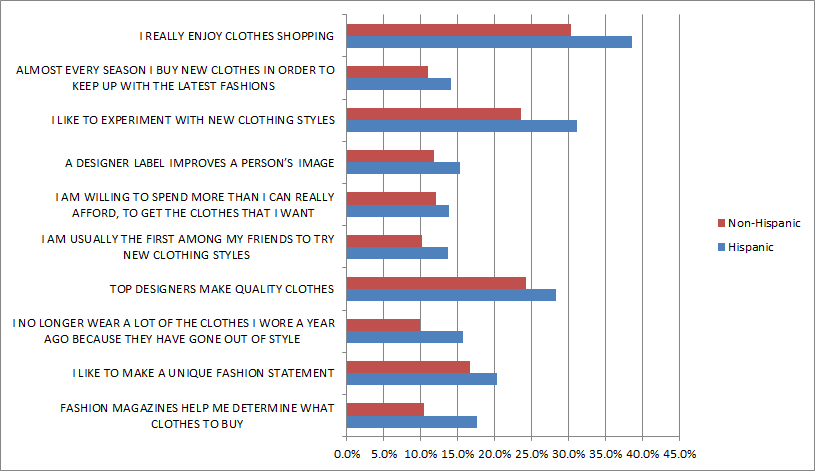


As observed above, Hispanics are more likely than non-Hispanics to be feel they are opinion leaders about clothes and fashion. They also are more likely to trust top designers and to trade up to newer designs faster than non-Hispanics.

Latinos are more likely to be influenced by fashion magazines and most importantly, Latinos enjoy more the activity of shopping for clothes. And Hispanics are also more experimental in the approaches to clothing and style.

What does these trends tell us? I think that Latinos are now influencers in fashion that need to be carefully watched as their tastes and preferences evolve. Marketers need to be pay attention to these trendsetters as their numbers and influence increases in the US.

Further, the eagerness these Hispanic consumers show to be in style, corroborates that merchandising for them is not necessarily the same as what is traditionally done for the rest of the population. Interestingly, the contrast of the attitudes on which non-Hispanics exceed Hispanics are interesting as documented in the chart below:
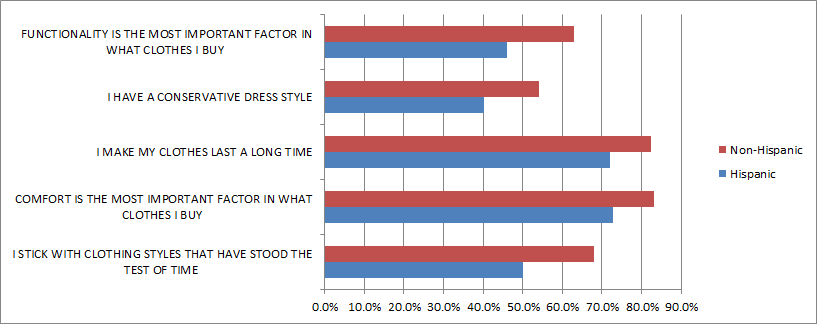


As can be seen non-Hispanics are the ones who are more likely to express conservative style and clothing attitudes. This trend adds evidence to the observation that Latinos are more likely to lead in dress, fashion, and style.  In terms of profitability and trend making marketers need to be be aware of the differences that Latinos represent for the future of their brands and retailing activities.

Clearly, examining the trends in the charts above suggests that conservatism is in general a more pervasive trends that leadership and innovativeness.  The percentages of conservative attitudes are higher. Still, where Hispanics excel is in having larger minorities that express an eagerness to change and innovate regarding style.

What can marketers do? Include more Latinos/Latinas in their approaches to marketing, regardless of whether or not their approach is a “Total Market” or more targeted approach. The voice of Hispanics needs to be over-represented in strategies that are forward looking. Further, Latinos need to be considered as opinion leaders and co-opted to represent your brands as they are more likely to genuinely embrace innovation and change.

The moral of the story is that there is no general market and that Latinos are shaping marketing futures.

The data used here is from Experian Marketing Services’ Simmons National Hispanic Consumer Study of adults 18+ -and was collected from January 30, 2012 to March 13,, 2013. The sample of Hispanics contains 7,982 individuals and the non-Hispanic sample has 16,870 people.

Friday, May 10, 2013

Brands Make a Difference: Latinos Over Index in the Hair Styling Product Category


I have been conducting ethnographic interviews with Hispanics in the last several months and have visited many homes and talked to many Latino women. I have looked at their bathrooms and bedrooms and have seen many of the products these families use for styling their hair. I got the impression they are very much into the hair style product category, but qualitative observations can only go so far in terms of making generalizations about the population.  

To check my impressions I looked at data from the Experian Marketing Services Simmons National Hispanic Consumer Study that was collected in the twelve months ending on November 30, 2012, and confirmed that my impressions were on the right track.

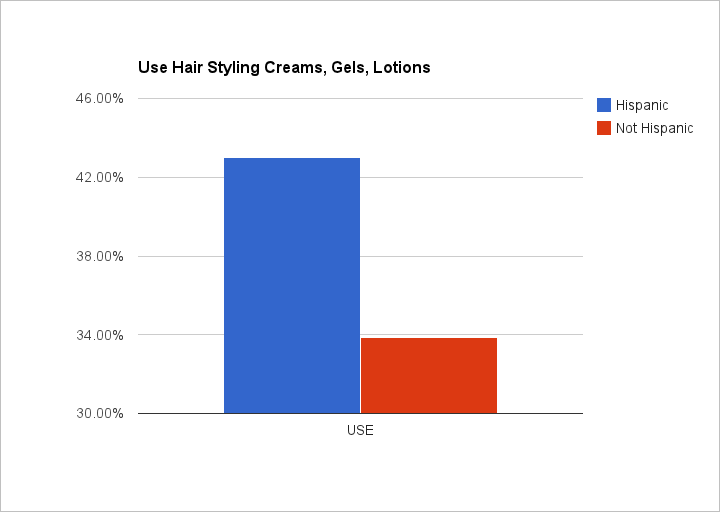
As can be seen in the chart below, 43% of Latinos use hair styling products while only 34% of non-Hispanics use them.


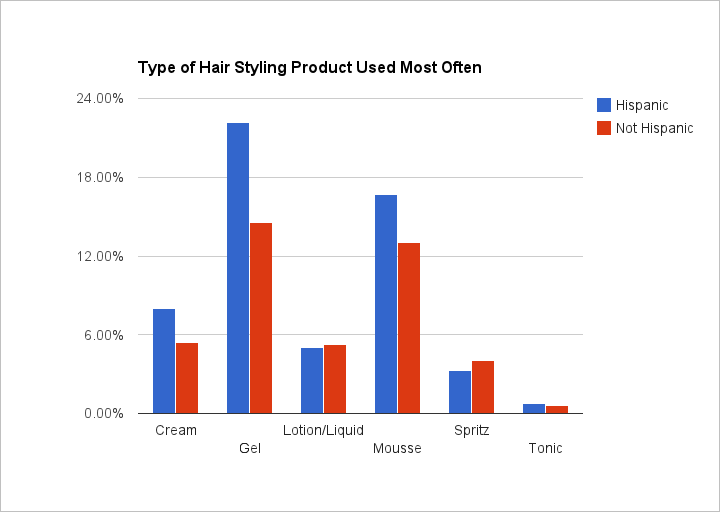
Clearly, there are several reasons why this may be the case, including the fact that Latino adults have a median age that is about 10 years younger than the overall population. Also, we have discovered over the years that Latinos enjoy being well groomed in their everyday life. Further, their grooming customs come from their countries of origin where cultural patterns are strongly ingrained. Now, are all hair styling products equally used? As can be seen below there are products that are more heavily used than others.


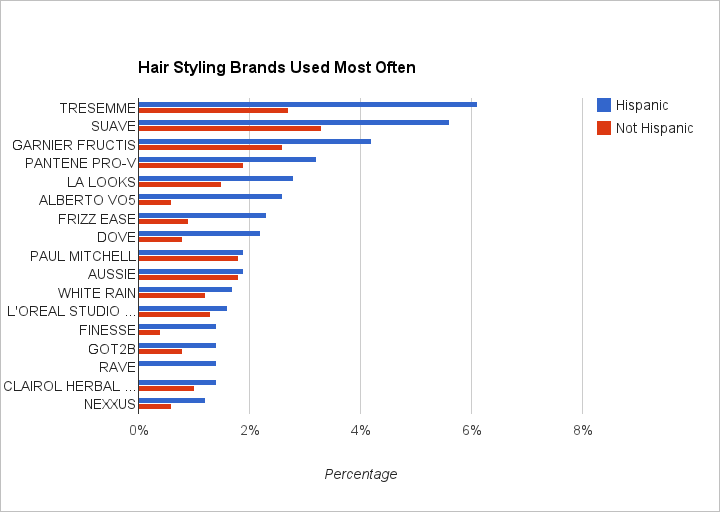
Gel and mousse are by far the most popular hair styling products among Hispanics, and in general their use is in line with the overall population pattern of usage. Nevertheless, Latinos over-index quite dramatically in the both categories. But what brands are more popular? As can be seen in the chart below, consumers are quite divided among the different brands they use most often and the chart only includes the brands that have more than 1% usage among adult Hispanics. Still each for each of the top brands, Latinos exceed their non Latino counterparts. There are cases in which usage is triple among Hispanics, such as in the case of Alberto V05, and double such as in the case of Tresemme, or substantially higher like in the case of Suave.


The lesson I learn is that some of these brands may capitalize on making a serious effort to further their share among Hispanics. Particularly promising are brands with Latin American heritage and with names that are culturally compatible, like Tresemme, Alberto VO5, Suave, and Pantene.  In the age of social media, and knowing that Hispanics are particularly keen in the use of this technology, reaching out to Latinos with brand experiences that are appealing, informative, and seductive can render a large return on relatively modest investments.

Large media, like television, can also make a major difference with advertising  and branded entertainment. Ultimately any brand that makes a serious effort can find creative ways to connect culturally, for example, by attaching symbolic handles to their brands that Latinos can relate to.

The data used here is from Experian Marketing Services’ Simmons National Hispanic Consumer Study of adults 18+  and was collected from October 24, 2011 to November 30, 2012. The sample of Hispanics contains 8,521 individuals and the non-Hispanic sample has 17,043 people.

Tuesday, December 4, 2012

Language Preference for Television Watching by Latinos of Different Socioeconomic Levels

It has been of interest to me to explore how socioeconomic level relates to different consumer and media behaviors of Latinos in the United States. As media outlets become more abundant and as Latino growth shifts to births as opposed to sheer immigration, it is relevant to learn more about how to target Hispanics of different socioeconomic levels. In this particular instance, I am exploring the television watching behavior of Latinos according to their language of preference depending on their socioeconomic level.

Using data from the Experian Simmons National Hispanic Consumer Study that was collected in the twelve months ending on August 31, 2012, I created crosstabulations of the TGI Socio Economic Scale in the Simmons database by preference to watch television “Only in English,” “Mostly in English but Some in Spanish,” “Mostly in Spanish but Some in English,” and “Only in Spanish.” The television language preference variable in the analysis combined those who watch “Only in English” and “ Mostly in English but Some in Spanish” in one group, and those who watch in “Only in Spanish” and “Mostly in Spanish but Some in English” in another group.   Respondents stated their preference when reacting to the statement “When you watch television do you prefer to watch television programs...” The TGI Socio Economic Scale is a composite of education, ownership of selected household durables, mobile phone ownership, credit card ownership, usage of Internet and air travel. The scale results in four levels of socioeconomic standing: The top 10% of the population, the next 20% of the population, the next 30% of the population, and finally the remaining 40%.

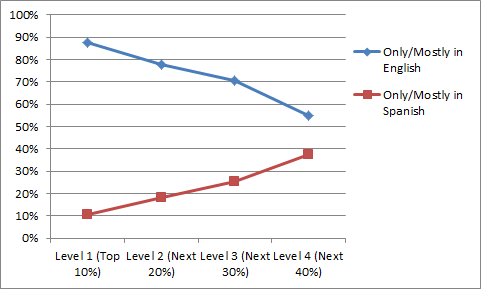
The following line chart illustrates the trends uncovered:


As can be observed, the lowest socioeconomic level of Latinos is more likely than anyone else to prefer watching television in Spanish, although a substantive percentage of them also indicate preferring only English or mostly English television exposure. The percentages of Hispanics at this lowest level are more equally divided among language preferences than for any other socioeconomic level. Those in Level 3 are more polarized than the lowest level as their percentages are more divided between the two languages. The polarization increases at Levels 1 and 2 as they are more dramatically divided and in the large majority they prefer television exposure in the English language.

Overall, there is a tendency for those better educated and more affluent to prefer television in the English language and for those who are in the lower levels to be more oriented to the Spanish language. It is also likely that those in the higher socioeconomic levels are more acculturated into the US. The tendencies are almost linear and monotonic.


These trends point to the dynamics of the Latino market and its complexity.  While the preference to watch programming in the Spanish language continues to be important for a substantive portion of the Latino population, it is not a uniform tendency.  This is clearly due to the fact that with so many channels in English, Latinos simply find more offerings in English than in Spanish.  It is likely that the diversity of content in English drives some of these trends.  Those more affluent can be expected to have more choices of channels for the enjoyment of television programming and that may explain some of these preferences. Also, at the lower levels there are those who have been born in the United States that share their socioeconomic level with newer immigrants.  That makes for an interesting mix of acculturation stages that affect television language preferences.

Further, as Latinos become more able to appreciate content in English, their content horizons seem to expand. Socioeconomic status and bilingualism and English fluency are related.

Marketers can take from these findings important lessons and cautions:

1. Media planning is not straightforward.  Socioeconomic level plays a role and thus different types of products may do better on English language television platforms, and others on Spanish.

2. A mix of language television platforms may be appropriate for many advertising campaigns as television language preferences, particularly at Levels 3 and 4, are more divided. They represent 70% of the Latino population.

3. Language preference for television watching may not be indicative of assimilation but of content availability and content preferences.  Thus cultural insights should likely drive marketing and advertising campaigns.

This data confirms the diversity and complexity of the Latino market and the importance of sophisticated media planning efforts.

The data used here is from the Experian Simmons National Hispanic Consumer Study and was collected from August 1, 2011 to August 31, 2012. The sample contained 8120 Latinos.

Wednesday, October 31, 2012

Hispanic Attitudes and Behaviors by Socioeconomic level: Implications for Marketers

When talking about US Hispanics marketers seldom explore socioeconomic level as it relates to their attitudes and behaviors.  For me this is a most interesting relationship because if, for example, Latinos hold cultural attitudes in the same esteem regardless of their social standing, then one may conclude that one marketing approach may reach diverse types of Hispanics.
What should the marketer tell Hispanic consumers when selling a new Toyota Camry? Or what should the marketer tell Latinos when selling diapers? Should the communication and positioning approaches used be equally crafted to reach the Hispanic that can afford a new relatively expensive car, or a more common product like diapers?
Using data from the Experian Simmons National Hispanic Consumer Study that was collected in the twelve months ending on June 1, 2012, I created crosstabulations of the TGI Socio Economic Scale in the Experian Simmons database by those “agreeing a lot” with cultural attitudes and behaviors that will be specified below.  The TGI Socio Economic Scale is a composite of education, ownership of selected household durables, mobile phone ownership, credit card ownership, usage of Internet and air travel. The scale results in four levels of socio-economic standing: The top 10% of the population, the next 20% of the population, the next 30% of the population, and finally the remaining 40%.
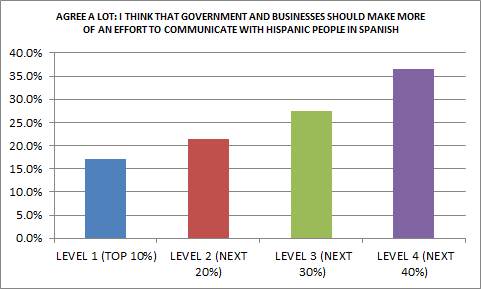
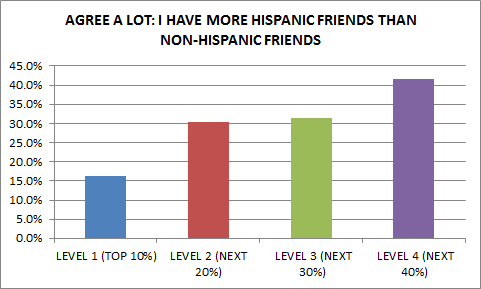
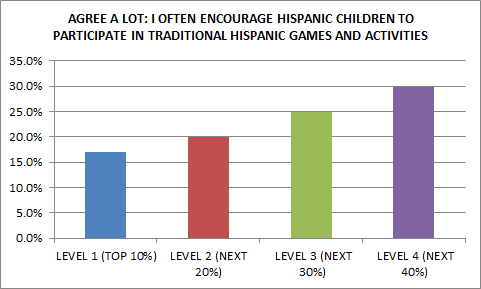
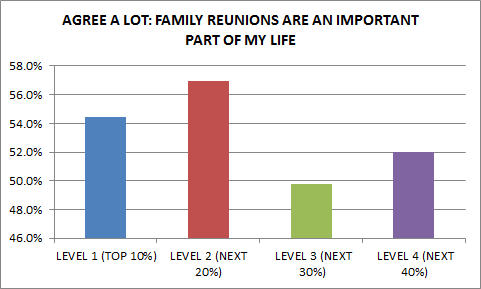
The bar charts below report the percentage of Latinos in each of the Socio Economic Level that stated they “agree a lot” with each of the cultural statements.
The way to read these results is, for example:  Of those Latinos that are in the lowest 40% of the TGI Socio Economic scale, 30% “agree a lot” with “I often encourage Hispanic children to participate in traditional Hispanic games and activities,” and 25%  those in the next higher 30% level state they “agree a lot” with the statement.  Twenty percent in the next higher level and only about 16% in the highest Socio Economic level similarly “agree a lot.”   Meaning that strong agreement with the statement is heavily concentrated in the lower socioeconomic classes. There is a monotonic trend that indicates that as Socio Economic Level rises, attitudes and behaviors endorsing Latino cultural elements decrease. There are other attitudes and behaviors that do not conform with the above trend, for example:


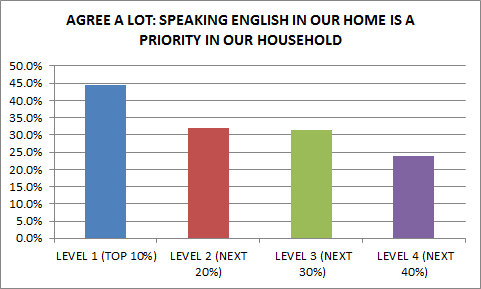
The cultural value of being gregarious and enjoying family and extended family appears to be consistent across Socio Economic Levels, and to an even higher extent at the upper levels of the Socio Economic scale.  In general, however, the percentages are very high and they speak more readily about how certain cultural values persist even as people become wealthier and more educated. It appears, then, that some values and behaviors decline as Hispanics climb the social ladder and others persist regardless. This highlights the complexity of the Hispanic market. Further, those higher in the Socio Economic scale are more likely to endorse values of US society as reflected in the chart below regarding the priority of speaking English in the household.


The findings are consistent and surprising, in my opinion.  Those who are less affluent and less formally educated are the largest share of those indicating they engage in culturally related behaviors as well as holding attitudes and beliefs that are culturally based. Nevertheless there appear to be values that survive Latino prosperity like the value for family get togethers. It may be that those better off have more family around to get together with and that those less well off tend to be more geographically separated because of lack of economic resources.

These findings corroborate what our book “Hispanic Marketing: Connecting with the New Latino Consumer” says about how lower socioeconomic classes are more likely to be attached to their culture to a larger extent. It is also likely that having roots, of any kind, is more important to those who have not fared as well in society. Nevertheless, this data shows that there are exceptions and that more affluent Latinos are likely to endorse US values to a larger extent. That may not be too surprising but certainly the trend points to the importance of Socio Economic Level considerations in marketing to Hispanics.

Another factor to point out is that recency of immigration to the US should be correlated with Socio Economic Level. That may also explain to some extent why lower levels endorse cultural attitudes and behaviors to a larger extent.

The consistencies are important and we will report some more of these in future postings. The trends have powerful implications for those who for example plan business to business campaigns, or plan approaches geared to the more affluent. In a business to business setting, if targeting relatively well to do Hispanic business owners a culturally based approach may not be as relevant as when targeting Latino employees of that business.

Three trends were highlighted here. Specific cultural attitudes and behaviors that differentiate Latinos of diverse levels and that tend to be more strongly endorsed by those in the lower 40%; Other more general cultural attitudes and behaviors that seem to be relevant to all Hispanics; And, a tendency for the better off to endorse US values to a larger extent.

Marketers should, in my opinion, pay close attention to these findings. Marketing in culture may render more robust results when campaigns are directed to the lower socioeconomic strata. It appears that cultural heritage loses some prevalence as Latinos become increasingly affluent. Thus, having a campaign in Spanish with Latino themes for better off Hispanics may not be as productive as once thought.

The data used here is from the Experian Simmons National Hispanic Consumer Study and collected from April 25, 2011 to June 1, 2012. The sample contained 8252 Latinos.