Showing posts with label email. Show all posts

Sunday, June 2, 2013

Maximize Bank Marketing Results With CRM Retargeting

From the beginning of a relationship, banks and credit unions capture and store customer data within a CRM database. This data is often enhanced with transaction history, purchase behavior and contact history and used as the foundation for building models to better target communication through direct mail and email marketing.


But what if you could leverage your offline CRM database for digital marketing campaigns as well, transforming your data into anonymized online segments through a process called data onboarding? These segments would then receive messages as a follow-up to your direct mail and email campaigns, improving all direct marketing results.


In the whitepaper, "Data Onboarding: The Key to a Successful Marketing Kingdom," Epsilon and LiveRamp discuss the benefits of integrating offline CRM data with online digital marketing. "Using CRM data to market effectively across channels is essential for marketers who want to reach their target audience multiple times with engaging, relevant and consistent messaging," says Auren Hoffman, CEO of LiveRamp.

What is CRM Retargeting?


Unlike regular retargeting (covered in Bank Marketing Strategy last October), CRM retargeting uses your internal offline customer and/or prospect database to reach individuals and households online, not just after they visit your website. By 'onboarding' your offline data, you can reach your customer and/or prospect segments with highly targeted display ads appropriate to their purchase history and interests.

CRM retargeting provider ReTargeter founder and CEO Arjun Dev Arora says, “With CRM Retargeting, marketers can seamlessly integrate display ads with their existing email and direct mail initiatives to create effective cross-channel campaigns with ease.”

Simply put, it's the marriage of the precision of using direct mail or email combined with the rich content and context of display - bridging the worlds of offline and online marketing for more successful customer communication. Since not every customer visits your website regularly (if at all), CRM retargeting is a great way to re-engage these customers and welcome them to key areas of your site.


Subscribe to Bank Marketing Strategies

How Does CRM Retargeting Work?

CRM Retargeting (also referred to as Data Onboarding) matches your internal CRM data with online registration information from hundreds of websites to allow marketers to reach a customer (or prospect) as they search the web as a follow-up to an offline campaign as shown below.

While there are several approaches to this matching process, here is how LiveRamp (Direct and Digital Marketing Agency New Control's primary CRM Retargeting vendor) does it:
      • We provide LiveRamp with a client's encoded CRM file safely through a secure upload portal
      • LiveRamp matches our client's offline customer and/or prospect data keyed off either an email or postal address to an anonymous online audience via cookies with extensive coverage and high accuracy
      • LiveRamp places the matched online audience on our client's existing DSP or DMP and the campaign runs in conjunction with a direct mail and/or email campaign
      • Our client's customers see a relevant and timely message supporting other media communications
      • There is no buying or selling of data, cookies do not contain any PII, and no audience information is passed to a third party (thereby adhering to privacy regulations)
Source: LiveRamp (2013)
It is important to note that onboarding data is anonymized -- aggregated based on customer segments (such as customers without a specific product) who will receive a specific message (special offer to open an account). And while each physical address can't be matched to a digital online counterpart, the ability to have customers or prospects who have been marketed through email or direct mail see your display ads as they search the web and brought back to your sales site is a powerful enhancement to your marketing efforts.

What Are The Benefits of CRM Retargeting?


How powerful could CRM retargeting be? According to a recent study by Oracle, 78% of people will research a product over at least two channels before committing to a purchase. Serving a retargeted online ad to those that have receive direct mail or email will remind them of your brand and the product/service being marketed. Retargeting also can reinforce a desired action from the customer without leading to direct mail or email fatigue.

By adding an additional channel to your targeted direct marketing program, you are more likely to reach your targeted audience with their preferred channel. And, each time your audience sees your retargeted ads, your brand gains more traction and recognition. The results is higher click-through rates and increased conversions.


Should Banks and Credit Unions Do CRM Retargeting?


Banks and credit unions have the most thorough and up-to-date customer databases of any industry. In addition, many financial institutions have prospect databases for their primary trade areas that have almost as much valuable data which is the perfect foundation for CRM retargeting.

With most marketing budgets of financial institutions being kept flat or even reduced over time, the importance of using relatively inexpensive marketing tools that can improve ROMI has never been greater. In addition, with every basis point of response rate and account opening rate for direct mail and email programs being scrutinized, the value of a tool that can improve the returns on both channels is well times.

Best use cases for financial institutions include:
      • Leverage CRM retargeting as an enhancement to a direct mail and/or email cross-sell campaign, generating a higher response rate for every channel (see below)
      • Use CRM retargeting to quickly respond to trigger marketing opportunities. Due to the speed and channel benefits of CRM retargeting, this is an excellent way to connect with a customer that has a lifestage, behavioral and/or purchase level opportunity
      • Test attribution models using direct mail, email and online display advertising
      • Leverage CRM retargeting to enhance the power of a prospect direct mail campaign, matching postal addresses to online databases

CRM Retargeting FInancial Case Study


New Control tested the value of CRM retargeting with a client wanting to generate new checking account customers from both current non-checking account customers and pure prospects in current branch trade areas. Rather than simply using saturation mail or traditional targeted direct mail for this effort, we assisted the client by developing three different communication strategies for the proposed target audiences:
      • Direct mail to prospects (50% of targeted audience also included CRM retargeting)
      • Direct mail to current non-checking customers where email address was not available (50% of targeted audience also included CRM retargeting)
      • Direct mail and email to current non-checking customers where email was available (50% of this audience received an email follow-up with the other 50% receiving only direct mail. Both of these sub-audiences had a 50/50 slip of CRM retargeting)
The results of this test showed that the most powerful combination from a ROMI perspective was the audience that received direct mail, email and a CRM retargeted display ad. The segment with the lowest ROMI was the prospect segment that received just direct mail, while the volume of accounts generated from the customer group receiving direct mail was the highest of all combinations. The customer segment with direct mail and email was the second most powerful ROMI.

Overall, CRM retargeting improved the ROMI in every case where used due to the lower cost of engagement and the power of the other channels. CRM retargeting used alone was not effective with any segment in our test.


Selecting a CRM Retargeting Partner


When selecting a CRM onboarding partner, the following questions should be asked:
      • Scale: Look for a partner that has the largest scale of the existing match networks. The best partners should be able to match 30% to 40% of your offline database with online cookies.
      • Accuracy: You should be looking for the strongest 1:1 matching between the offline data and the online network. Inference or model matching may provide a higher match rate, but the accuracy of the match will be less. In financial services, accuracy of the match avoids issues down the road.
      • Security, Compliance and Privacy: Make sure the partner selected has demonstrated experience in handling sensitive CRM data and that they adhere to strict data privacy standards.
      • Integration: Your partner should be integrated into all of the Demand Side Platforms (DSPs), Data Management Platforms (DMPs) and online measurement tools.
      • Speed: Top CRM retargeting partners have engineered systems that allow for matching and marketing within hours. This is important when you are trying to do trigger marketing programs where minutes count.
“CRM Retargeting represents a leap forward in terms of serving the right users the right ads at the right time,” said ReTargeter Director of Marketing Hafez Adel. “It offers the unparalleled ability to leverage a business’s existing CRM to create a compelling new engagement channel that works for both brand advertisers and direct response marketers alike.”

Additional Resources


Cross-Channel Commerce: A Consumer Research Study: Oracle White Paper (March 2011)

Wednesday, February 20, 2013

Competition for Wealth Management Customers Increasing

At a time when retail banks are finding it difficult to achieve pre-recession levels of growth and profitability, the competition for wealth management business has never been more intense. But while increased marketing and significant monetary incentives are being used to lure customers, recent research indicates that organizational barriers remain that could hamper growth. 


A just published Retirement Plans Trend Report conducted by the direct and digital monitoring firm Competiscan found that retirement rollover direct mail, electronic media and digital communication volumes increased during the second half of 2012 as did the value of offers used to entice customers. While many of these offers came from investment firms, more marketing was done by traditional banking organizations than in the past. 

In 2012, Bank of America was one of the most aggressive wealth management marketers, cross-selling the services of their brokerage unit, Merrill Lynch to current higher value bank customers and prospects.

Bank of America/Merrill Lynch Cross-Sell Mailing (December 2012)
"Over the past couple years, we have seen more banks use targeted direct mail, email and digital communications to encourage 401(K) and other retirement rollovers from both customers and prospects", stated Richard Goldman, CEO and founder of Competiscan. "We have also seen the amount of incentive increase, indicating a greater focus on the affluent customer and the $200K+ rollover relationship."

Offers over the previous six months have ranged from $100 to as high as $600 for people who transfer higher amounts from existing plans. While some institutions have a sliding scale based on the amount transferred, others have a set offer with a minimum rollover balance requirement.

ING 401(K) Rollover Direct Mail (December 2012)

Direct mail isn't the only direct channel used to promote wealth management services, however. Institutions have used email and digital channels much more in the past 12 months according to the study from Competiscan. As can be expected, the majority of email communication is to existing customers, and includes a jump page link to more detailed information on the organization's website. Below is an example of email used by Capital One.

Capital One Email (November 2012)
Interestingly, in conjunction with more extensive marketing initiatives has come more extensive disclosures related to the products and offers. This is likely the result of the greater involvement of compliance that we are seeing in the development of all marketing communication over the past 18-24 months.

"Although the bonus rewards via direct mail and email continue to rise, we are observing an ever-growing amount of disclosures and caveats for reward redemption", stated Goldman from Competitscan. "The fine print seems to be growing proportionately with the proposed offers."

As with almost all financial services offerings, digital marketing is also increasing in use. Not only are banner ads being used within online banking sites, but banners are also being targeted to shoppers across the Internet. Below are examples of online banners used by Charles Schwab and Scottrade to generate leads. Both of these banners were used extensively on sites frequented by investors and used in conjunction with online search results.

Charles Schwab Online Banner Ad
Scottrade Online Banner Ad

Opportunity For Significant Growth


The increased marketing and incentives make sense for many banks given the search for additional revenues and fees. According to recent research from Novantas coordinated with the Bank Insurance and Securities Association (BISA), historical revenue contribution from wealth management has been modest compared to other lines of business, providing only 6 to 9 percent of revenues over the past several years. 

The research entitled, Growing the Wealth Business in Retail Banking, included interviews with senior retail and wealth management executives from major banking firms across the country. Interestingly, despite increased marketing, the percentage contribution to revenues has actually decreased over the past couple years compared to the past as shown below.


Given the changing demographics of the retirement marketplace, the opportunity for growth is evident. According to Novantas, with existing relationships with baby boomers who are retiring, banks should be able to increase the revenue contribution from wealth management services to as high as 15 percent to 20 percent.

"As baby boomers prepare to retire and many households begin to search for longer term credible investment solutions, retail banks should increasingly view the wealth business as a strong alternative source of revenue," said Wayne Cutler, partner and head of the Wealth Management Practice at Novantas and author of the study.

To accomplish this, however, banks will need to substantially improve their wealth service cross-sell effectiveness which currently is only 3 to 5 percent at most large banks who took part in the research. The good news is that some participants in the study have already achieved a cross-sell penetration of between 10 to 15 percent of their retail base.


While marketing of wealth and retirement services has increased, it is not a top priority for all financial institutions based on the recently released 2013 State of Bank and Credit Union Marketing conducted by The Financial Brand. In fact, when more than 300 financial organizations were asked about the priority of marketing different products and services, retirement services was ranked #15 as shown below.


Marketing May Not Be Enough


Despite increased marketing that may get the consumer in the branch or visiting a jump page, the lack of senior management commitment to integrating the retail and wealth management businesses could be an impediment to optimal growth according to the Novantas study. In addition to a lack of top down commitment, challenges could include a lack of clearly defined strategy, insufficient product differentiation and the need for internal integration of the branch, call center and technological infrastructure.


The Novantas study found that several service models are being deployed by the largest institutions with varying results. While many firms believed a 'hub-and-spoke' approach to deploying wealth advisors was preferred, the success of this approach was contingent on strong relationships between the advisors and branch personnel, education of the front-facing staff and a strong referral discipline.

The good news is that many of the leading financial institutions have made wealth management and the affluent customer a top priority. Instead of parallel but disparate silos within the organization, many banks are trying to mesh the retail and wealth organizations to achieve an improved partnership. As this partnership improves, new products will be developed and a consistent sales model can be implemented across the organization.

As the sales model improves, the effectiveness of the direct channel communication will also improve since many leads and opportunities are currently lost due to organizational issues.

Additional Resources


Competiscan Q2 2012 Retirement Plans Trend Report - Available upon request by emailing richard@competiscan.com

The Mass Affluent: An Elusive Bank Target - Bank Marketing Strategy (November 2012)

Growing the Wealth Business In Retail Banking - Novantas (February, 2013)

2013 State of Bank and Credit Union Marketing - The Financial Brand (February 2013)

Wednesday, December 5, 2012

Direct Mail Still Preferred Over Email, Social and Mobile Marketing

Despite a greatly increasing penetration of smartphones and tablet devices and a marketing industry focus on digital, social and mobile channels, a just released study of channel preferences by Epsilon reveals that consumer desire for postal mail continues to be strong.


The new report, Channel Preferences for Both The Mobile and Non-Mobile Consumer, found that, despite a more digitally-focused world, a majority of consumers still prefer postal mail for a large portion of their multichannel communication. This was especially evident with regard to financial services communication, where 38 percent of the U.S. households surveyed preferred receiving postal mail compared to 17 percent desiring information over the internet and 7 percent via email. Only health related communication had a higher preference for postal mail, indicating the advantage of direct mail for communicating sensitive information.


Interestingly, this preference for direct mail extended to smartphone owners and was actually slightly higher for households owning a tablet device. Tablet users are also roughly 50-60% more likely to prefer receiving information via email and the internet than non-tablet owners,illustrating their more digital focus as a segment.

As can be seen below, the digital channels aren't the most preferred, but there is still a group of consumers who prefer to receive online offers. As with any group, however, this target market should be further segmented by device ownership and the ways they use their mobile devices.


In a related report from the Raddon Financial Group, it was found that while most consumers don't want to be contacted, those who did preferred direct mail over email by a small percentage.


Relevancy Still Rules

The desire for less clutter and more relevancy is an overriding desire from consumers with all channels as could be expected. The Raddon research above showed that consumers feel inundated with communication that does not interest them. That said, consumers still like postal mail.

Continuing a theme found in last year's study (covered in my blog entitled, "As Channel Proliferation Increases, Consumers Still Prefer and Trust Direct Mail for Financial Services Communication"), consumers also indicated an 'enjoyment' from visiting their mailbox and receiving direct mail, while being somewhat overwhelmed by the amount of communication received electronically.


From a marketing perspective, these attitudes emphasize the importance of sophisticated targeting and clear messaging when using any direct media. While the cost of digital channels may appear to be comparatively low on the surface, this does not validate using a 'carpet bomb' approach to communication since it definitely impacts open rates and negatively impacts the customer experience. In addition, with the majority of consumers indicating that they receive more emails than they can open, any cost advantage of digital communication may be negated if the communication goes unopened.

For those consumers who preferred direct mail, the primary reasons included the portability of the channel (you can read it now, read it later or pass it along). Interestingly, among those who preferred digital channels (email and online) to postal mail, the same two reasons (convenience, ability to refer to later) topped the list but in reverse order and with lower overall enthusiasm (45% and 42% respectively).


Direct Mail More Trusted Than Email and Social Media

Compared to a 'trusted advisor' such as a doctor, healthcare provide, friends or family member, all media channels underperform from a trust perspective as shown below. In fact, the strongest marketing channels in terms of trust (newspapers, company websites and online search) are perceived to be less than half as trustworthy as family and friends and have only a quarter of the respect as healthcare professionals.

But while trust in direct mail was modest compared to other marketing channels, the postal channel was still almost twice as trusted as email (18% vs. 11%) and three times as trusted as social media channels. From a gender perspective, women tend to be more trusting of all channels than men.

This channel/media trustworthiness should be considered when marketing financial services. Where trust is not as important in retail and other industries that are referenced in many of the marketing journals when discussing moving channel funding from direct mail and mass media to digital, mobile and social media, it is very important with banking and credit union products. This may explain the vast difference in channel preference shown above.


Impact of SoLoMo Marketing

With the increased penetration of smartphones, the combination of the power of social, local and mobile communications will definitely gain in importance. This marketing trifecta is already being tested with various degrees of success with applications like Foursquare and Groupon and independent mobile 'push' applications that can provide personalized offers based on your location and purchasing habits. But, with trustworthiness of social media still being less than 10 percent, the power of these channels to market financial services remains limited.

According to the Epsilon study, consumer desire to receive 'offline' offers based on their social media engagement is very limited (17 percent in the U.S.). The percentage of households who want to receive a mobile offer based on their location at any given time also seems to be low at this time which may be a function of awareness and understanding of the benefits as opposed to disliking the concept overall. While there may be a potential with SoLoMo marketing, the technology capability may definitely be ahead of the need in this area, especially in financial services.

Implications for Financial Services Marketers

While this most recent channel preference research by Epsilon and past research from firms covered in this blog continue to emphasize the importance of direct mail, none of these findings should be viewed in a vacuum or used to eliminate one channel or another from your marketing mix. Instead, a multichannel strategy should be pursued, understanding the importance of trust, consumer channel preference and the benefits of each communication channel. In addition, an ongoing test and learn mentality needs to be utilized to determine the ROI implications of each channel 'blend'.

At a time when 'big data' is garnering many of the headlines, marketers would be wise to use this research as a guide for capturing 'small data' such as current email addresses, mobile phone numbers, and even customer channel preferences as part of all customer interactions much like retailers such as Nordstrom do daily. With this insight, we will be in a better position to deliver relevant messages, using each customer's preferred channel as the perfect time.

With the knowledge above collected, trust in all communication through all channels will be improved, resulting in improved results and an enhanced customer experience. This trust will provide the foundation for enhanced communication and the utilization of potentially powerful SoLoMO strategies in the future.

About the Data: 

The Epsilon report on channel preferences for the receipt of marketing information is based on the completed responses of 1,991 U.S. and 3,816 Canadian consumers to an online survey conducted in June 2012. The survey is representative sampling of U.S. and Canadian consumers and has statistical significance at the 95% confidence level. This study was preceded by studies in 2008, 2010 and 2011.

Additional Resources:

Channel Preferences for Both The Mobile and Non-Mobile Consumer: Epsilon, 2012
The Formula For Success: Preference and Trust: Epsilon, 2011
Direct Mail Still Has an Impact in a Digital World: Bank Marketing Strategy Blog, 2011


Monday, October 8, 2012

Mobile Latinos

I was quite impressed when Max Kilger, Chief Behavioral Scientist for Experian Simmons, talked to my graduate Hispanic Marketing Communication class about new data findings regarding mobile technology use by Latinos.  I was particularly impressed because the sample that Experian Simmons uses yielded similar results to the ones I have been obtaining with the sample provided to Florida State University by Research Now. Cross-validation of results is reassuring.  Basically, Hispanics are eager users of mobile technology.

Here are some of the findings reported by Dr. Kilger to my class:

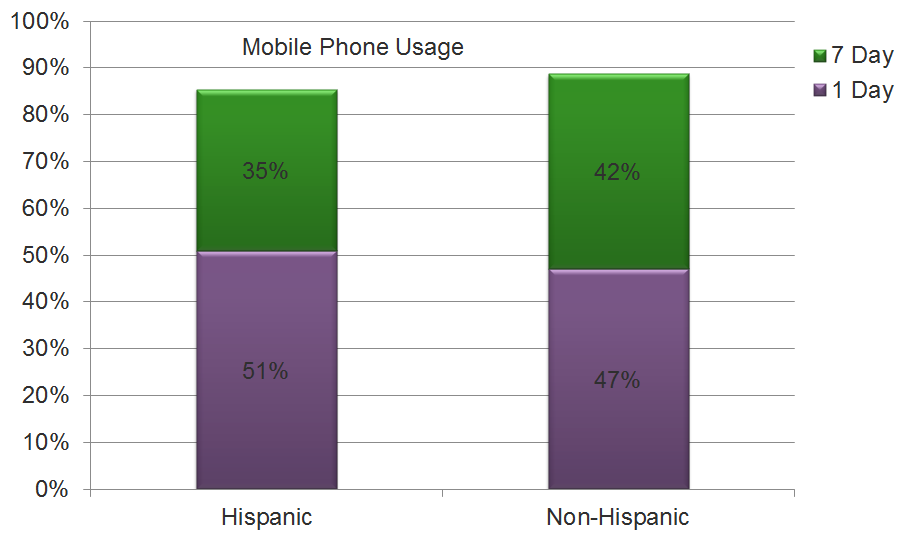
First, the percentage of use of mobile phones by Hispanics and non-Hispanics over a 7 day period is almost the same for Hispanic and non-Hispanics, with non-Hispanics having a 4 percentage point lead as seen in the chart below.  The Latino percentage of mobile use in one day, however, is about 4 percentage points higher.


Clearly, the small differences highlighted are interesting but almost trivial.  What matters here is that Hispanics are eager users of mobile phones, at least as much as the rest of the market combined. In prior blog postings I have presented data which shows that Hispanics, African Americans, and Asians use their mobile phones about double the amount of time as their non-Hispanic White counterparts. That suggests that when looking at all non-Hispanics combined it is likely that minorities are the ones responsible for much of the usage.

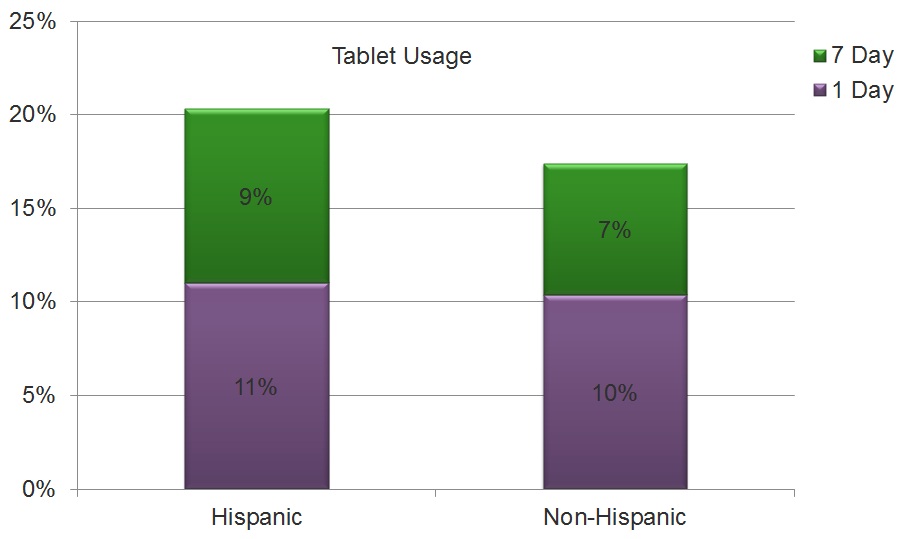
The next chart is more dramatic, not so much in terms of actual differences but in the fact that Latinos are eager to adopt new technologies and that when they adopt them they use them more. Here is the trend in terms of Tablet use.


While the penetration of tablets among Hispanics is not yet as high as among other cultural groups, Latinos who have them are more likely to use them. That comes as no surprise given the findings I have reported in the past couple of years. Technologies that allow for more fluid interpersonal communication and mobility have shown to be very attractive to Hispanics. My interpretation is that this is due to the eagerness that Latinos have to be connected. New technologies appear to be in fact “technologies of liberation” for Latinos.  Liberation in the sense that the constraints impeding interconnection among Hispanics are being removed by these electronic machines.


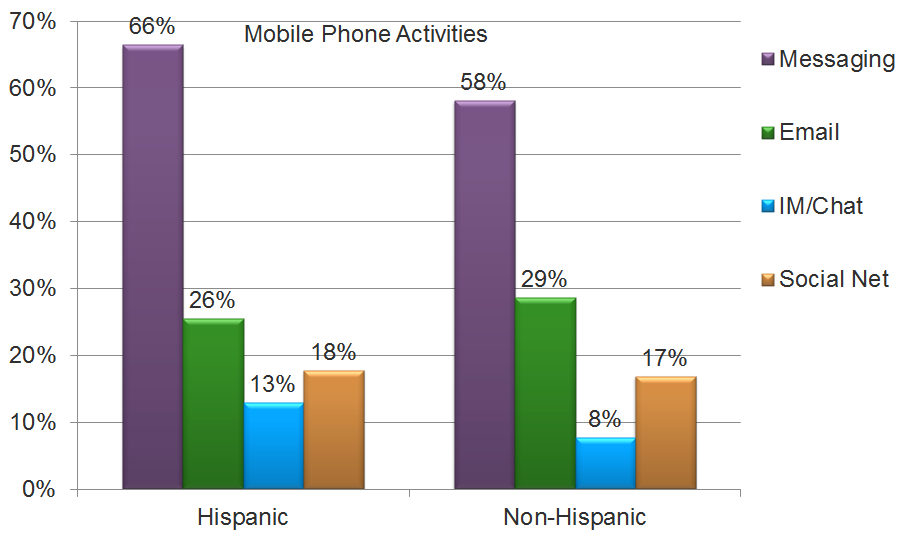
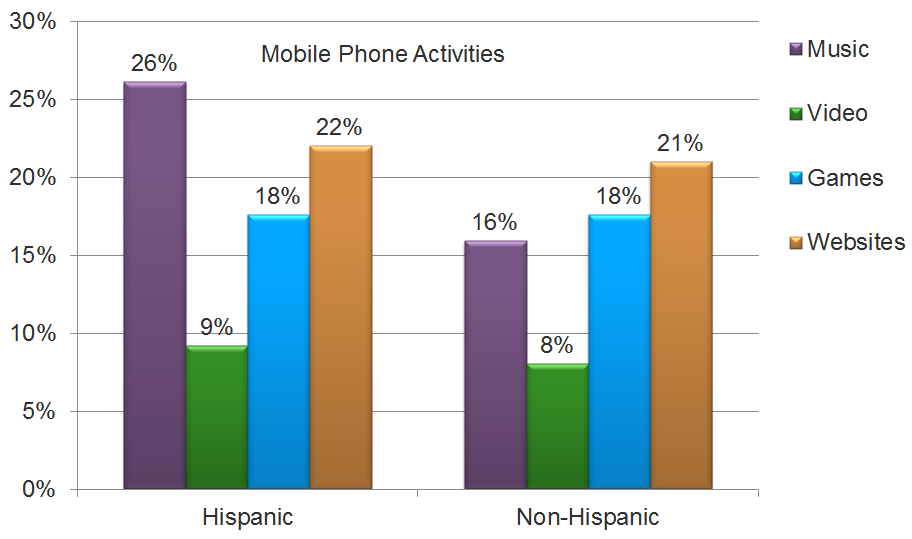
Another two charts that impressed me have to do with activities that Latinos engage in on their mobile phones.


Perhaps not surprisingly, Hispanics overindex in their use of text messaging, IM/Chat, and to a smaller degree in social networking.  My guess is that if these data were broken down further by cultural group we would see that minorities in general overindex in social networking as we have seen with our FSU data before.  That Latinos engage in mobile phone listening to music to a larger degree than anyone else confirms their attraction to music as part of their cultural existence.


It would be most interesting if the Experian Simmons data were broken down by different cultural groups so that comparisons could be made in more detail. Comparing culturally diverse groups among themselves can be illuminating for segmentation purposes.

My students and I were gratified to see that the Experian Simmons data supported the results we had found with the data from Research Now, and this confirmation lends credibility to the fact that Latinos are eager technology users who lead in many digital domains.

The data from which the above results are reported is from the Simmons Connect Study with a cross-platform sample of Hispanics of over 7,000 respondents.

Tuesday, October 2, 2012

Bank Brand Loyalty Tested With Every Move

When it comes to lifestage marketing events, new movers have always represented a significant opportunity and risk. This is because consumers who move tend to significantly increase spending in a variety of categories while also changing their brand loyalties as to where they shop, eat, buy personal services and even bank. 

But, with new home sales in 2011 being 80 percent below the peak in 2005 (making the number of existing and new home sales the lowest in almost two decades), should bank marketers still invest in this target audience? Do consumers still spend at the same rate as in the past? Is this target audience even scaleable?

Interestingly, despite the ongoing reduction in home sales, the number of people moving has steadily increased since mid 2009, indicating that consumers in transition still represent both a risk and opportunity for marketers. In fact, the New Mover Report 2012 from Epsilon found that consumers continue to spend thousands of dollars in the months following a move, representing a valuable opportunity for those marketers who can identify and effectively communicate to new movers. 

The study also found three major themes when they looked at consumer spending habits, brand affinity and channel preferences associated with a move from one location to another:
    • Consumer brand loyalty is tested during a move, with new movers being twice as likely to change brands or service providers than non-movers.
    • New movers have an interest in changing and/or upgrading services such as banking, credit cards and insurance after a move.
    • Direct mail continues to be a highly valued channel for receiving information during a move, and is even highly valued by Gen Y consumers.
New Movers and Home Purchasers are Not Synonymous

According to the U.S. Census Bureau, roughly 17% of Americans move each year, representing more than 53 million people. Those who move tend to be younger, with the distance of the move also being greater for younger demographic segments. The only exception being those households reaching retirement (around age 65) who also are more likely to move. 

Research shows that while the economy is showing signs of slow and steady recovery, the volume of home sales continues to lag behind the highs achieved in the past. As a result, the ratio of renters on the move versus new homeowners continues to favor renters as it did in 2011. While this trend is not necessarily surprising given the scope of the housing market difficulties, marketers need to understand the difference between these two segments of movers as it relates to demographics, loyalty and purchasing behavior. The good news is that both new movers and home purchasers appear to be on the upswing.

The bad news is that as many as 33% of the people who move do not report their new address to the USPS (the central compiler of the National Change of Address (NCOA) file. As a result, targeting new movers (or even keeping a house file current) requires compiling multiple list sources including utility connections, phone changes, county records, etc.

Do Households on the Move Remain Brand Loyal?

Research shows that even when a household moves a short distance, marketers can't assume purchasing patterns will remain the same. According to the research done by Epsilon, brand loyalty is tested during a move, with the frequency of changing providers/brands being twice as likely for a new mover compared to a non-mover (some categories of services have a much higher propensity of change).

As shown below, some of the lowest levels of loyalty were in the category of professional services, where the difference in likelihood of changing brands between movers and non-movers were greatest for home insurance (3:1), auto insurance (2:1), credit cards (2:1), and banking accounts (3:1).


While a move, by itself, may not prompt a change in providers, it does appear to put loyalty to a specific brand or provider in play which indicates a defection risk for current customers and acquisition opportunity for prospects in a trade area.

When the research dug deeper into the reason for why movers changed brands, the overwhelming reason for change in the professional services category was the move itself (63%) compared to pricing (40%), service (19%) or any other feature/benefit offered.


Finally, beyond changing brands, new movers were also more likely to acquire or upgrade products and services in the professional services category. As was the case for the reason why movers switched brands, new movers indicated that the move itself as a major reason for acquiring or upgrading a professional service (59%), with pricing again being important but taking a back seat as a reason for upgrading (39%). 


What Communication Channel(s) are Best?

As consumers use more and more channels to shop and buy services, it should be no surprise that a multichannel approach is recommended to connect with new movers related to retaining or acquiring households on the move. While there is very little disparity between the preferred channel of communication between movers and non-movers, word of mouth (referrals), email and direct mail are the channels most often mentioned as the way households want to learn about products and services. 

It should be noted that recent research indicates the desire for direct mail being even more pronounced for the marketing of financial services as discussed in a number of previous blog posts including As Channel Proliferation Increases, Consumers Still Prefer and Trust Direct Mail for Financial Services Communication (December, 2011). This study also indicated a higher preference for direct mail among Gen Y consumers than for any other channel.

And while there is always a great deal of buzz among marketers around the use of social media, this channel is the least desired by both movers and non-movers. That said, social media should still be integrated as part of a marketing strategy since targeting new movers using social media will be much easier than with other channels such as mass media and email (due to list availability and accuracy).


Key Take-Aways for Marketers

As I mentioned in my previous post on the subject, Targeting New Movers for Enhanced Growth (February, 2010), the keys to reaching this transitional segment include:
    • Be the first in the mailbox (or on the computer, phone or newspaper box) after a household moves to avoid clutter and benefit from early decisions
    • Develop a system of immediate processing of prospects/customers to provide the foundation for being the first to reach the new mover in your category
    • Measure the incremental impact of the program against your alternative acquisition/retention initiatives
For the majority of my clients, a new mover program is the foundation of their acquisition efforts, generating one of the strongest returns on investment and a steady flow of new households at a time when market growth is at a premium. In addition, a physical convenience is becoming less important for households, more and more of my clients are looking for ways to identify current customers who may be preparing for (or have just completed) a move to protect this household from attrition.

According to Don Hinman, SVP of Data Strategy at Epsilon, "An average household moves every five years on average and spends approximately $9,000 on a broad array of goods and services. By understanding at a deep level where new movers are spending and what opportunities are available to gain share of wallet, brands can create more effective, targeted campaigns to reach consumers during this transition."

The 2012 New Mover Report can be downloaded free of charge here.

Additional Insights:

Thursday, March 1, 2012

Banks Need to Collect More Insights to Communicate Effectively


By Bob Williams, Director of Marketing Technologies at Harland Clarke and author of the blog, The Merchant Stand.
A friend and colleague Jim Marous shared an article from American Banker on Googe+ entitled Banks Underuse Mobile for Communication. The article discusses challenges that financial institutions have with communicating with their customers through mobile devices. While mobile device applications and mobile optimized sites are becoming more common, and expected by account holders, financial institutions are not using the mobile channel for proactive communication. Kael Kelly, senior director at Varolii is quoted in the article “Banks don’t have the data that they need. A lot of the phone number data doesn’t easily distinguish between a mobile number and a land-line.”
So the idea that banks don’t know what data they have made me think about some other data that Jim Marous shared about financial institutions and customer data. Like this tweet about banks not having email addresses for their account holders.
The challenge I see is missing or unintelligible customer profile data. That problem expands beyond the boundary of the financial services industry. It’s really a common need for any type of business. Another challenge is the misuse (or lack of use) of the data that an organization has. Another conversation with Jim last week revealed that he noticed his bank mention that online banking was 'down' using Twitter. While admirable that they used a more modern social media tool for this notification, there probably aren't many people following Twitter the way Jim does. Making matters worse, they didn't use either his email address (which is tied to his online banking account) or SMS (the bank has his cell phone) to make this notification. In other words, the bank had the tools, but didn't use what was at their disposal.
There’s no doubt that many organizations have a good process to manage customer profile data and communication. But for those that don’t, I believe there is a fairly simple solution.
A Simple Multi-Solution for Collecting Profile Data
The first step is to collect accurate information at the time of new account opening. That seems obvious, but for many businesses this may require updating the customer/client profile record to support addresses for current communication mediums. That means distinguishing between phone number types such as home, mobile, work etc. It means a place for an email address as well. If is it a business, you may also want to include a variable field for social media type contact information. At a minimum, require one phone number and one email address. If the customer insists they do not have an email address, then fill the field with an agreed upon standard such as (noemail@yourbusinessdomain.com)
I understand there are regulations governing anti-spam communications via email and SMS text. But I don’t think banks or other businesses need to over think/engineer a basic solution to keep accurate profile data.  The email and phone number should be required and make sure the customer knows when they establish the account that you may use this information to contact them with important notices about their account. You can optionally create a permission indicator (opt-in) that is designated for future marketing or non-marketing communications. While these changes may require IT, online banking and branch management support, the customer experience and cost benefits are significant.
A Simple Multi-Channel Solution for Keeping Profile Data Accurate
I suggest sending notifications through multiple channels annually for customers to check and update their profile contact information. Here are some possible touch points:
      1. Pop up in the online account area after login.  Remember, customers are in your system by their own choice. So this is a fair message to display to them regularly. This is also an area where the customer can self-serve any updates they need to make.
      2. Email reminder. Don’t ask the customer to login from the email message or reply to it. That’s a technique used by phishing attacks and creates mistrust. Rather, use the email to notify and request the customer update their profile information the next time they login to their online account or the next time they visit a branch/store location.
      3. Post the reminder message on Facebook/Google+/Twitter and other social sites where customers may follow your brand for the purpose of receiving communication. These social medium platforms are broadcast platforms. You don’t need permission to place messages there and customers that see a message from your account page are there by their own choice.
      4. Leverage the ATM. While some ATMs are equipped with interactive communication options, the ATM can at least be used as a reminder tool. Of maybe use a QR code on the ATM for customers to go to a log-in site for updating.
      5. Put the reminder message in a recording for customers holding for live assistance. It’s a simple reminder that they should keep their profile information up-to-date to help with important account notifications.
      6. Have any branch/store employees verify with customers on a designated week (quarterly or annually) that their information is up-to-date information. This only covers the customers that are serviced in-person for that week, but it’s a great touch point for interaction and shows that your brand is proactive to keep good records. Branch POS material can also emphasize the need for updated information.
      7. Messaging on all statementing and promotional materials. Emphasizing the 'green' aspects of keeping all communication channels up to date makes this a priority all year long.

Since some customers may have fees associated with SMS texting, it’s not advisable to use that channel unless you have established that as part of their profile setup.
The email channel is different in this multi-channel approach because it is a message to an individual area. In fact, email addresses that are not accurate may return as undeliverable. Consider monitoring undeliverable emails and putting these customers on a list for follow-up through other means such as phone or postal mail.  Alternatively, remove email addresses from the profile record if they are not deliverable after three attempts.
What do you think? Should it be difficult to keep accurate profile data and request the customer update/verify it with recurring frequency? Do you have a process or program at your organization that has worked? I would love to know.

Friday, December 2, 2011

As Channel Proliferation Increases, Consumers Still Prefer and Trust Direct Mail for Financial Services Communication

According to a just released consumer channel preference study from marketing services firm Epsilon entitled, The Formula for Success: Preference and Trust36% of consumers prefer to receive financial services communication through the mail (compared to only 8% preferring email), while 50% state that they pay more attention to direct mail than email. Interestingly, U.S. consumers actually receive an emotional boost from receiving mail, with 60% agreeing that they "enjoy checking the mailbox."

The 2011 study is the latest in a series of studies conducted by Epsilon around communication channel preferences. In the latest study, it was found that the preference for direct mail extended to the 18-34 year old demographic, highlighting the risk in making assumptions around age and channel preferences. Part of this preference bias compared to email and other channels could be caused by the level of trust associated with the channels reviewed, since 26% of U.S. consumers found direct mail to be more trustworthy than email. The least trustworthy channel continued to be social media, with the channel only being viewed as trustworthy by 6% of consumers. Consumers also found direct mail to be more 'private' than email or online channels (important for 37% of consumers).


"Consumers use and trust certain communication channels more than others," states Warren Story, VP of product marketing at ICOM. "This means that marketers need to understand which channels resonate most at various stages of the consumer purchase cycle and incorporate a cross-channel strategy that leverages data and technology to communicate on a 1:1 basis." Story also suggests starting with direct mail and layering other channels into the marketing mix for message reinforcement.

Not only do consumers seem to prefer direct mail communication, but there seems to be an increasing frustration with the amount of email received and the level of satisfaction received from receiving emails. The study showed that 75% of U.S. consumers get a lot more emails that are not opened, with 65% saying they get too many emails overall. Conversely, 43% of consumers surveyed still enjoy receiving emails from brands on new products, indicating that targeting and messaging of communication is needed to capture attention.


For financial services communication, consumers also overwhelmingly preferred personally addressed mail as opposed to 'dear occupant' mail that doesn't have the emotional pull of a personally addressed communication. (This should be tested on an ROI basis however, since I have found that the financial benefits of less personalized direct mail can work in some instances).

Even with the strength of direct mail indicated in this study, financial marketers should not exclusively use direct mail or remove email from their marketing mix. In fact, the Epsilon study showed a greatly increasing use of Facebook and mobile phones as communication channels, while showing that the most trusted channels were newspapers, company websites and television. The study also showed that there were many perceived benefits to both direct mail and email as shown below from people who preferred direct mail to email and visa versa..


In this time of communication message overload, financial marketers need to balance the use of multiple channels based on consumer preference, financial considerations, objective of the marketing program, and the results of multichannel effectiveness measurement initiatives. Bankers also need to continue efforts to improve the targeting of messages through all channels from both a financial and customer satisfaction perspective. 

And while social media did not perform well from the perspective of trust, social channels provide several benefits that should be leveraged in a multichannel communication program due to economic considerations and the expanded use and reach of social media. Mobile channel communication should also be tested as we enter the new year and are building our marketing plans.

Of greatest importance is the development and use of advanced metrics that can assist you and your team in measuring the effectiveness of channels and channel mix. As opposed to measuring only single channels independently, advanced analytics are now available that can provide a view into the consumer's media consumption patterns and the impact of different channels.

As we enter 2012, the importance of an effective and efficient marketing communications mix is important. Budgets should be shifting to digital and social channels to build a reservoir of learnings that can be leveraged in the future, but it appears that the projected demise of traditional channels such as direct mail has been overstated. 

How will your team be shifting marketing channel dollars in the new year? How will you be measuring the impact of your efforts?

I would love your comments.

Friday, November 18, 2011

Direct Mail Still Has Impact in Digital World

As more and more marketing dollars are funneled into digital and social media, and as postal rates continue to climb, direct mail marketing has been getting less and less attention. While there is definitely a case to be made for building a multichannel communication plan integrating a number of different channels to reach customers, recent research indicates that direct mail should still be part of the mix.

A study entitled, Using Neuroscience to Understand the Role of Direct Mail conducted by the research company Millward Brown found that direct mail actually leaves a deeper impression on the human brain than its digital counterpart. The research project used functional Magnetic Resonance Imagery (fMRI) brain scans to show that our brains process paper-based and digital marketing differently and that direct mail actually created a greater emotional impression than digital communications.

During the study, participants were given marketing messages on a screen and printed on a card with brain scans done to assess how the processing of messages was impacted by the medium of communication. It was determined that tangible communication (direct mail) left a deeper 'footprint' on the brain even when the physicality of the channel (sensory impact of touch) was discounted.
    • Material shown on cards generated more activity within the area of the brain associated with the integration of visual and spatial information (the left and right parietal)
    • This suggests that physical material is more 'real' to the brain. It has meaning and a place and is better connected to memory because it engages with spatial memory networks.
The study also found that direct mail involved more emotional processing which is important from a memory and brand association perspective.
    • More processing is taking place in the right retrosplenial cortex when physical material is presented. This is involved in the processing of emotionally powerful stimuli and memory, which would suggest that the physical presentation may be generating more emotionally vivid memories
    • Physical activity generates increased activity in the cerebellum, which is associated with spatial and emotional processing (as well as motor activity) and is likely to be further evidence of enhanced emotional processing.
Finally, the study found that physical materials produced more brain responses connected with internal feelings, suggesting greater 'internalization' of the ads. According to Graham Page, Executive Vice President of Consumer Neuroscience at Millward Brown, the results suggest, "The brain is more emotionally engaged and is potentially reflecting more on a response" when viewing direct mail. "Due to the fact that the brain recognizes mail as real, memories of that piece are being created. Our brains seek to understand the thing that we hold in our hands more so than a transient image on a screen." said Page.

Even understanding some of the neuro benefits of direct mail, digital communications have distinct advantages over paper such as interactivity and the ability to integrate audio and video. In addition, with continuously improving targeting tools, digital communications can more effectively target audiences based on interests, behaviors, past transactions and other characteristics that direct mail can't match.

Bottom line, this study and other studies covered in one of my previous blog posts (Marketers Not Aligned with Consumer Marketing Channel Preferences) indicates the importance of integrating multiple channels to communicate your marketing message to people who will process and react to different channels differently. More importantly, while response rates to a credit card, new customer acquisition or cross-sell campaign may seem low, direct mail can still have a positive impact on the brain from a brand perspective . . . even to those who did not respond to the direct offer. According to Graham Page, "each point of contact with the consumer gives marketers another opportunity to communicate broader brand messages."

As marketers, we need to realize the advantages and impact of different channels and realize that each channel needs to both compliment and supplement the the other channels and the campaign as a whole. We also need to consider more tactile and emotional elements of direct mail to increase the impact of the printed piece. For instance:
    • Consider heavier stock, textured finishes and unique shapes and die-cuts that may increase the tangibility of the direct mail piece
    • Try to build on the emotional power of direct mail with more emotional messaging
    • Don't forget to build a brand message as part of your direct mail package since even those not responding will be left with an impression
    • Remailing has an advantage of reinforcing the brand communication in a way that digital communication can not
Finally, we need to be careful about making assumptions as to which channel(s) may have the greatest impact on different demographic groups. For instance, while our gut may tell us that the tech-savvy millennials may only respond to social media and digital communication, studies have shown that direct mail is still important in making a purchasing decision.


The 2010 Consumer Channel Preference Study from Epsilon found that for certain categories including financial services, the preference among millennials and even Gen X participants for receiving marketing communication from offline sources such as direct mail and newspapers was 2-3 times greater than for digital communication and social media. Likewise, a 2009 survey from ExactTarget found that 75 percent of the people 25-34 had made a purchase resulting from direct mail. The rationale for these results was due to the ability to cut through the clutter and due to the way the media was consumed (at a pace and time that was convenient to the reader).

In fact, 53% of all respondents to the Epsilon study said they paid closer attention to information they received by postal mail than through email. The research also found that there was an overall strengthening in attitudes toward postal mail between 2008 and 2010 mainly due to the convenience factor (the mail can be read when and where they want and can be saved and passed on).

On additional telling finding from the study is that respondents believed they were getting significantly less mail than in the past and that they were able to spend more time with the mail received. The implication for marketers is that there may be an opportunity to get the attention and more dedicated readership using direct mail since mail volumes are lower. The opportunity may be even greater given the overload of email marketing received by many prime consumers.

So, as you make budgetary decision for 2012, how will you allocate your media funds? What channels will get less and what channels will get more funding. More importantly, how will you measure the impact of the integrated marketing programs you will be implementing?

I would love to hear about the shifts you may be considering.