Showing posts with label branding. Show all posts

Thursday, June 20, 2013

What Do You Brand For?


In recent years, “brand” has become somewhat of a buzzword in business.  While a lot of people think it is an intangible and amorphous word with little meaning, your company’s brand is the single most important contributor to your bottom line as an organization.  Successful brands are invaluable.  Conversely, undefined brands are a black hole on your organization’s balance sheet.

Brands have real, actual value behind them, which is known as “brand value” or “brand equity.”  Investopedia defines brand value as “the value premium that a company realizes from a product with a recognizable name as compared to its generic equivalent.  Companies can create brand equity for their products by making them memorable, easily recognizable and superior in quality and reliability.  Mass marketing campaigns can also help to create brand equity.”   

Let’s use Coca Cola as an example.  It is the most recognizable brand in the world with its brand valued at $77.8 billion, according to the 2012 Best GlobalBrands Report by Interbrand.  This $77.8 billion is the cost of the actual brand…not inventory or real estate or its executives.  It is the value of Coca Cola’s brand recognition throughout the world.  Coke’s consumers pay more for the Coca Cola brand product over competitors and generic labels, and that difference of what consumers will spend is Coca Cola’s brand equity. 

Coca Cola promises fun, freedom, and refreshment to consumers.  Not the lowest price for cola, or the most convenient to find.  Their aim is to sell an experience. 

The reason behind branding is because you are standing for something. 

It’s difficult to near impossible to put a figure on the brand of our credit union or community bank and our financial products and services.  But the important lesson we can learn from Coca Cola is that you have to stand for something, build your brand around it over time, commit to continuous marketing and communication of your brand's elements, and then you won’t have to rely on price as your differentiator.

How can your financial institution increase its brand value with current members/customers and the community?  Develop a brand strategy, which includes a brand promise, positioning statement, and a defined identity and be that brand every day.  Over time, you will earn recognition and loyalty, which should be the true foundation of your financial institution’s marketing efforts.

My next post will focus specifically on how to define your brand promise, so be sure to check back next week. 

Amanda


Let MarketMatch help you harness the power of your brand to impact your bottom line.  Our proprietary branding process will target opportunities to obtain new customer relationships, grow existing customer relationships, and build brand awareness. Contact me for details.


Wednesday, June 12, 2013

Goldilocks and the Three Brands


Make sure your brand is just right.
If you look up the word “brand” in the dictionary, here is what comes up:

brand  (brænd) 

— n
1.
a particular product or a characteristic that serves to identify a particular product
2.
a trade name or trademark

But a brand is a whole lot more than a mark or a characteristic.  There are many imperceptibles that go into a brand, and it is a lot more complicated than just an icon or logo as a successful brand has many elements.

Look up “brand” in business or marketing books, however, and it is overcomplicated, impersonal, and ambiguous:
"Unique design, sign, symbol, words, or a combinationof these, employedin creating an imagethat identifies a productand differentiates it from its competitors. Over time, this image becomes associatedwith a level of credibility, quality, and satisfactionin the consumer'smind. Thus brands help harried consumers in crowded and complexmarketplace, by standing for certain benefitsand value. Legal namefor a brand is trademarkand, when it identifies or representsa firm, it is called a brand name."
(Source: www.businessdictionary.com)

Getting Your Brand Just Right

A brand is personal.  People choose to buy and/or interact with brands they can relate to and that evoke a set of emotions.  The easiest way to define a brand is to think of your organization as a person.  Everyone has a certain consistent appearance, a tone, a set of personality attributes and quirks, likes and dislikes, ideal friends and partners, etc.  This definition is easy to understand and is just right for any business.

While a brand takes a long time to build and define, there is a science behind it.  The great and successful brands of today are personifying their brands, and many have actually hired someone to embody those attributes in order to amplify their brand awareness with consumers.

Some brands that, in my opinion, do a fantastic job of personifying their attributes are Progressive Insurance, M&Ms, and Geico to name a few.  And, while they are actual people, Oprah, Martha Stewart, Donald Trump and even Jennifer Lopez are successful brands.

What words describe your brand?
If you’ve had trouble knowing where to start in defining your credit union or community bank’s brand, take a step back and start describing it as you would another person.  Then you’ll be on the road to getting your brand juuuuuust right. 

Amanda

***Stay tuned for next week’s blog for tips about how to define the different elements of your brand!  


Let MarketMatch help you harness the power of your brand to impact your bottom line.  Our proprietary branding process will target opportunities to obtain new customer relationships, grow existing customer relationships, and build brand awareness.  Contact me for details.

Wednesday, June 5, 2013

The New “Basics” Every Marketer Should Know


This week, we are focusing on the fundamentals of marketing on the MarketMatch blog and Facebook.  And by basics, we aren’t talking about TV commercials and billboards, radio, newspapers, direct mail, and all of the more traditional forms of marketing.  There are some new basics that every marketer should know because marketing has changed dramatically since the days of Mad Men, and changes more rapidly as time goes on.

Let’s break down the basics of today’s marketing:

Tell a story with personality

Business Banking Services – Example 1
“We have business loans for all sizes of businesses and industries.  Our rates are competitive and we feature friendly, knowledgeable loan officers and an easy application process.”

Business Banking Services – Example 2
“Jerry Smith has owned his glass shop for 34 years and always had what he thought was a great relationship with his financial institution.  That was, until he received an unexpected call from his ‘personal banker.’  ‘We understand that you have never missed a payment on your credit line and you’ve always been a good customer,’ said the personal banker.  ‘But we are cutting back our lending, and we’re closing your line of credit loan effective next month.’

Angry and betrayed, Jerry turned to his local credit union/community bank, where the loan officer came to his shop, learned about his business and designed a custom solution tailored to Jerry’s individual needs.” 

Which of these examples is more compelling to you?  People make decisions based on emotion.  Stories make it easy for people to put themselves in a given situation allowing you an opportunity to “sell” your services in a way with which the readers can identify.  And, more importantly, makes your sale more memorable for the consumer.

Solve a problem with your positioning. 

We don’t need a marketing campaign to tell us how amazing chocolate is.  Or how it tastes.  99% of people love chocolate.  So how would a chocolate company position itself?  Enter my favorite candy, M&Ms: their tagline is “melts in your mouth, not in your hand.”  It instantly creates a visual, and they don’t describe the features of their candy with their positioning.  Plus they have the whole adorable character thing going for them, too.  

A great exercise for you to try next time you are developing a marketing campaign is to take off your marketing hat and be the consumer.  What problems or opportunities do you have or see with your personal finances, accessing your accounts, getting loans, visiting the branch, etc.  Once you have brainstormed those processes, back into how your account, loan, service, etc. will solve that problem.  If there aren’t any problems to be identified (which is great), how can those touch points and transactions be enhanced so that the transactions become memorable over other financial institutions selling the same services and products?

Personalize and position your product so that someone can identify with it and make it their “own.” 

"Bride" on my wedding day
As a coffee-loving person, the experience of going into Starbucks and ordering a “grande, one pump, nonfat, no whip cafĂ© mocha” is a personal experience.  Am I in line like everyone else to buy coffee?  Yes.  But that is my drink.  

We obviously don’t sell coffee drinks.  We sell trust through our financial products and services.  This doesn’t mean recreating the wheel.  It means modifying (or creating) the consumer experience.  How can you appeal to the innate human desire of acceptance and belonging through the various transactions at your financial institution? 


Stop being a logo! Show your brand personality.  (Yes, you have one).

“Flo” has over 5 million Facebook fans.  It’s an insurance company!  But Progressive has done an amazing job at taking their commodity-based transaction and turning it into a people-based transaction.
 
It’s also insurance, but the Allstate “Mayhem” commercials do a fantastic job of dramatizing insurance needs in a funny, identifiable way. 

Why is this important?  The more consumers relate to and remember your institution, the higher your brand loyalty will be.


Engage and encourage them in conversation

In the age of social media where it takes all of eight seconds to tweet about a service experience, people are going to talk about the good, the bad, and the ugly whether you want them to or not.  So, instead of playing defense (or worse, not playing at all), how about being proactive and engaging them in conversation on your terms? 

Some negative response is inevitable and can even turn out to be a great opportunity for your financial institution.  In fact, your members or customers expect you to do things wrong from time to time, but it is how your organization handles those issues as Ron Zemke talks about in his article “Service Recovery: Turning Oops! Into Opportunity.”  He says, “the true test of an organization’s commitment to service quality is the way the organization responds when things go wrong for the customer.”  Conversation enables these opportunities to be uncovered and on your terms.

Choose the medium that is right for your financial institution, drive traffic there with your marketing and communications efforts, and actively engage your audience in conversation, whether it is in person or online.  Your members and customers want to know that there are real people with real personalities behind that logo of yours.  That’s why the examples above are so identifiable and memorable.

Make it about them, not you. 

In the same way that you go about positioning a product or service, remember your credit union or community bank is there to serve the people coming in the door, connecting with you online, or calling on the phone.  Marketing isn’t just about how you promote your business; it is how your business operates and involves everything from the building atmosphere, the employee dress code, how people are greeted, the transaction process…everything.  We are in a people business, and it is about them. 

It is imperative in today’s competitive environment that we as marketers go beyond traditional marketing mediums and tactics and do it before we need to.  Once your target audience has gone elsewhere, it will be that much harder to capture their attention and tell them your story.  And it’s a great story you have to tell.  

Amanda


MarketMatch brings these philosophies and die-hard energy to credit unions and community banks.  Want to learn more about how MarketMatch can help you with your strategic marketing efforts?  Contact me!

Follow me on Twitter.

Friday, May 10, 2013

Brands Make a Difference: Latinos Over Index in the Hair Styling Product Category


I have been conducting ethnographic interviews with Hispanics in the last several months and have visited many homes and talked to many Latino women. I have looked at their bathrooms and bedrooms and have seen many of the products these families use for styling their hair. I got the impression they are very much into the hair style product category, but qualitative observations can only go so far in terms of making generalizations about the population.  

To check my impressions I looked at data from the Experian Marketing Services Simmons National Hispanic Consumer Study that was collected in the twelve months ending on November 30, 2012, and confirmed that my impressions were on the right track.

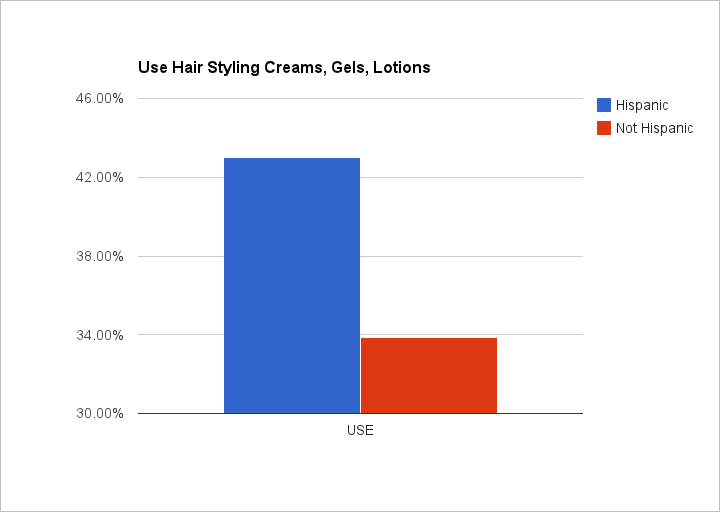
As can be seen in the chart below, 43% of Latinos use hair styling products while only 34% of non-Hispanics use them.


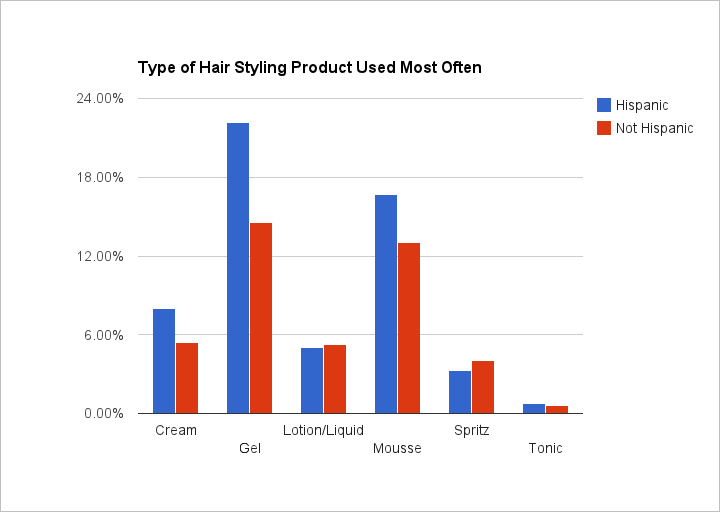
Clearly, there are several reasons why this may be the case, including the fact that Latino adults have a median age that is about 10 years younger than the overall population. Also, we have discovered over the years that Latinos enjoy being well groomed in their everyday life. Further, their grooming customs come from their countries of origin where cultural patterns are strongly ingrained. Now, are all hair styling products equally used? As can be seen below there are products that are more heavily used than others.


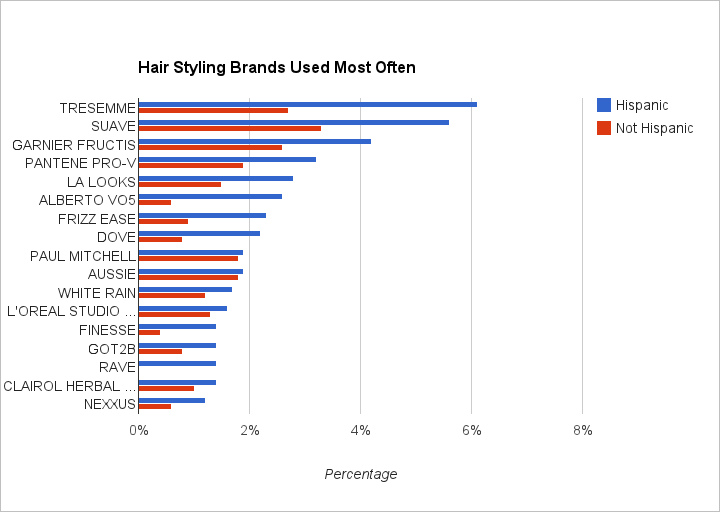
Gel and mousse are by far the most popular hair styling products among Hispanics, and in general their use is in line with the overall population pattern of usage. Nevertheless, Latinos over-index quite dramatically in the both categories. But what brands are more popular? As can be seen in the chart below, consumers are quite divided among the different brands they use most often and the chart only includes the brands that have more than 1% usage among adult Hispanics. Still each for each of the top brands, Latinos exceed their non Latino counterparts. There are cases in which usage is triple among Hispanics, such as in the case of Alberto V05, and double such as in the case of Tresemme, or substantially higher like in the case of Suave.


The lesson I learn is that some of these brands may capitalize on making a serious effort to further their share among Hispanics. Particularly promising are brands with Latin American heritage and with names that are culturally compatible, like Tresemme, Alberto VO5, Suave, and Pantene.  In the age of social media, and knowing that Hispanics are particularly keen in the use of this technology, reaching out to Latinos with brand experiences that are appealing, informative, and seductive can render a large return on relatively modest investments.

Large media, like television, can also make a major difference with advertising  and branded entertainment. Ultimately any brand that makes a serious effort can find creative ways to connect culturally, for example, by attaching symbolic handles to their brands that Latinos can relate to.

The data used here is from Experian Marketing Services’ Simmons National Hispanic Consumer Study of adults 18+  and was collected from October 24, 2011 to November 30, 2012. The sample of Hispanics contains 8,521 individuals and the non-Hispanic sample has 17,043 people.

Wednesday, January 30, 2013

How Should Brands Give Back in a Multicultural Market?

Marketers frequently ask how their brands can give back to a community to create good will and enhance their brand's position. The answer to the question is complex, but one of the ways of trying to address it is by asking consumers of different cultural and acculturation backgrounds how they rate different actions that brands can take in order to give back.

In 2012 with the cooperation of Research Now and the leadership of +Melanie Courtright, we again collected an online national sample composed of Hispanics and Asians born in the US and those born abroad, in addition to African Americans and Non-Hispanic Whites. We used the country of birth as a proxy for acculturation to see if technology adoption varied accordingly.

We asked respondents to rate different actions that companies can take to give back as follows:
“When a brand gives back to a community, which of the following are most and least important contributions from your perspective? Please rank in order, from 1, most important, to 5, least important, each of the following items.”

The following chart shows the total across all respondents (indicated by the blue bars) and for each of the culturally unique groups (indicated by the colored lines) for the rank of “Most Important” in regard to the following possible brand actions:

  • Provide jobs
  • Give scholarships
  • Help clean the environment
  • Keep jobs in the local community, and
  • Employees get free time to do community service


The rank shown is just the “Most Important” for each of the items. The totals for each culturally unique or acculturation group add to slightly more than 100% because each item was rated independently.

The first surprise is that the differences across culturally unique and acculturation groups is relatively small and that these cultural groups agree on the priority of the items.  The number one priority across the board is that the most important contribution that brands can make is to provide jobs to the community, followed by keeping jobs in the local community. It is perhaps not surprising that these two items have the highest priority given the economic downturn that most Americans have experienced in the recent past.

At a distance the next two priorities for brands are to help clean the environment and give scholarships. This does not necessarily mean that these are not important brand contributions, but that jobs are a more prevalent contribution at this time.

Interestingly, giving employees free time to do community service was ranked as top by the smallest proportion of respondents in each cultural group. This is perhaps due to the lack of visibility that such action may have as a contribution.

What are the lessons from these findings?

  1. Cultural groups and those at different levels of acculturation tend to agree on approaches that brands need to take to give back to the communities where they operate. Clearly, the implementation of providing jobs has to be by cultural group in order to satisfy the expressed sentiment of these consumers. Creating jobs is not enough but creating jobs that satisfy these segments individually.
  2. At times of economic distress there are actions that consumers feel are important but they subside to the more pressing issues of the time. While cleaning the environment and giving scholarships are important, jobs take preeminence in economic downturns.
  3. Marketers are encouraged to emphasize how their brands contribute to employment of these different cultural groups with specific emphasis on the local community.

The data for this study was collected by Research Now of Dallas, Texas, thanks to the generous initiative of +Melanie Courtright. Research Now contributed these data to the research efforts of the Center for Hispanic Marketing Communication at Florida State University (+Hispanic FSU). This online survey included the responses of 936 Asians (398 US born), 458 African Americans, 833 Hispanics (624 US born), and 456 non Hispanic Whites. This national sample had quotas for US region, age, and gender to increase representativeness.

Wednesday, August 1, 2012

Find Your Greatness


I absolutely love the Olympics!


As a runner, as a fan and as a world citizen … the Olympics are a radiant flower that blooms for only 3 weeks every 4 years.

The true blessing, as an American, is that this 3-week festival of competition and world-togetherness offsets and provides a distraction from our own American, poo-slinging political environment.

But lets focus back on the Olympic competition.  Not between the USA and China, not even between the finely honed athletes, but the competition of sports apparel brands.  As a marketer, I’m as enthralled by the Nike/Adidas competition as I am in the marathon competition between the Kenyans and the ... ahhh … well … OK, they really don’t have competition.

Here’s a link to Nike’s Find Your Greatness campaign.


Quick question:Is Nike an official sponsor of the London Olympic Games?

Answer: It doesn’t really matter!  But no, they’re not. 

Last week, Ad Age reported that an online survey found that 37% of those surveyed identified Nike as an Olympic sponsor (compared to 24% for Adidas, a real sponsor).  Add to that, in the last week, Find Your Greatness landed as #1 on the Viral Chart with 4.5 million views compared to Adidas’ 2.9 million views with their Take the Stage campaign.

In short, Nike has hijacked the London Olympics.  Without mentioning the games or paying the $40 million+ sponsorship price tag.  They did it by focusing solely on emotion.  They’ve tapped into the consumer’s reality.  One I’ve related to since I first started running in 4th grade … I’ll never be an Olympian, but I love being an athlete!  I’ll never compete internationally, but I can’t listen to the National Anthem without picturing myself on a podium.  Admit it, most of you know exactly what I’m talking about … and Nike identified it … put it into words and images … and made us feel it!

So, what can WE do as marketers without Nike’s marketing budget or rock star ad agencies?  We can learn from their strategy of tapping into emotions.  It sounds idealistic, but the truth is that emotions sell better than product or price.  Take Find Your Greatness, for example.  We’re not selling shoes or shorts, but our financial consumers want to find their greatness at home, right?  They can’t buy a car, move into a home, pay for groceries, hope for retirement or insure their property without us. 

How can you help your community find their greatness?

Take care and enjoy the remainder of the games.
Eric


Monday, February 13, 2012

All I ever Needed to Know...I learned at the Grammy's!


Greetings...

The Grammy's were watched by an estimated 39 million people last night... it must be true-- music brings people together!  I had an "a ha" moment during the 2012 Grammy telecast -- specifically during the section that Paul McCartney performed followed by Taylor Swift -- EVERYTHING
I ever needed to know about marketing was summed up by the Grammy's!

There were three key lessons that jumped out at me...while watching the Grammy's last night...
  1. Relevance matters:  How can Paul McCartney STILL draw attention and a standing ovation?  He has stayed relevant!  How does Chris Brown attract any attention?  He is relevant to his target audience!  Both important points for marketers in every industry...relevance is the ONLY thing that matters.
  2. YOU can win:  How does Susan Boyle make TV and better yet...make records?  Because she has talent! No matter how small, how remote, how unknown you are today...tomorrow can be a different day is you have a true point of difference!
  3. Music connects:  Regardless of age, color, creed, economic, or social...music connects people.  8-track, cassette tape, 45, CD, Walk Man, or iTune...that format has mattered little...the music has mattered greatly. 
Money connects people, too.  Big bank, small bank, savings and loan or credit union....we can ALL connect to our customers/members.  We operate in the banking industry that money is the great connector for us.  People want access to it...more of it... security for it.  EXACTLY what we as bankers and credit union folks provide. 

Our challenge??

Being Relevant...Realizing that WE CAN win...and connecting people to US how they want and when they want...regardless of the format.  Sure, some formats offer better sound or better service but the bottom-line...there is ROOM for each of us to stake our claim and be a Grammy winner.

It just takes focus and energy...

But that is the next blog!

Cheers!

Bruce


MarketMatch is a full-service marketing consulting firm, dedicated to the credit union and community banking community.  We utilize knowledge-based strategies to help you FOCUS on the efforts that will generate MOMENTUM and yield the greatest RESULTS for your bottom line.

Wednesday, December 28, 2011

Branding ... It's Not Rocket Science.

... And Rocket Science isn't branding - it's two totally different industries!


But seriously, whether you're branding a retail bank, commercial bank, credit union or coffee shop, the basics remain the same.


Strategy
In its simplest form, brand strategy comes down to one simple recipe:

  • One part: know thy self
  • One part: know thy competition
  • One part: know thy audience
  • Shake well and pour over differentiation

If you follow this blog, you've probably read one of our branding blogs. If not, here are some good ones:
     What if?...
     Brand YOU Day.
     Marketing & Branding
     Branding...It's Not What You Say, But What You Do.
     Is It Time To Relook At Your Brand?


Communicate
"If a tree falls in a forest and no one is around to hear it, does it make a sound?"  As a true marketer, I say...who cares?!?!  No one heard it!


Any change in brand requires a focus on awareness.  Your key target audience(s) should have better top-of-mind awareness of your institution AND understanding of your brand message. This requires pre and post brand research.


Your creative doesn't necessarily need to win awards, but should be focused:

  • On the right audience
  • On your key point of differentiation
  • Benefits, Benefits, Benefits

Employee Engagement
Advertising and logos are great, but your brand lives and breaths with the experience.  And the experience resides in your staff.

  • Every employee MUST understand the brand
  • They must understand how the brand is designed to make the customer feel
  • They must know their role in the brand and what is expected of them
  • They must be provided tools and training to make brand delivery second nature
  • Experience must be measured, monitored and tweaked for improvement
  • Consistency, Consistency, Consistency

See, branding is really not all that hard!


MarketMatch is a full-service marketing consulting firm, dedicated to the credit union and community banking community.  We utilize knowledge-based strategies to help you FOCUS on the efforts that will generate MOMENTUM and yield the greatest RESULTS for your bottom line.


Monday, August 8, 2011

Lessons from Congress...

Well...today the stock market is taking a beating.  I usually don't make political comments in our blog...and this one is not a strict political commentary...but I must borrow from the recent political happenings surrounding the debt ceiling.

Congress toiled and toiled and bantered around a political hot potato that is the statutory debt ceiling for the United States.  Finally, at nearly the 11th hour, Congress ratified an agreement that in principle increased the debt ceiling and addressed several other key political points...however, they forgot to ask the rating agencies for their reviews. As you know, on Friday Standard and Poors downgraded the rating on US debt...creating the exact problem that Congress was trying to avoid!

The lesson here is that you MUST not only pay attention to the interested parties in your market (for us...our customers and potential customers) but LISTEN to what they have to say when you actually ASK them for their input.

The customer has keen insights and may see things differently than we do...like the rating agencies seeing things differently that Congress. 

You need to stop and engage your customer and marketplace to determine WHEN and IF the actions that you are considering are going to be accepted and if not...help to determine what you should do!

Far too often, as an industry, we have insulated ourselves in meeting rooms and have a false sense of the customer pulse...the only way to know it, is to take it yourself through customer interactions and asking tough questions.

So, learn the lesson that Congress has not yet learned...ask the questions and be ready to modify your answer or strategy based upon the feedback you receive....in the end, you will be miles ahead and dollars saved!

Cheers!

Bruce

Wednesday, November 17, 2010

Is it Time to Relook at Your Brand?

If you haven't reevaluated your brand in the last 24 month, it may be time ... and it doesn't have to eat up your budget.

It's no secret that banking consumers today are not the same as they were before the "banking crisis" (enter ominous music here). The truth is that, for whatever reason, national surveys show bank customer satisfaction with larger banks is down (and credit union's is up).

Thanks to the media, consumers as more educated about banking, their perceptions and expectations have changes, and they are more motivated to make a change (12% fewer customers said that they "definitely will not" switch this year vs. 2007).

You need to make sure your brand still aligns with what consumers know, how they feel, what they expect and what will motivate them to come to you -- all while holding true to your actual identity.

But you won't know what's going on in your market until you ask. I'm not saying that you need to rebrand - but I am saying that you should reevaluate and see if there is any tweaking to do to make you more competitive and a more likely consumer choice.

Take care,
Eric

Monday, March 15, 2010

TGIM...

TGIM.

That's right...Thank God its MONDAY!

Changing my opinion of Mondays and making 2010 sing!

In case you have not read it, Thank God is Mondays, by Roxanne Emmerich is a quality read. It simply helps you refocus on the important little things that make the important big things easy.

Its all about making the environment in which you work the best it can be...positive, focused, constructive and engineered for team success.

Its kind of like the Staples "easy button"....that was easy!

With the full and complete knowledge that it IS that easy...and at the same time it is NOT that easy. The difference?  Attitude. Confidence. Team Focus.

At MarketMatch we are all about Focus. Momentum. Results. Three key words that sum up our mantra and keep us all working on the same goals with clients and rowing in the same direction.

I encourage you and your team to find that same type of razor sharp focus for you and your team.

It WILL make the difference and help to create a FUN/PRODUCTIVE/ENERGIZED working environment that will be creating great results along the way....

Cheers!

Bruce

Wednesday, June 3, 2009

What have you done today?

I heard a radio ad yesterday that was profound in its simplicity.  The ad simply asked:

"What have you done for your marriage today?"

Wow ... it really makes you think.

Today's posting is simple ...

"What have you done for your brand today?"

It's important not to forget that we need to nurture our brand (and our marriage) every day.

Take care,
Eric

Tuesday, May 26, 2009

Branding ... It's Not What You Say, But What You Do.

If you don't think that you can afford to rebrand your institution in this economy, think again.

It’s all in the definition.  Yes, your brand is tied (in part) to your name, logo and visual appearance.  But it is defined by the customer experience.

To rebrand your institution properly, you need to focus less on the creative department and more on strategy and day-to-day interactions.

Check out this great article published on customerthink.com.  

Where are you in the continuum of: do-nothing; basic Customer Loyalty programs; CRM (customer relationship management) and CEM (Customer Experience Management)?

As financial institutions, we know more about our customer’s activities than most any industry – yet we are one of the most commoditized.  We help our customers manage their money – yet we tend to take the emotion and empathy out of our messages. 

This is why branding is my passion!  It’s about people … it’s about turning “potential-customers” into “customers” and converting “customers” into “evangelists!”

When there is little tangible difference between “Bank A” and “Credit Union B,” can you afford NOT to rebrand in this economy? 

Take care,

Eric

Thursday, May 14, 2009

Quick Branding Exercise

Just getting a chance to go through my notes from the Indiana Bankers Association Mega Conference held in Indianapolis a couple of weeks ago. Came across a great tidbit from Joe Sullivan's presentation on creating brand differentiation.

"Take the seemingly inconsequential things that
differentiate your brand and blow them out of proportion."

Sounds like it could be a fun Friday afternoon branding exercise. Spend a few minutes listing those things big or small that make your bank or credit union different from the ones down the street. Make it fun. Think of all of the quirky things that make you different. Think of the little things that customers comment on, like the dog biscuits in the drive-through.

Look at the list and see what you think could really resonate with customers needs today. Now, determine how to market that differentiation to customers as a benefit and you've created something to give your brand the "Wow" factor in a commodity market.

Enjoy,

Deanna

Tuesday, May 12, 2009

7 Ways to Stand Out From The Crowd

According to a recent J.D. Powers and Associates and Novantas study, customer service drives 15%-20% of growth performance at the branch level - accounting for a differential of $50,000 - $90,000 of additional annual earnings per branch.


As a firm who conducts market research and secret shops for banks and credit unions across the country, we empirically know that customer service will provide the differentiation that your institution is looking for.

How do you standout from the crowd?

  • Know your competitionwhat are their strengths and weaknesses?  Who is providing outstanding service in your market?
  • Know your markets – your market needs may be different from branch to branch.
  • Focus your efforts don’t expect your staff to be good at all things.  Find your niche and maximize it.
  • Train and set expectation levels communication with the staff is the key.  Tell them what you expect and how to be successful.
  • Offer the right products Do you provide “value meals” that bundle key products together?  Do you offer product packages based on life stage?
  • Provide the right tools – relook at your sales process and sales materials.  Remove obstacles and provide targeted benefit-driven materials.
  • Track, recognize and reinforceyour team should know, at all times, how they are doing against their goals and be rewarded for success.

With a focus on customer service, you will cost-effectively:

  • Support your brand
  • Increase share of wallet
  • Reduce customer attrition
  • Increase revenue
  • Increase staff retention
But it takes a commitment.  
From the senior management down, every level of the organization must support this effort.  Often, it's best to look to a third party for an objective perspective and to focus on the plan while you manage the day-to-day institution operations.

Take care,
Eric