Showing posts with label television. Show all posts

Thursday, August 23, 2012

Multicultural Video Consumption by Mode of Delivery


How is the amount of time spent watching video divided among streaming, DVD’s, and broadcast/satellite/cable among the different cultural groups in the US?  Here we present some of the data collected by Research Now for the Florida State University Multicultural Marketing study of 2012 that answers that question.

We asked our online sample of respondents to tell us “in an average week, approximately how many hours do you spend...?” for multiple activities. The respondents were divided into those born in the US and those born abroad because that could have an impact on the language they select for their video exposure.

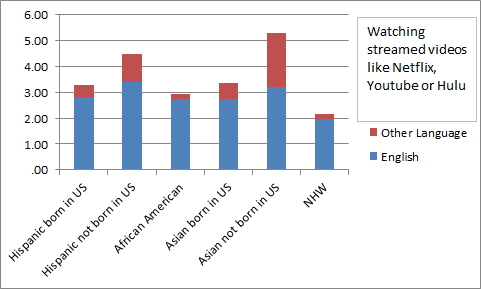
Below is the chart detailing the number of weekly hours spent watching streamed videos by different cultural groups. As can be seen streaming is most popular among Hispanics and Asians not born in the US and least among non-Hispanic Whites. Asians not born in the US report more than five hours per week watching these videos, followed by Latinos not born in the US with almost five hours per week. It may be that these groups, because of their bilingualism add more content to their routines.


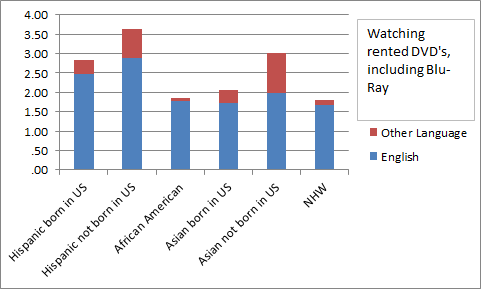
As seen in the chart below, watching rented DVD’s presents a similar pattern, but the number of hours allocated to this video delivery mode is lower and Hispanics born abroad have the highest tendency to rent DVD’s. In general, Hispanics and Asians are generally more likely to rent DVD’s than anyone else.  Perhaps the heritage of countries of origin and the availability of certain types of content account for these differences.
Watching TV via broadcast, cable, and satellite is still the dominant mode of video consumption as can be seen below.  
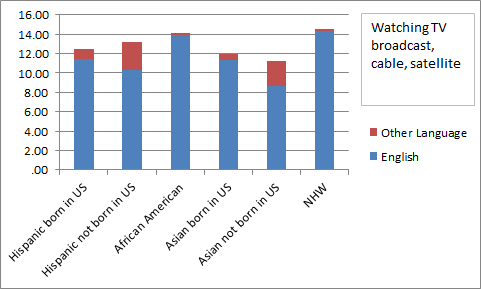
It is interesting to note, however, that those more likely to stream and rent are those less likely to watch TV in more traditional ways.  Asians and Hispanics are less likely to watch broadcast than their African American and non-Hispanic White counterparts.

These results imply that changes in video watching routines vary by cultural group and by place of birth, with the obvious implication for language preferences. Video providers like Netflix and Hulu that favor streaming are likely to be more attractive to Hispanics and Asians, particularly those born abroad. Traditional video providers like Comcast, Dish Network, and broadcast may do well in anticipating the transition that is taking place by putting more of their content online, in particular if they wish to survive in a much more competitive environment. In this new environment emerging culturally diverse groups appear to be taking the lead in enjoying newer modes of delivery.  

Cable and satellite companies may not only want to make their content available online but also they may want to reconsider how subscribers buy their content. The greater ability to choose provided by streaming and the fading DVD’s mode is not as available in cable and satellite since these companies require the purchases of large bundles of programming.

All in all, the competitive world of online video delivery seems to be hot and worthy of much attention.

The data for this study was collected by Research Now of Dallas, Texas, thanks to the generous initiative of Ms. Melanie Courtright. Research Now contributed these data to the research efforts of the Center for Hispanic Marketing Communication at Florida State University. The distribution of the sample is as follows:
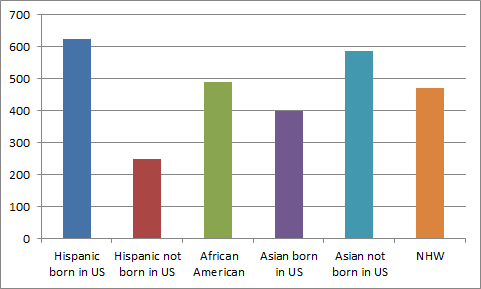
This national online sample had quotas for US region, age, and gender to increase representativeness.

Tuesday, July 10, 2012

Be a "Lemon" & "Think Small"

I'm a marketer!  But in my heart, I'm also an ad man.
So it's only right that I just bought a classic Beetle.  This is my new baby... 


So what does a Bug have to do with advertising?


In 1959, Doyle, Dane, Bernbach (DDB) created the ad campaign that would forever change advertising.  It was ranked as the best advertising campaign of the 20th Century by Ad Age and ... most importantly ... it was insanely successful in boosting sales and building a lifetime of brand loyalty.


The Volkswagen ad campaign - featuring the headlines “Lemon” and “Think small” (both used to describe the appearance of the car) - ushered in the era of modern advertising.


In a post-war America where Detroit was focused on big, family-sized or muscle cars and advertising was straight-forward and obvious, VW and DDB broke all the rules.


Why was this campaign so revolutionary and how can these 1959 concepts work for you?
  • Differentiation: Certainly the bug was radically different than anything else on the road in '59 (and still is), but the ads stood out too.  In this era, ads were all about the "hero shot," the product being used by happy people.  The ads also filled the page with the rationale of, "We're paying for the page, so we're going to use every last bit."  The Beetle ads still had the product as hero, but focused on black and white photos and white space to drive home the simplicity of the vehicle.  A technique of deliberate understatement.
Pick up most any bank or credit union ad or watch a few on TV.  Let's be honest with ourselves, in most cases, you can swap the logos and the ads are pretty much interchangeable. Make a point of having your ads stand out in the crowd.
  • Don't Be Obvious: "Lemon." is a car that breaks down.  "Think small." goes against the grain of what we see as a positive message - especially in '59!  The headlines grabbed the reader's attention in an unexpected way and forced them to engage with the copy - where the true benefits were revealed.  
In 1959, this was revolutionary.  In 2012, in the banking world, it would be too.  So many financial ads today focus on rate and "free" and everything that's important to US.  Few messages focus on real benefits that effect consumer's lives.  Don't be obvious.  Don't write a "bank ad."  Create something that will touch the consumer and get them to take notice.


Even though everything has evolved in the last 53 years, we can still learn a lot from the ad pioneers.  If you're ever stuck in a creative rut, crack open a book of old ads and see what you can bring back.


Take care and have a great week.  Now I need to get outta here and jump in the convertible! 


-------------------------------------------------------------------------------

MarketMatch is a full-service marketing firm, dedicated to the credit union and community banking community.  We utilize knowledge-based strategies to help you FOCUS on the right story that will generate the greatest  MOMENTUM and prove the best RESULTS with our written ROI Guarantee.


Saturday, December 23, 2006

New Television and US Hispanics

Television networks have for a long time ignored social trends. Slowly they have seen their share eroding as alternative media channels become more relevant in people's lives. It is interesting that Desperate Housewives have claimed a large viewership that includes many US Hispanics. Its obvious sex appeal makes it relevant to many people. But also it is its diversity and the extent to which the audience can see themselves in the screen.

Identification with characters in entertainment has been known, for a long time, to make a difference in attracting audiences. Nevertheless, television networks, perhaps concerned with losing their mainstay audience, did not seem to notice that society and their audience had changed dramatically. Not only have they been ignoring their growing audiences at the expense of their dwindling past fans, but they had not noticed that new even what they call the "mainstream" had changed its taste in favor of what is "cool." And "Latino" has been increasingly "cool." Ugly Betty, a show that started in Spanish language TV in Spanish several years ago now it is shown in English by ABC to the delight of many diverse audiences. The universal value of a woman who appears to be ugly but that is "beautiful," is relevant to many, and interestingly, it has cultural nuances relevant to US Hispanics.

The new Hispanic audience for television is not focusing on the Spanish language exclusively. It is focusing on cultural relevance. "General" audiences enjoy seeing others who are "cool" that also reflect universal values. We shall not wait too long to see more of what the industry calls "cross-over" appeal.

The old shows targeted to Hispanics, largely from Latin America, had ignored the new identify of Hispanics in the US. New and successful entertainment needs to reflect the life of US Hispanics as it is here, not there. This is the new "New World."