Showing posts with label leadership. Show all posts

Monday, November 25, 2013

Thanksgiving


As a kid, I never liked Thanksgiving much.  My undeveloped palette didn’t like the taste of stuffing, turkey was always boring, and I hadn’t yet realized the sheer bliss that can come from my mother’s pecan pie.  And I had zero interest in football.

Now that Thanksgiving week is here, I can’t stop thinking about this coming weekend.  Yes, I’m excited about the food, of course!  But I’m also thinking about traditions and the things I’m most thankful for in the world: a wonderful husband, mother, father, sister and family.  And then it hit me…how many times a year do I tell them I am thankful for them?  Usually it’s just around Thanksgiving when we are toasting and getting ready to dig into our feast.  The rest of the year, we are caught up in our own jobs and hectic lives that these types of things get lost in the shuffle, yet they are the most important people in the world to me.

The girls in my family at our annual "Cookiethon" Thanksgiving weekend
Why do we wait for a holiday to tell people we’re thankful for them or their efforts?  Because telling someone they have done a great job, or even having the time to notice ways people go “above and beyond” is always falling to the bottom of our priority list when everything else always seems to take precedence: fixing a problem, responding to those 100 emails waiting in your inbox, returning phone calls.

Showing appreciation to your staff members for a job well done is the most important time you can spend as a leader.  So go ahead and set aside a few minutes this week to tell them you care and why.  It will be the best time you spend this week as we get ready to spend this holiday and kick off the Christmas season.

Happy Thanksgiving to you all.  Wishing you safe travels, wonderful time with family and friends, and a fantastic meal!  (Oh, and GO BUCKS!)

Amanda

Thursday, August 29, 2013

The Empty Seat at the Table


There could be an important person missing from your senior management/executive team meetings.  I’ll give you a hint: this person is responsible for driving the strategic plan to grow loans and other key performance indicators for your credit union.  This person has invaluable feedback when it comes to opportunities for growth, process improvements, new product and service recommendations, and ideas to get the staff more engaged. 

Pssstt…it’s the marketing person. 

If this seat is empty at your institution, I urge you to reconsider the merits of why your marketing vice president/manager/director/department head hasn’t been included in meetings thus far.  It may be because their schedule is already so packed that you couldn’t possibly ask him or her to sit in on another meeting.  Or perhaps there is the perception that a lot of the conversation at these meetings is operational and therefore doesn’t apply to marketing. 

Ahhh…but that is EXACTLY why your marketing person should be included in these meetings.  If you have a seasoned marketing exec, their insights into industry and institutional trends, ROI, staff culture, and organizational goals will not only enhance the meeting as they are the most knowledgeable about potential growth opportunities inside and outside the institution, but it will help to make the marketing efforts that much more successful if this person is very well informed about all aspects of the organization.  If, perhaps, you have a less experienced marketing person at the helm, what better way to help them grow than to expose them to the whole of the organization so they can be more knowledgeable about, for example, why loans need increased, who a good target market will be for a campaign, and how that affects the bottom line?

Marketing is the engine that drives all of the operational goals.  For example, how is ROA increased?  Pinpointing the exact opportunities within your membership/customer base for potential growth and pulling various tactical levers to achieve growth in loans, deposits, products per member and retention.  Marketing isn’t about pretty postcards and banners on the website.  Marketing is born out of the strategic goals - and even challenges – for your institution. 

The results of including this person in your senior leadership/executive team meetings are twofold.  As stated above, it will only increase the effectiveness of your marketing efforts and growth in your institution’s key performance indicators.  The goal of any organization should be to grow and challenge its people and give them opportunities for advancement.  Including the marketing department head will also challenge and grow this person – regardless of tenure- and make them more loyal to your institution, which saves you money long-term as well.

If your financial institution is already including your marketing VP/Director/Manager in these meetings, then I would like for you to give yourself a big pat on the back!  Way to go! 

And, if you find yourself in the latter category, it’s not too late!  Go ahead - the rewards significantly outweigh the risks!  You will be on your way to even more amazing growth and success in the future while also having a more well-rounded employee that is a loyal spokesperson for your organization both inside and out.


 Amanda


We bring these philosophies to credit unions and community banks all over the country to help them with their strategic planning, marketing, and branding initiatives.  Contact me to learn more about how MarketMatch can help your financial institution define its "why" and achieve sustainable growth in the future.  Don't forget to ask about our ROI Guarantee - the only guarantee of its kind in the entire financial industry!


Thursday, July 18, 2013

Want engaged employees? Be a better leader.


Want to hear a scary statistic?  According to a recent study by Dale Carnegie Training, nearly 75% of employees aren’t working fully engaged in their positions.  

That means three out of every four employees in YOUR organization are not giving you 100%. 

And a recent study by McLean & Company listed the following statistics that stated, in comparison to disengaged employees, engaged employees are:
  • 30% more likely to agree that they regularly accomplish more than what’s expected of them in their role
  • 66% more likely to agree that their contributions are very important to the success of the organization
  • 109% more likely to put in extra hours to improve results

So how do you engage employees?  

It all boils down to being a good leader yourself and making sure that the senior management team and managers all the way down and across your organization are good leaders.  Also note that there are huge differences between a manager and a leader.  Managers may not necessarily be leaders, and leaders may not necessarily be managers, but the success of your organization depends on your managers being good leaders with their staff members.

What are the traits of a good leader in a management role?  

I’m so glad you asked.  Here are several:

Self-effacing and humble.  If you expect your employees to fess up and take ownership when they made a mistake, you have to be willing to do the same thing.  Admit when you are wrong.  Many managers think that doing this is a sign of weakness and will compromise employees’ trust, but it is really a sign of a strong leader and will actually increase your employees’ trust in you. 

Not threatened by brilliant ideas.  It is human nature to have the gut reaction of “why didn’t I think of that?”  But a good leader lets go of that thought and instead embraces that their team members are growing and succeeding as a result of their tutelage.  Good leaders are never scared to hire people who are smarter than them. 

Care about their people.  I mean truly care.  If one of your staff members gets married, ask them about their wedding and honeymoon instead of pretending its business as usual on their first day back to the office.  Yes, it may be 10 minutes out of your busy day, but that 10 minutes means the world to your employees.  People want to work in an organization – and for a manager – who they feel cares about them as a person.  This is an absolute must in a good leader.

Encourage honest feedback.  Poor leaders will squirm in their chairs when someone comes into their office with some honest feedback about a goal that was set or an initiative they think would work better in a different way.  Your organization will not thrive if everyone is telling you what you want to hear because they are afraid of the repercussions.  Honest feedback from employee to manager and manager to employee is the only way to build trust, which is the foundation of any organization.  And your organization can only truly thrive when everyone works in an honest environment where opinions are valued and shared.

Trust your employees first.  If you start out someone’s employment by giving them limited duties, expect them to do everything exactly the way you would, and don’t provide them with the autonomy and empowerment to take risks and make mistakes, then you aren’t trusting them to do their job.  Your front-line people especially deserve this as they are the ones who are taking care of your organization’s most precious asset: member and customer relationships.  If you trust them to take care of those relationships but won’t trust them on a new project, you need to answer one question: is it me who is scared to trust, or have they damaged my trust in some way?  Either way, fix the situation. 

Empower employees.  Ritz Carlton is famous for its “$2,000 Rule” that empowers any employee at any level to solve customer problems and spend up to $2,000 without having to go to a supervisor.  Risky?  Absolutely.  It doesn’t have to be $2,000, or even monetarily-related in your case.  However, if you trust your front-line employees with your company’s relationship with customers and members, then you can trust them and create an environment of empowerment and enable them to make the right decisions and do the right thing when it comes to taking care of those relationships. 

Challenge employees.  One way to do this is to give them what are known as “stretch” projects: things they’ve never done before and would like to learn how to do.  This “stretches” their professional and leadership muscles and ultimately makes them more valuable to your team and organization. 

Invest in your employees.  This takes many forms.  Benefits and compensation are the two most obvious parts of this equation.  Many studies that have come out through the recession clearly state that companies that pay their employees higher than average salaries in conjunction with a good employee development program have a higher success rate and overall better profit margin.  Another very important way to engage employees is by providing opportunities for professional development.  This is a financial investment, but it is one that ultimately rewards your organization because, if you invest in your employees, they will be more likely to invest back in the company. 

Recognize them when they do good work.  
“The model of ‘if you aren’t getting yelled at, you’re doing a good job’ isn’t going to cut it anymore.  Managers must switch their perspective of management from a job of ‘critique and assess’ to one of ‘teach’.”  -Dr. Jean Twenge, iGen Consulting
It’s easy to get up from your desk or place a call to an employee when an error has become apparent, but do you spend an equal amount of time (if not more) recognizing them for their outstanding efforts?  Recognition means more to employees than anything else because they want to know that their efforts are valued. 

Help them reach their own goals.  Make no distinction between professional and personal goals.  This is also where the honest feedback and caring about them personally comes into play.  You could have a great employee who is starting out in his or her career and, in your work on helping them achieve their professional and personal goals, they realize that they have a dream of owning a restaurant.  Yeah, this sucks for your organization, but helping your employees achieve their dreams is also your job in addition to taking care of your members and customers. 

There are many rewards to being a good leader, but the biggest difference will come to the success of your organization.  Employees will be happier and more engaged in their positions, overall organizational trust will increase leading to more great ideas, and everyone will be moving in the same direction – toward success.  

Amanda


We bring these marketing philosophies to credit unions and community banks nationwide, and would love to bring them to your institution too. Contact us to see how.

Nearing 245,000 visits worldwide, we hope that you enjoy this blog.  If you find it helpful, please share it with your colleagues. Also, check out our YouTube Channel for short video blogs about financial marketing.  

MarketMatch is also a nationally and internationally requested speaker. Contact us to bring our marketing ideas to your next conference.

614-745-5503
Follow me on Twitter @amandalthomas

Wednesday, November 14, 2012

Multicultural Technology Leadership: Tablets and Blogs

Over the past several years we have measured technology use and adoption at the Center for Hispanic Marketing Communication at Florida State University. We have consistently found that emerging minorities tend to lead in most areas of technology adoption. In 2012 with the cooperation of Research Now and the leadership of Ms. Melanie Courtright, we again collected an online national sample composed of Hispanics and Asians born in the US and those born abroad, in addition to African Americans and Non-Hispanic Whites. We used the country of birth as a proxy for acculturation to see if technology adoption varied accordingly.

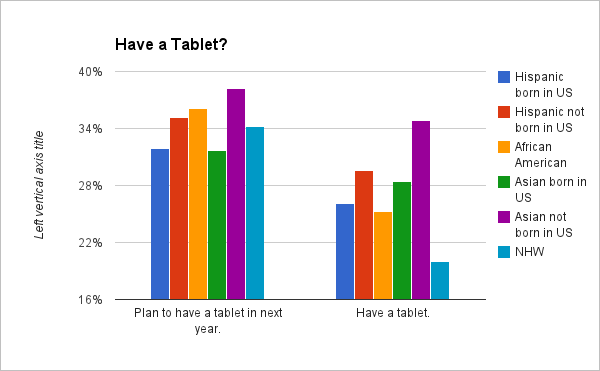
Tablets are creating chaos in the computer industry because consumers are adopting them and discarding laptops, desktops, and netbooks. The following chart shows how adoption of tablets varies of by cultural group and by place of birth.


As can be seen, Asians born abroad exhibit the largest penetration of tablet current ownership and also their projected ownership in the next year. Their affluence and technological savvy may account for this trend. Hispanics not born in the US are the second group in their ownership of tablets, and their minority counterparts follow them closely. Non-Hispanic Whites, however, lag substantially. This speaks of the technology eagerness of minorities and their leadership in technology adoption.  The differences, however, appear to vanish when looking at aspirations for the next year. Thus, minorities innovate but tablets are becoming very desirable overall.

Having a blog should be a good indicator of innovativeness in web communications. The following chart illustrates the penetration of blog ownership in different cultural groups.


Current blog ownership is highest among Asians, followed by Hispanics. African Americans and Non-Hispanic Whites lag. Tendencies for the next year vary and highlight that those not born in the US are more interested in having a blog, both Latinos and Asians. African Americans also show the aspiration to have a blog in a year in sharp contrast to their current blog ownership. Non-Hispanic Whites seem less eager to have a blog now and in the future, and interestingly Asians born in the US are at the same level as Non-Hispanic Whites in their future blog ownership.

Overall, these trends are puzzling and definitely should ignite the imagination of technology marketers. The relative popularity of blogs and their future growth indicate the social eagerness of minority groups. Culturally, blogs provide an outlet for creativity, expression, and a voice that minorities did not have before.  Marketers can take advantage of this eagerness by using these growing blogs as advertising venues for reaching out to minority networks, for example.

The phenomenal adoption of tablets and their appeal for the near future are more striking.  Mobile advertising will become increasingly powerful and tablets will be the new platform for communication. That minorities are leading now should give food for thought to marketers that are trying to predict future trends and understand where their brands will be in the near future.

The data for this study was collected by Research Now of Dallas, Texas, thanks to the generous initiative of Ms. Melanie Courtright. Research Now contributed these data to the research efforts of the Center for Hispanic Marketing Communication at Florida State University. This online survey included the responses of 936 Asians (398 US born), 458 African Americans, 833 Hispanics (624 US born), and 456 non Hispanic Whites. This national sample had quotas for US region, age, and gender to increase representativeness.

Monday, July 9, 2012

From the rooftops...

 Greetings:

There are two schools of thought when it comes to advertising your marketing message...
  1. Constant and consistent
  2. Loud and Proud
Much of our work is dedicated to development of client strategy for communications and marketing.  A consistent question we receive that I thought would make a great blog post...

How often should I be advertising my marketing message?

Our answer??

Whenever you have something to tell...tell it loud and proud with consistency!

Perfect...so the answer falls squarely between the two schools of thought...nice consulting!  Actually, the reality of life says that EVERYTHING falls between the two certainties...that's Murphy's Law at play!  Consulting advice is nothing different.  The key to great consulting is knowing where and when to apply the strategic pressure...not just that you apply pressure.

So, what am I meaning??

We believe that you advertise WHEN you have a:
  • compelling story
  • unique product or offer
  • cannot wait item or news/interest
  • market opportunity
and IF do you have one of these instances... say it LOUD and PROUD...meaning make enough noise in the marketplace that your unique and powerful message is heard!  Then be consistent with that message for as long as your budget can support and the uniqueness stands.

If you don't have of these instances...then be constant and consistent... a drum beat is the description we use.  Be constant and consistent but at a lower level-- you know,  the level just above "not much" and below the "hear us now" levels.

The key is making sure that your investment in advertising is doing the two items it is intended to do....create awareness and generate interest.  To create awareness the market needs to know about it...and to generate interest it has to be relevant and compelling.

That's where the marketing strategy comes into play for the advertising.  Knowing when to hold your cards and investment is sometimes more powerful than playing all of your cards!

So...if you have a compelling and relevant message...Shout it from the ROOFTOPS with all the gusto you can muster!

Cheers!

Bruce

PS>> Look for our announcement of a game-changing Leadership Session coming in the fall!
 
-------------------------------------------------------------------------------

MarketMatch is a full-service marketing firm, dedicated to the credit union and community banking community.  We utilize knowledge-based strategies to help you FOCUS on the right story that will generate the greatest  MOMENTUM and prove the best RESULTS with our written ROI Guarantee.