Showing posts with label ethnic. Show all posts

Tuesday, December 4, 2012

Language Preference for Television Watching by Latinos of Different Socioeconomic Levels

It has been of interest to me to explore how socioeconomic level relates to different consumer and media behaviors of Latinos in the United States. As media outlets become more abundant and as Latino growth shifts to births as opposed to sheer immigration, it is relevant to learn more about how to target Hispanics of different socioeconomic levels. In this particular instance, I am exploring the television watching behavior of Latinos according to their language of preference depending on their socioeconomic level.

Using data from the Experian Simmons National Hispanic Consumer Study that was collected in the twelve months ending on August 31, 2012, I created crosstabulations of the TGI Socio Economic Scale in the Simmons database by preference to watch television “Only in English,” “Mostly in English but Some in Spanish,” “Mostly in Spanish but Some in English,” and “Only in Spanish.” The television language preference variable in the analysis combined those who watch “Only in English” and “ Mostly in English but Some in Spanish” in one group, and those who watch in “Only in Spanish” and “Mostly in Spanish but Some in English” in another group.   Respondents stated their preference when reacting to the statement “When you watch television do you prefer to watch television programs...” The TGI Socio Economic Scale is a composite of education, ownership of selected household durables, mobile phone ownership, credit card ownership, usage of Internet and air travel. The scale results in four levels of socioeconomic standing: The top 10% of the population, the next 20% of the population, the next 30% of the population, and finally the remaining 40%.

The following line chart illustrates the trends uncovered:
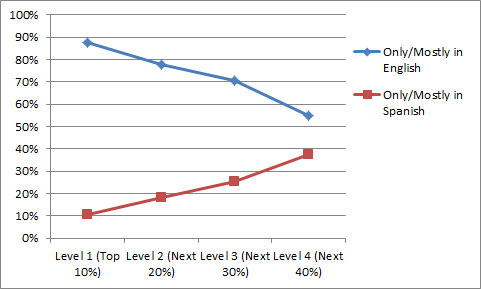


As can be observed, the lowest socioeconomic level of Latinos is more likely than anyone else to prefer watching television in Spanish, although a substantive percentage of them also indicate preferring only English or mostly English television exposure. The percentages of Hispanics at this lowest level are more equally divided among language preferences than for any other socioeconomic level. Those in Level 3 are more polarized than the lowest level as their percentages are more divided between the two languages. The polarization increases at Levels 1 and 2 as they are more dramatically divided and in the large majority they prefer television exposure in the English language.

Overall, there is a tendency for those better educated and more affluent to prefer television in the English language and for those who are in the lower levels to be more oriented to the Spanish language. It is also likely that those in the higher socioeconomic levels are more acculturated into the US. The tendencies are almost linear and monotonic.


These trends point to the dynamics of the Latino market and its complexity.  While the preference to watch programming in the Spanish language continues to be important for a substantive portion of the Latino population, it is not a uniform tendency.  This is clearly due to the fact that with so many channels in English, Latinos simply find more offerings in English than in Spanish.  It is likely that the diversity of content in English drives some of these trends.  Those more affluent can be expected to have more choices of channels for the enjoyment of television programming and that may explain some of these preferences. Also, at the lower levels there are those who have been born in the United States that share their socioeconomic level with newer immigrants.  That makes for an interesting mix of acculturation stages that affect television language preferences.

Further, as Latinos become more able to appreciate content in English, their content horizons seem to expand. Socioeconomic status and bilingualism and English fluency are related.

Marketers can take from these findings important lessons and cautions:

1. Media planning is not straightforward.  Socioeconomic level plays a role and thus different types of products may do better on English language television platforms, and others on Spanish.

2. A mix of language television platforms may be appropriate for many advertising campaigns as television language preferences, particularly at Levels 3 and 4, are more divided. They represent 70% of the Latino population.

3. Language preference for television watching may not be indicative of assimilation but of content availability and content preferences.  Thus cultural insights should likely drive marketing and advertising campaigns.

This data confirms the diversity and complexity of the Latino market and the importance of sophisticated media planning efforts.

The data used here is from the Experian Simmons National Hispanic Consumer Study and was collected from August 1, 2011 to August 31, 2012. The sample contained 8120 Latinos.

Wednesday, November 14, 2012

Multicultural Technology Leadership: Tablets and Blogs

Over the past several years we have measured technology use and adoption at the Center for Hispanic Marketing Communication at Florida State University. We have consistently found that emerging minorities tend to lead in most areas of technology adoption. In 2012 with the cooperation of Research Now and the leadership of Ms. Melanie Courtright, we again collected an online national sample composed of Hispanics and Asians born in the US and those born abroad, in addition to African Americans and Non-Hispanic Whites. We used the country of birth as a proxy for acculturation to see if technology adoption varied accordingly.

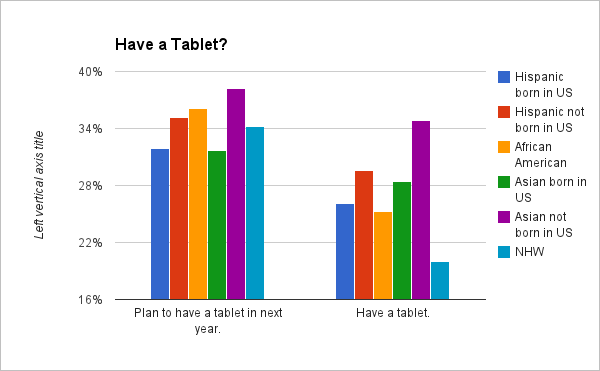
Tablets are creating chaos in the computer industry because consumers are adopting them and discarding laptops, desktops, and netbooks. The following chart shows how adoption of tablets varies of by cultural group and by place of birth.


As can be seen, Asians born abroad exhibit the largest penetration of tablet current ownership and also their projected ownership in the next year. Their affluence and technological savvy may account for this trend. Hispanics not born in the US are the second group in their ownership of tablets, and their minority counterparts follow them closely. Non-Hispanic Whites, however, lag substantially. This speaks of the technology eagerness of minorities and their leadership in technology adoption.  The differences, however, appear to vanish when looking at aspirations for the next year. Thus, minorities innovate but tablets are becoming very desirable overall.

Having a blog should be a good indicator of innovativeness in web communications. The following chart illustrates the penetration of blog ownership in different cultural groups.


Current blog ownership is highest among Asians, followed by Hispanics. African Americans and Non-Hispanic Whites lag. Tendencies for the next year vary and highlight that those not born in the US are more interested in having a blog, both Latinos and Asians. African Americans also show the aspiration to have a blog in a year in sharp contrast to their current blog ownership. Non-Hispanic Whites seem less eager to have a blog now and in the future, and interestingly Asians born in the US are at the same level as Non-Hispanic Whites in their future blog ownership.

Overall, these trends are puzzling and definitely should ignite the imagination of technology marketers. The relative popularity of blogs and their future growth indicate the social eagerness of minority groups. Culturally, blogs provide an outlet for creativity, expression, and a voice that minorities did not have before.  Marketers can take advantage of this eagerness by using these growing blogs as advertising venues for reaching out to minority networks, for example.

The phenomenal adoption of tablets and their appeal for the near future are more striking.  Mobile advertising will become increasingly powerful and tablets will be the new platform for communication. That minorities are leading now should give food for thought to marketers that are trying to predict future trends and understand where their brands will be in the near future.

The data for this study was collected by Research Now of Dallas, Texas, thanks to the generous initiative of Ms. Melanie Courtright. Research Now contributed these data to the research efforts of the Center for Hispanic Marketing Communication at Florida State University. This online survey included the responses of 936 Asians (398 US born), 458 African Americans, 833 Hispanics (624 US born), and 456 non Hispanic Whites. This national sample had quotas for US region, age, and gender to increase representativeness.

Wednesday, July 13, 2011

Social Networking Sites is Where the Action is for Hispanics and Emerging Minorities

The new town center and “plaza” is online and it is very relevant to today’s marketers in the new global village. In March 2011 we asked consumers to “please tell us how important to you the following reasons are for using social networking sites like Facebook or Twitter?” Respondents answered on a 5 point scale from “not at all important” to “extremely important.”

The two reasons for using social networking sites that stood up most significantly were: “Keeping up with new trends,” and “asking friends and relatives about their opinions on products to buy.” The graphs below summarize the aggregated percentages for the top two points of the 5 point scale.

Keeping up with New Trends

NHW stands for non-Hispanic White, AA for African American, A for Asian, HE for Hispanics who responded in English, and HS for Hispanics who responded in Spanish to the survey.


Asking Friends and Relatives about Their Opinions on Products to Buy

NHW stands for non-Hispanic White, AA for African American, A for Asian, HE for Hispanics who responded in English, and HS for Hispanics who responded in Spanish to the survey.


Minorities in general are more likely than non-Hispanic Whites to say they use social networking sites for keeping up with new trends and for interacting with friends and relatives about their opinions on products to buy. Latinos who answered in Spanish to the survey are more likely than anyone else to endorse these reasons.

There are several important implications of these findings. First, as we have seen in other results from similar surveys, emerging minorities are more engaged with the new media and are likely to use it as a source of information for their lifestyle and consumer behavior. This speaks strongly to the importance that marketers need to place in being where these consumers are, i.e., social media. Brands that facilitate interaction seem likely to have an advantage as that plays directly to what is important to these consumers.

Further, Latinos who prefer Spanish are even more engaged with social networking sites for obtaining guidance and knowing about things like fashion. While Spanish dominant Hispanics have lagged in the adoption of online technologies, they are now fast adopting them and once they adopt these technologies they seem to strongly depend on them. The synergies of social media and traditional electronic and print media are likely to be important and should be capitalized upon to create conversations and discussions. The virtual social world is opening enormous possibilities to people, and it is creating a new system of influence. Growing minorities appear to be eager to break traditional barriers.

Opinion leaders among these emergent minority groups are very likely to have an impact on their followers who share their background, but also on others who frequent social media sites. Thus, these minorities are not only finding a town center or “plaza” online but are likely to also be affecting a larger social milieu because of the very public nature of social media.
Figuring out the role of social media is still an ongoing challenge for marketers. They should start paying close attention to what is happening in the virtual marketplace. Understanding flows of influence in online networks can be crucial for the marketing of the future.

The data for this study was collected during March 2011. This online sample was comprised of 500 respondents per segment, for a total of 2,500, based on quotas by gender, age, and geographic location. DMS Insights managed the sample and data collection and they graciously contributed their effort to the academic program of the Center for Hispanic Marketing Communication at Florida State University. This study was conducted by the faculty and students of the graduate Multicultural Marketing Communication course offered by FSU.