Showing posts with label ATM. Show all posts

Monday, October 15, 2012

As Online Banking Acceptance Grows Is Mobile Banking Reaching the Tipping Point With Millenials?


A new survey by the American Bankers Association (ABA) found that for the fourth year in a row, consumers named the Internet as their favorite way of conducting banking business, with 39 percent of respondents saying it is the method they 'use most often to manage (their) bank account(s).'  The second most popular way to bank – visiting a branch – continued its downward trend to 18 percent from 30 percent in 2008.

In addition, this year’s survey showed a sharp increase in the popularity of mobile banking, driven mainly by customers in the 18 to 34-year-old age group. Use of the mobile channel by millennials escalated from 4 percent in 2010 to 15 percent this year. Conversely, the use of branches by this age group during the four-year period dropped from 20 percent to 11 percent, with ATM use also dropping from 32 percent to 14 percent. Overall, mobile banking is now preferred by six percent of customers, a 100 percent increase from 2010.

The distribution of primary channel use this year was as follows:

      • Internet Banking (laptop or PC) – 39% (36% in 2010)
      • Branches – 18% (25% in 2010)
      • ATMs – 12% (15% in 2010)
      • Mail – 8% (8% in 2010)
      • Telephone - 9% (6% in 2010)
      • Mobile (cell phone, Blackberry, PDA, I-Pad, etc.) – 6% (3% in 2010)


Online banking first became the most preferred banking method in 2009 with 25 percent of customers naming it as their favorite. Previously, visiting a branch was the most popular method, followed by ATMs. “The survey results show consumers have a clear preference for the speed and convenience that come with Internet and mobile banking,” said Nessa Feddis, ABA senior counsel and retail banking expert. “However, banks are committed to serving the needs of all customers regardless of which method they prefer,” she added.


Even the oldest demographic segment surveyed (55+) is moving away from branch visits and towards online and mobile channels. As shown below, the 61 percent of the oldest segment preferred branches and ATMs in 2008, while this preference dropped to 37 percent in this year's results. And, while mobile banking preference by this segment is still close to non-existent, internet banking has almost doubled over the past four years. 

Interestingly, this segment is the only group where bank-by-mail and telephone banking has increased consistently. In fact, telephone banking has increased during each period for all demographic segments, representing an opportunity to move many of these transactions to alternative (less expensive) channels.


“These results show customers are embracing new technologies that make managing a bank account simpler, easier and more convenient but that doesn’t mean that the traditional bank branch is going anywhere soon,” said Feddis.

“Branch design may evolve as a result of declining foot traffic. However, we know that nothing replaces human interaction and that’s why branches will never disappear,” she added.

The key going forward will be to encourage adoption the mobile channel by more than just the early adopters for more robust use beyond simple balance checking. According to the white paper developed by Fiserv a few months back entitled, "Breaking the Mobile Banking Glass Ceiling: Five Factors Will Drive Consumer Adoption," these early adopters may represent as much as 20% of eligible users.

To move beyond this 'tipping point', Fiserv recommends five factors to move mobile banking into the mainstream. These include:
      • Establishing mobile banking as useful
      • Providing access to mobile banking through all devices
      • Helping consumers overcome security concerns
      • Fostering familiarity for a natural transition across channels
      • Making mobile banking easy to use
"Financial institutions have rushed to offer mobile banking during the last few years, and many now realize that driving adoption is not just a ‘build it and they will come' proposition," said Kelly Rodriguez, vice president, Strategy and Business Development, Digital Channels, Fiserv. "In order to maximize return on investment, financial institutions need to engage both their staff and customers. This requires a proactive strategy for delivering mobile financial services and educating potential users on the benefits."

With the continued growth in smartphone ownership and the accompanying comfort level with all things digital and mobile, it is clear that mobile banking acceptance will continue to grow. The key to success will be to introduce marketing initiatives that will stimulate mobile banking utilization beyond the level which naturally occurs in the marketplace. This will require enhanced mobile capabilities, improved customer communication and a focus on the excellent win-win opportunity for both banks and customers.

Additional Resources:

The annual survey of channel preferences was conducted for the ABA by Ipsos Public Affairs, (an independent market research firm) on August 2-6, 2012. For the survey, a nationally representative sample of 1,000 randomly selected adults aged 18 and over residing in the U.S. were interviewed by telephone. This ensured survey accuracy within ±3.1 percentage points and reflected the demographic composition of the U.S.

Thursday, September 20, 2012

Banks Transforming Branch Networks to Improve Efficiencies

A lot has been written lately around the desire for banks to transform their branch networks given the consumer acceptance of alternative channels and the need to reduce distribution costs. In the past week, there has been coverage in both the American Banker as well as in BAI's Banking Strategies publication (see links to recent articles and white papers below).

One such report, published by the financial market research firm Fitch Ratings entitled, U.S. Banks: Rationalizing the Branch Network, expects that both fewer numbers of branches and different types of branches will be serving customers in the future. According to the report, the continuously increasing cost structure of banking, accompanied by a challenging revenue environment and higher capital requirements is prompting banks to evaluate all expense categories — especially their branch distribution system, which is one of the most significant expenses.

Past Branch Growth

For the past 30 years, branch growth continued unabated while the number of financial institutions declined by more than 50%. The growth occurred largely through consolidation and de-novo expansion, with the objective being to expand a bank's footprint and customer base and therefore low cost deposits and loans.

Expanding a bank's footprint was viewed by consumers as being synonymous with 'strength', and provided a bank the ability to market more cost efficiently. In the past, branches were also the primary form of distribution. The result was that markets with stronger economic activity became overbanked (similar to the growth of gas stations and car dealers in the past and drug stores today).


Branch Profitability

While in the past fees have subsidized branch networks, recent regulations (Reg. E and interchange regulations) have significantly reduced the ability to generate fee income (especially in lower income areas where branches were built to satisfy Community Reinvestment Act (CRA) requirements. Additional regulatory, human resource, real estate and compliance costs combined with the impact of a lower interest rate environment with lower spreads have further impacted the ability to support an expensive branch network.

As shown below, while non-interest income per branch has fallen off recently, non-interest costs continue to rise.


Changing Consumer Transaction Behaviors

As noted in my previous post, The Changing Definition of Convenience in Banking, a large percentage of consumers no longer equate branch distribution with convenience. While there are still some demographic segments who put a premium on the ability to transact at a local bricks and mortar facility (older demographics and small businesses), more and more consumers are banking from their desktop, ATM and mobile phone. 

While many consumers still prefer to perform account opening and more involved financial transactions at a branch, the Fitch Ratings report references Fiserv's 2011 Consumer Trends Survey that indicated that the vast majority of households with internet access (80% or 79M) use online banking, and that the growth rate of using this channel is increasing rapidly. The study also showed a substantial increase in the use of the mobile channel.


In short, changing consumer transacting behaviors combined with continued technological advances and the lower costs to the customer and bank associated with online and mobile banking, will continue to support a shift from traditional branches to digital channels.
In fact, Fitch expects increased technology spending over the near to intermediate term by the banks to continue to improve efficiency and streamline operations. While over the near term these additional technology expenses may offset cost savings from culling bank branches, longer term it should improve earnings and, therefore, returns to shareholders.

Impact of Reducing Branch Networks

Fitch views the reductions in costs, and therefore improvement in earnings, as the biggest near-term positive to the reduction (or at least the reconfiguration) of branches. Fitch also believes that larger banks with more resources are in a better position to benefit from both a technology spending and cost-savings perspective.

In the study, Fitch notes that financial institutions unable to transform their branch models in the near term may actually suffer declining market share and customer attrition since consumers are demanding new ways of transacting with their bank. Alternatively, the increased use of technology could have the impact of making it easier for customers to move funds from one bank to another, which could have the unintended impact of increasing customer attrition rates and decreasing the stickiness of deposits as banks encourage channel shift.

Branch Transformation Alternatives

With the increased cost structure of branches, changing consumer transaction behaviors and potentially negative impact of simply closing branch offices, what might be the new banking distribution model? Fitch and Infosys both believe that technology, innovation and channel integration will play a major role in the transformation of bank distribution.

While new banking entities such as Simple and Movenbank can build a truly branchless bank, traditional financial organizations will need to find the right balance of branches and alternative channels to maintain a physical presence while still moving to a more feasible cost structure for the future. And while the announcements of branch closings are becoming more commonplace (BofA, KeyBank, PNC, HSBC, Capital One) to various degrees of controversy, the decision to close or modify a branch location will not be an easy one.

Digitally Enabled Branches

Some banks, like ABN AMRO have introduced a high tech teleportal that utilizes interactive technology without the presence of any staff. The branch can conduct the majority of the functions of a traditional branch through the interaction with a 3D screen that provides an effective, albeit different, branch experience.

Banks wanting to maintain a reduced staffing model without eliminating all direct human interaction have integrated digital and video technology to supplement a reduced staff in a smaller facility. Phone banking, self-service teller stations, online banking stations (using iPad style devices) and video web conferencing are being used in some banks for loan processing and even cross-selling.

ATM Modernization

With ATM capabilities expanding rapidly, some banks are increasing the presence and utilization of ATMs to handle more customer needs. We have already ATMs that can accept checks, make bill payments, provide change and even issue stamps and movie tickets. Future advances will include the potential for live video interaction and customer support and new ways to access cash utilizing mobile devices. These expanded capabilities will allow banks to reduce (or replace) a traditional bricks and mortar branch.

Enhanced Branch Value Proposition

For those branches that remain, banks must extract a higher value from the existing real estate through improved cross-selling, expanded services (brokerage, advisory, insurance, community outreach, etc.) and an overall enhanced customer experience. Citibank has gone as far as developing branches inspired from the Apple store, integrating modern design with technology and high customer service to improve engagement and sales (see Citi Rolls Out Its Version of the Apple Store in The Financial Brand).

With banks needing to reduce and reconfigure their distribution networks due to cost and revenue implications, disruption in bank distribution will continue. In an environment where customer fees have recently increased and dissatisfaction with the banking industry is still at high levels, any perceived cutback in service levels will be met with quick and widespread negative publicity and potential for further regulatory push back. This will leave banks with having to balance their need to change their distribution strategies with potential negative public sentiment.

It will eventually fall on the shoulders of bank marketers to soften the impact of any negative response through effective (and proactive) communication using all available traditional and digital/social media channels.

What do you think will be the best near and long term distribution strategy for banking? What will be the impact of the new banking entities that will enter the marketplace without branches? I would love to know.

Recent Related Articles on Bank Branch Transformation
Riding the Innovation Curve for Branch Transformation
Boiling the Frog: Time to Re-think Branches?
Branch Consolidations: Handle with Care
Bankers Talk Bluntly About Closing, Streamlining Branches
The Branch Killers Have It Backwards in Eyes of BB&Ts King
Bank Branches Are Dead

Recent Related White Papers
Infosys - Branch Bank of the Future: Transforming to Stay Relevant
Fitch Ratings - U.S. Banks: Rationalizing the Branch Network


Tuesday, September 18, 2012

The Changing Definition of Convenience in Banking

Historically, one of the reasons people have chosen big banks has been their large network of branches and ATMs. Especially for people like myself, who travel across the country frequently, finding a place to conduct basic transactions without a fee was a competitive advantage for those institutions with a wide distribution network.

Recently, however, small institutions have been working on ways to erode this advantage, closing the gap through expanded ATM networks, improved online banking and now mobile banking services. In short, technology is quickly changing the definition of convenience for bank customers.

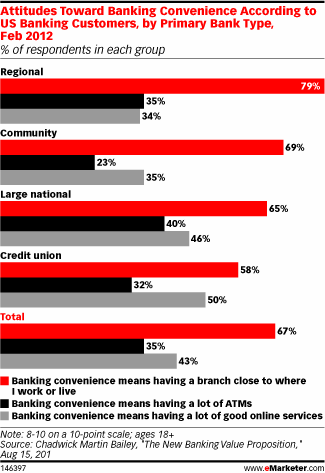
A recent study, The New Banking Value Proposition, from market research firm Chadwick Martin Bailey, finds that credit unions and smaller banks are maintaining their perception of having high levels of personalized service while also catching up with their larger competitors in terms of banking convenience. For those smaller institutions who are focusing on new technologies, this can allow them to more effectively compete for the increasing number of accounts in motion. Additional findings include:


  • While 42% of consumers state that they use a large national bank (21% regional, 13% community, and 21% credit union), the tenure of relationship (and the value received) is inversely correlated to the size of organization.


  • Online and mobile banking have quickly become key components of banking convenience. While consumers still value the branch and ATM access, 43% agree that banking convenience and having good online services are synonymous. As shown below, while large bank customers place a higher value on branch and ATM convenience, the customers of credit unions place a higher value on online services. It is expected that mobile banking service convenience will mirror or surpass the convenience value of online banking in the future.


  • Somewhat surprisingly, the research found that credit unions receive very high marks on the access to and performance of new technologies from their customers. While some of this rating may be related to the type of services desired through online and mobile channels by credit union customers (balance inquiries as opposed to more sophisticated uses), this does go against the typical perception of credit unions being less technologically advanced. It should be noted, however, that community and regional banks did not fare as well on technology performance.


In an interview with Bank Marketing Strategy, I asked Jim Garrity, Managing Director of Chadwick Martin Bailey’s Financial Services practice why he believes there is such a difference in offerings as well as consumer perception of technology innovation between credit unions and small banks? His response was, "Much of what you describe can be attributed to differences between the customer bases; credit unions are pulling customers from further away than small banks. A function of this is credit union customers wanting and needing remote access solutions more than the typical community bank customer." He also believed that credit unions often have larger pockets of young members than community banks and these customers are simply more comfortable with remote transactions.

I questioned Jim further around the introduction of new technologies in the mobile wallet and payment areas, and whether this may make differentiation between larger banks and their smaller competitors even less pronounced. Garrity responded, "The speed of technology adoption at credit unions and smaller banks is definitely quickening, but larger banks continue to have the advantage of being able to build this functionality 'to order', whereas small banks and credit unions need to purchase this functionality 'off-the shelf.'  So, while the pace of implementation is undoubtedly quickening, that doesn’t mean that big banks don’t retain the advantage being able to get there first."

Finally, I wondered if digital innovation and the importance of 'have it now' convenience could be the Achilles heel for an entire segment of the industry? Jim believed that what all banking players need to worry about is if banking is following the same path as bookstores —where many small players were selling a commodity product, then the conglomerates (the Barnes and Nobles and the Borders) dominated and forced many small bookstores out of business except in those cases where the business wasn't valuable enough or there was an unserved niche.

According to Garrity, "What we have here is that several players are vying to become the next 'Amazon of banking,' with an online presence supported by products produced by others (i.e. Simple and Movenbank)." 

There is no doubt that this research, combined with the learnings of the bookstore industry, provides some lessons to be learned from around the changing nature of convenience, the impact of commodity price pressures, the importance of service differentiation, and the relevance of community connections, etc. The key will be whether the distribution disruption continues at the same pace, how consumers will respond to the changes in the marketplace, and whether banking can alleviate concerns around security and perceived risk with digital channels.


Video overview of The New Banking Value Proposition

Thursday, March 1, 2012

Banks Need to Collect More Insights to Communicate Effectively


By Bob Williams, Director of Marketing Technologies at Harland Clarke and author of the blog, The Merchant Stand.
A friend and colleague Jim Marous shared an article from American Banker on Googe+ entitled Banks Underuse Mobile for Communication. The article discusses challenges that financial institutions have with communicating with their customers through mobile devices. While mobile device applications and mobile optimized sites are becoming more common, and expected by account holders, financial institutions are not using the mobile channel for proactive communication. Kael Kelly, senior director at Varolii is quoted in the article “Banks don’t have the data that they need. A lot of the phone number data doesn’t easily distinguish between a mobile number and a land-line.”
So the idea that banks don’t know what data they have made me think about some other data that Jim Marous shared about financial institutions and customer data. Like this tweet about banks not having email addresses for their account holders.
The challenge I see is missing or unintelligible customer profile data. That problem expands beyond the boundary of the financial services industry. It’s really a common need for any type of business. Another challenge is the misuse (or lack of use) of the data that an organization has. Another conversation with Jim last week revealed that he noticed his bank mention that online banking was 'down' using Twitter. While admirable that they used a more modern social media tool for this notification, there probably aren't many people following Twitter the way Jim does. Making matters worse, they didn't use either his email address (which is tied to his online banking account) or SMS (the bank has his cell phone) to make this notification. In other words, the bank had the tools, but didn't use what was at their disposal.
There’s no doubt that many organizations have a good process to manage customer profile data and communication. But for those that don’t, I believe there is a fairly simple solution.
A Simple Multi-Solution for Collecting Profile Data
The first step is to collect accurate information at the time of new account opening. That seems obvious, but for many businesses this may require updating the customer/client profile record to support addresses for current communication mediums. That means distinguishing between phone number types such as home, mobile, work etc. It means a place for an email address as well. If is it a business, you may also want to include a variable field for social media type contact information. At a minimum, require one phone number and one email address. If the customer insists they do not have an email address, then fill the field with an agreed upon standard such as (noemail@yourbusinessdomain.com)
I understand there are regulations governing anti-spam communications via email and SMS text. But I don’t think banks or other businesses need to over think/engineer a basic solution to keep accurate profile data.  The email and phone number should be required and make sure the customer knows when they establish the account that you may use this information to contact them with important notices about their account. You can optionally create a permission indicator (opt-in) that is designated for future marketing or non-marketing communications. While these changes may require IT, online banking and branch management support, the customer experience and cost benefits are significant.
A Simple Multi-Channel Solution for Keeping Profile Data Accurate
I suggest sending notifications through multiple channels annually for customers to check and update their profile contact information. Here are some possible touch points:
      1. Pop up in the online account area after login.  Remember, customers are in your system by their own choice. So this is a fair message to display to them regularly. This is also an area where the customer can self-serve any updates they need to make.
      2. Email reminder. Don’t ask the customer to login from the email message or reply to it. That’s a technique used by phishing attacks and creates mistrust. Rather, use the email to notify and request the customer update their profile information the next time they login to their online account or the next time they visit a branch/store location.
      3. Post the reminder message on Facebook/Google+/Twitter and other social sites where customers may follow your brand for the purpose of receiving communication. These social medium platforms are broadcast platforms. You don’t need permission to place messages there and customers that see a message from your account page are there by their own choice.
      4. Leverage the ATM. While some ATMs are equipped with interactive communication options, the ATM can at least be used as a reminder tool. Of maybe use a QR code on the ATM for customers to go to a log-in site for updating.
      5. Put the reminder message in a recording for customers holding for live assistance. It’s a simple reminder that they should keep their profile information up-to-date to help with important account notifications.
      6. Have any branch/store employees verify with customers on a designated week (quarterly or annually) that their information is up-to-date information. This only covers the customers that are serviced in-person for that week, but it’s a great touch point for interaction and shows that your brand is proactive to keep good records. Branch POS material can also emphasize the need for updated information.
      7. Messaging on all statementing and promotional materials. Emphasizing the 'green' aspects of keeping all communication channels up to date makes this a priority all year long.

Since some customers may have fees associated with SMS texting, it’s not advisable to use that channel unless you have established that as part of their profile setup.
The email channel is different in this multi-channel approach because it is a message to an individual area. In fact, email addresses that are not accurate may return as undeliverable. Consider monitoring undeliverable emails and putting these customers on a list for follow-up through other means such as phone or postal mail.  Alternatively, remove email addresses from the profile record if they are not deliverable after three attempts.
What do you think? Should it be difficult to keep accurate profile data and request the customer update/verify it with recurring frequency? Do you have a process or program at your organization that has worked? I would love to know.