Wednesday, September 12, 2012

Taking Extra Precautions to Keep Ads Safe


  1. We notify you: If we believe we’ve detected a violation of our policies, we either disapprove your ad, disallow your site from advertising in AdWords, or suspend your AdWords accounts. When we take an action, we will send you an email and send a notification to your account that will provide you customized information about the particular violation(s) we’ve detected, and will include links to AdWords Help Center articles about disapproved ads, suspended sites, or suspended accounts respectively.

  2. You can respond directly: If you think we’ve got it wrong, you can resubmit the ad for review. If you believe your site or account has been penalized inadvertently, or you disagree with our assessment, you can appeal via this form.  The best responses refer to the relevant part of the AdWords Policy Center and provide as much context in your appeal as you can. We respond as fast as we can - it typically takes us five business days to resolve appeals - each one is reviewed manually by a person in our support teams.

Rahul Pangam, Ads Quality Operations and David W. Baker, Ads Engineering

Monday, September 10, 2012

10 Tips for Effective Brand Marketing


No matter what you sell apples, office furniture, or airplane engines it’s a good idea to regularly check if your marketing campaigns are aligned with your target customers and your overall brand message.

So in the spirit of David Letterman’s Top Ten Lists, here are my top ten tips or strategies for effective brand marketing.

[1] Clearly and simply explain your brand promise in your employee handbook – most employees won't visit your website or read your brochures.

[2] Define your brand and what it represents to customers and stakeholders – and allow your brand’s unique personality to stand out among the competition.

[3] Create a company name that is memorable as well as easy to pronounce and spell.

[4] If you include a tagline with your company name or logo, make sure it adds value and doesn't just repeat the business name or initials.

[5] Create a style guide that explains how to reproduce your logo (color, size, font, etc.).

[6] Ensure that all your marketing, advertising, website, press releases, logos, signage, corporate communications, etc., convey the same message.

[7] Determine your competitive advantage – what makes your product or service unique and makes it stand out from others in your industry.

[8] Think very carefully before launching brand extensions – they must fit with the overall brand and not cause confusion – they could unintentionally result in loss of market share.

[9] Social media may be a useful tool for your company or brand to tell a story and participate in conversations.

[10] Always remember, all of your employees are brand advocates whether they work as official members of the marketing department or not – therefore, reinforce the brand’s key attributes by educating all employees and spend the time to create a positive culture where employees are recognized and rewarded so that they will become enthusiastic brand advocates.

If you spend the time to implement these ten strategies, your workplace will be a great place to work, your employees will be amazingly convincing brand advocates, and your brand will be on the road toward becoming an industry leader.

AdWords system maintenance on September 22

On Saturday, September 22, some AdWords systems will be unavailable from approximately 10:00 am to 8:00 pm Pacific Time (17:00 Saturday to 03:00 Sunday GMT) due to system maintenance.

During this time, your campaigns will continue to run as usual, but you won’t be able to sign into your account or make changes. Please also keep in mind that any automated rules scheduled during this time will not run. Daily rules (rules set up to run at a given time every day) will not run from 8:00 am Pacific Time on September 22nd to 8:00 am Pacific Time on September 23rd. If you’re an AdWords Editor user, you’ll be able to make edits offline but won’t be able to upload or download recent changes.

We apologize for any inconvenience and appreciate your patience as our engineers work to keep AdWords running smoothly.

Posted by Mark Martel, Google Ads Team

Better bids, better ads, more downloads: New app promotion tools for advertisers

With more than one million apps currently in the Google Play and iTunes Stores, we know that those of you advertising apps are looking for ways to drive valuable installs at scale while helping your apps stand out from the crowd. We recently launched several app promotion features designed to help those of you who have created an app promotion campaign in AdWords, or are considering creating an app promotion campaign, maximize your return on investment.

CPA Bidding with Conversion Optimizer
You are constantly looking for ways to easily optimize your campaigns and attract the right customers at the right cost. Google’s Conversion Optimizer helps increase conversions across our search and display networks while decreasing cost per acquisition. Conversion Optimizer analyzes historical conversion data and adjusts bids on an ongoing basis to help you maximize your ROI. We're now extending the power of this automated bidding feature to app advertisers to help you drive efficient app installs at scale.


With Conversion Optimizer, instead of a traditional CPC bid, you can set a target cost per acquisition (CPA), based on your average cost per download. Conversion Optimizer will use historical conversion data and other signals to place CPC bids automatically, in order to hit the target CPA with as much volume as possible. While results vary per campaign, strong early results from our beta campaigns show a 20%+ decrease in cost per install with the addition of Conversion Optimizer. It’s important to note that Target CPA bidding does not guarantee a particular cost per install. The tool is now available to all advertisers that have created app promotion campaigns, and we’re excited to help you move beyond manual bid management to free, automated optimization.

Ad Formats
For advertisers looking to promote your apps to app users, capturing the attention of potential users and driving them to download your app is key. Many advertisers use our text ads to drive people to an Android or iOS app, and we've now optimized text ads for Android or iOS apps to include more information about what users are getting, what they have to pay for it, and how others feel about the app.

The ad rotates to display all the information when a user clicks on the ad. The user has to click on Download to go to the app download page.

With AdWords, app advertisements are automatically updated with the latest information like reviews and ratings. You simply create a text ad that points to your app download page, and AdWords supplies the graphics and formatting. We’ve found that when app advertisers provide users with this kind of important information about their apps, many have seen their cost per conversion decrease by about 25%.

If you’d like to learn more about Google’s app promotion features and see a live demonstration of how to implement and optimize these tools in your AdWords account, tune into our webinar on September 12th at 10am PST. Register today by visiting this link: http://goo.gl/B49ma.

Posted by Chrix Finne, Product Manager, Mobile Ads

Saturday, September 8, 2012

A Different Purpose for Your Blog


Have you ever wanted to write a book? Many of us who have honed our writing skills as a result of the Blogosphere secretly dream of writing the great American novel or a historical analysis of the Civil War – some of us anyway. But have you ever thought about re-positioning your blog posts into a book? It might be easier than you think.

According to Nina Amir’s book, How to Blog a Book, you can “Write, publish, and promote your book one post at a time…If you write good copy and promote your blog well, it’s possible to gain more readers than you would with a traditionally published book.”

First, you need to decide why you want to write a book. Since you already write regular posts for your blog, you have established your ability for consistent writing as well as a routine for sharing ideas and arguments. But is that enough for a book? You may choose to write a book from scratch post by post. Or you can peruse the archives of your blog – you may have a lot more content than you think – either on a specific topic or many topics. Either way, if your answer is yes, move on to the next step.

Second, you need to ask yourself these key questions:

[1] Is my topic unique?
[2] Does what I have to say add value to my readers?
[3] Is there a market for this blog or blogged book?
[4] Who are my readers?
[5] How is my blog or blogged book different from the competition?
[6] How will I position myself in the cyber market or bricks-and-mortar market?
[7] What will I include in my blogged book?
[8] How will I organize the blogged book’s content?
[9] Does a blogged book offer me a way to gain customers for my business?
[10] Will a blogged book prove that I am an expert on my subject?

If you can answer those questions and are still eager to blog a book, here’s the third action item: write a pitch for your blogged book. Consider the following questions:

[1] Are you giving readers a solution to a problem? What is the problem? What is the solution?
[2] What’s your goal in writing the book?
[3] What do you want your readers to achieve by reading your book?
[4] Who are your readers?
[5] Is the book timely or time-sensitive?

In the words of Toni Morrison, “If there's a book you really want to read, but it hasn't been written yet, then you must write it.”
__________


Connect on Facebook: http://www.facebook.com/InspirationToCreation

Friday, September 7, 2012

Political Affiliation and Attitudes of Hispanics

In this heated political season of the Fall of 2012, when the different political parties are trying to get the attention of Hispanics it is of interest to explore how the political affiliation of Hispanics relates to some of their attitudes.

With online data collected by Research Now of Dallas Texas, for the Center for Hispanic Marketing Communication at Florida State University, I explore here a variety of attitudes as they relate to the political affiliation of Hispanic respondents. Affiliation was measured by asking respondents “Could you please tell us your political affiliation?” and the answer categories were Republican, Democrat, Independent, and No Party Affiliation, as well as the opportunity to refuse to answer. The attitude items were statements to which respondents could answer any number from 5 to 0, where 5 meant “Completely Agree” and 0 meant “Completely Disagree.”

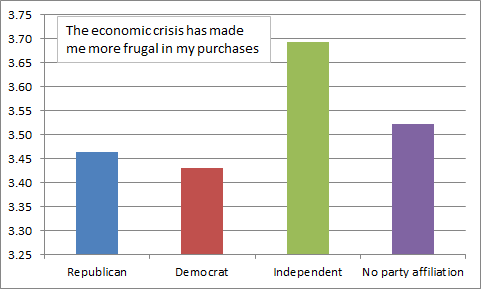
Independent respondents were more likely to state  the economic crisis has made them more frugal in their purchases than other respondents. They were followed by those with no party affiliation. Republicans and Democrats were somewhat less likely to agree with the statement.


Still, in the context of a scale from 0 to 5, there was a general sense that frugality has been a factor in these consumers’ lives.  Perhaps Independent respondents and those with no party affiliation have opted for those responses because they are politically dissatisfied.

Interestingly, when asked about worrying about retirement, the trend is somewhat different.


In the case of worrying about retirement, Republicans and Democrats seem to be more worried than their counterparts. Again, in the context of the scale we used, this is a concern to many Latinos, in general.  

The use of coupons can be construed as an indicator of economic concern.


Here the reader can see a monotonic decline of habitual use of coupons with political affiliation, from Republican to No party affiliation.  Is it the case that those with a party affiliation are somewhat more systematic in organizing their purchases?

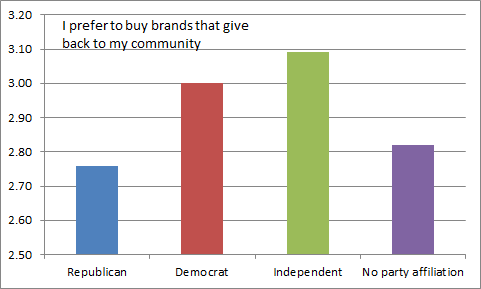
These days it is common for companies to endorse the idea that they need to give back to the communities they benefit from. 


Democrats and Independents are more likely to agree that they favor the companies that give back to the community. This is perhaps associated with socioeconomic status and with a more socially oriented philosophy.

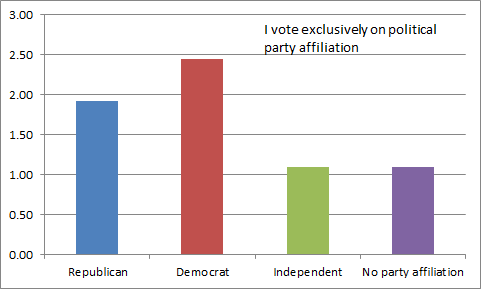
Voting along the lines of political affiliation is obviously more prevalent among Democrats and Republicans. This is perhaps not surprising but the trend confirms that there is a sense of loyalty to the party.


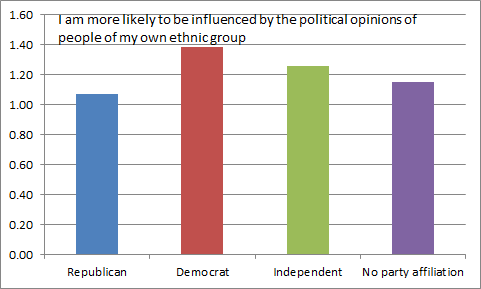
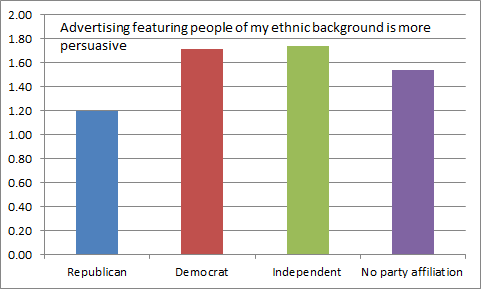
There are many politicians and advertising strategists who believe that to influence Hispanics they need to use Latinos models and that influence is likely to come from other Latinos.


While there are some small differences among affiliations regarding the feeling that one is more influenced politically by others of one’s own ethnic group, the overall level of agreement is very low. This means to me that the influence regarding Latino political behavior is more based on issues and party affiliation than on the ethnicity of influencers.

Similarly, regarding advertising, we find that while there are some differences regarding the influence of others who share a Latino ethnicity, overall the ethnicity of the people featured in the ads does not seem to be highly important.


This may be due to the fact that Latinos come in all colors and that the party affiliation and issues are more important than the ethnicity of the characters in ads. Republicans are particularly less likely to be influenced by the ethnicity of the advertising portrayals.

Overall one can conclude that political affiliation does seem to have a relationship with attitudes about the economy, even though everyone seems to be affected by economic conditions  in general. Further, political affiliation seems to be a matter of loyalty particularly for Republicans and Democrats. The ethnicity of influencers, however, does not seem to be that important to these online consumers.

The data for this study was collected by Research Now of Dallas, Texas, thanks to the generous initiative of Ms. Melanie Courtright. Research Now contributed these data to the research efforts of the Center for Hispanic Marketing Communication at Florida State University.  This national sample had quotas for US region, age, and gender to increase representativeness. The distribution of political affiliations was as follows:


Recap of SMB Hangout on Air: Special Edition

Last week we hosted an SMB Hangout on Air with Google ads executives and advertisers. For those of you who missed it, or would like to take advantage of the tips and ideas shared, here's a recap of what we covered:
  • Three tips for success: Francoise Brougher, VP of Global SMB Sales & Operations, shared that success with AdWords comes from having properly established goals, a well defined audience and highly relevant ads. 
  • Recent improvements to AdWords product: Paul Feng, Director of Google AdWords Product Management, talked about the new campaign creation flow, the Display Network tab and the ease of creating mobile-specific campaigns
  • Setting up strategy and saving time managing AdWords: Kim Clinkunbroomer, AdWords Certified Partner, got some tips from Paul on ways to save time in managing account with the use of AdWords Express and automated rules in AdWords. 
  • Video ads and Remarketing: Tom Sands, AdWords Certified Partner, received advice from Francoise on getting the most out of video ads, and learned from Paul how with the new Remarketing Tag, clients can deploy a single tag once across their whole site and build remarketing lists based on visitors segments. 
 If you missed this Hangout on Air - don’t worry - you can watch the recording now on the Google Business YouTube channel!

Posted by Agata Krzysztofik, Google Ads Team