Thursday, September 6, 2012
Finding your audience with demographics
Marketers have long looked to get a better understanding of the audience make-up of different print and broadcast media to help them better tailor their message and deliver more relevant ads to consumers. This audience insight is equally important in digital advertising, which is why, more than a year ago, we introduced a beta enabling you to show ads based on certain demographic categories, like age and gender.
Since 2011, we’ve been hard at work making this available to more advertisers. Marketers have been getting great results. For example, Blue Nile used demographics in a campaign to reach potential engagement ring buyers and saw a click through rate of 10x higher than the U.S. national average for online display campaigns.
Today, we’re happy to share that this feature is now widely available within AdWords for campaigns targeting 39 countries; if available in your region, it will start to appear in the Display Network Tab as Age and Gender targeting.
Demographic categories complement other AdWords targeting features, such as interest categories, remarketing and keyword contextual targeting. The ultimate goal is to help you better refine your marketing message and reach the right audience with the right ad. For example, if you sell yoga gear and know that your core audience tends to be women between the ages of 25 and 34, you can set your campaign to show mostly to that audience, rather than showing your ads to people less likely to be interested in the product.
Our goal is to help you better connect with your audience, meaning more effective marketing campaigns for you. This is an important part of our efforts to make our ads better for users, which helps to fund content across the web. To get started using demographics in your campaigns, visit our help center.
Posted by Jon Krafcik, Product Manager

Wednesday, September 5, 2012
Gagliano's 6 Laws of Marketing

My wife is a high school science teacher. She should love this blog.
Most of us are familiar with Newton’s laws of motion and Archimedes’ principle. Well, now here are (drum roll, please) … Gagliano’s Laws of Marketing.
Like the Laws of Science, these will describe, predict or explain why things happen in the marketing world.
1. The Law of Action
Every action should anticipate an appropriate reaction.
As marketers, we’re in the business of influencing people’s behavior. We are also in the business of driving revenue to our organization. That said, every dollar you spend should have a specific customer/target response in mind.
2. The Law of Consistency
A customer’s experience is only as good as their last interaction with your company.
Your team must be provide the same serve level at 4:58 on a Friday afternoon as they do any other time. As soon as they enter your parking lot, they are on stage and the curtain doesn’t drop until they leave the property.
This law also relates to your brick-and-mortar and electronic touch points. A sloppy building, down server or crashed ATM can play havoc with a relationship.
3. The Law of Differentiation
Customers never change a product or brand without a good reason.
As humans, we are creatures of habit. If we’ve made a product or brand choice, we tend to stick by it until the benefit of a change outweighs our comfort level with our previous verdict.
To motivate a change, you must demonstrate a tangible benefit for a customer to come to you. And make the switch as easy as possible.
4. The Law of Perception
A customer’s perception out-weighs a company’s reality.
You know you have the better mousetrap. You know your people are smarter and care more than anyone else in town. So why don’t you have 100% market share?
There are unlimited factors that drive a customer’s perception: building/employee image, brand recognition, social media/word-of-mouth, logo design, advertising messages, etc. You must gauge, analyze and manage your image in the community.
Part two of this law is that ANY perception can be changed – good-to-bad or vice-versa (see Law #2)
The best example I can share has to do with a fence that I had built a few weeks ago. I wanted a simple, split-rail fence. Nothing fancy, so my driving decision-criteria was price. I chose a company called Afford-A-Fence (seriously, I can’t make that up). In his heart, the owner knew he provided quality work, but with a name like Afford-A-Fence, my perception and expectation level was something different. In the end, they did a great job and changed my perception completely.
5. The Law of Need
The target’s needs take precedence to the company’s needs.
Your target has a need for a certain product, at a certain price-point, delivered by a certain technology and they want to use you in certain ways. If you do not meet those needs, someone else will.
To be successful, you must align your marketing to target individuals who are most aligned with your company’s product offerings, price-point and delivery system … but be ready to adapt with your target’s changing needs.
6. The Law of Measurement
That which is not measured cannot be considered successful.
This law follows closely with Law #1. As each marketing initiative has a defined objective, we must measure against that objective to determine success or plan future improvement. Whether you’re assessing unaided awareness or raw ROI, marketing must be measured to demonstrate success.
As “laws” these have each been tested and re-tested … proven over time. But this is, by no means, a definitive list. As a group of brilliant marketers, we can add to this. Please add your own Laws of Marketing in the comment section below.
With an in-depth knowledge of your product, a firm understanding of your target and these laws in-hand, you can plan marketing for anything from financial products to shin guards, custom homebuilders to tortillas, commercial air compressors to water parks (I know, because I’ve been responsible for all of these and more).
Take care,
Eric
With more than 125,000 visits worldwide, we hope that you enjoy this blog. If you find it helpful, please share it with your colleagues. Also, check out our YouTube Channel for short video blogs about financial marketing.
We bring these marketing philosophies to community banks and credit unions nationwide, and would love to bring them to your institution too. Contact us to see how.
MarketMatch is also a nationally and internationally requested speaker. Contact us to bring our marketing ideas to your next conference.
-------------------------------------------------------------------------------
MarketMatch is a marketing firm, dedicated to the credit union and community banking community. We utilize knowledge-based strategies to help you FOCUS on the right story that will generate the greatest MOMENTUM and prove the best RESULTS with our written ROI Guarantee.
AdWords scripts - now available to all AdWords users
In June we announced the limited release of AdWords scripts, a new AdWords tool that enables you to make changes to an AdWords account, such as updating keywords and ad copy or outputting account statistics, by writing simple JavaScript programs. Today we’re pleased to announce that AdWords scripts is available to all advertisers globally. In addition, we’re launching several frequently requested features that enable advertisers to:
- Run more complex scripts - We extended the length of script executions from 5 minutes to 30 minutes, allowing you to make more complex changes. In addition, we’ve expanded the entity limit to 100K.
- Use real-time data to manage campaigns - We’re adding support for Ad Parameters, which allow you to update numeric values in ads without having to delete and re-enter ad copy or wait for policy checks. Here’s a tutorial showing the use of US Geological Survey data to insert dynamic ad text.
- Automate scripts with scheduling - You can now schedule scripts to run a single time, daily, weekly, or monthly.
- On Tuesday, September 11th at 11:30am PST / 2:30am EST, we’ll be hosting a Hangout on Air through Google Developers Live, targeted to advertisers with more advanced coding skills. Questions asked via Moderator will be answered at the end of the presentation.
- On Thursday, September 13th at 10amPST / 1pmEST, we’ll be hosting a Learn with Google webinar targeted to advertisers with basic JavaScript experience. During this webinar, we will provide an overview of what can be accomplished with Scripts, walk through ways to customize pre-set Scripts, and show you how to write Scripts from scratch. Click here to register.
Upcoming webinars - Go Bigger, Faster with AdWords account management solutions
Over the last few months, we’ve hosted a number of Learn with Google webinars that help you go bigger, faster with AdWords technology that does the heavy lifting so that you can increase efficiency and reach new customers. In March we walked through best practices for efficiently building, optimizing and managing large campaigns using AdWords Editor and Automated Rules. Then in July we shared an overview of four account management tools -- AdWords Editor, automated rules, AdWords scripts and DoubleClick Search -- to help you navigate your choices and make the best decision for your business.
After each of these webinars, you shared that you’d like a deeper dive on how to make the most of these tools, including a walkthrough of new and little known features, as well as advanced applications. We heard you loud and clear, and are pleased to bring you two webinars focused on in-depth best practices for using AdWords Editor and AdWords scripts to manage your accounts automatically and at scale.
Managing AdWords Accounts at Scale - Go Bigger, Faster with AdWords Editor
Wed, Sept 5, 10am PDT / 1pm EDT (TODAY!)
This webinar is intended for current AdWords Editor users who are looking for a product refresher, as well as tips for making the most of new features released in version 9.8.1.
Managing AdWords Accounts at Scale - Go Bigger, Faster with AdWords Scripts
Thurs, Sept 13, 10am PDT / 1pm EDT
This webinar will be on AdWords scripts, a new tool which allows you to make changes to an AdWords account by writing simple JavaScript programs. We'll provide an overview of what can be accomplished with scripts, walk through ways to customize pre-set scripts, and show you how to write scripts from scratch. It is intended for AdWords users who have some basic programming experience and are excited to take advantage of this new tool.
Register for these, and other Learn with Google webinars, here.
After each of these webinars, you shared that you’d like a deeper dive on how to make the most of these tools, including a walkthrough of new and little known features, as well as advanced applications. We heard you loud and clear, and are pleased to bring you two webinars focused on in-depth best practices for using AdWords Editor and AdWords scripts to manage your accounts automatically and at scale.
Managing AdWords Accounts at Scale - Go Bigger, Faster with AdWords Editor
Wed, Sept 5, 10am PDT / 1pm EDT (TODAY!)
This webinar is intended for current AdWords Editor users who are looking for a product refresher, as well as tips for making the most of new features released in version 9.8.1.
Managing AdWords Accounts at Scale - Go Bigger, Faster with AdWords Scripts
Thurs, Sept 13, 10am PDT / 1pm EDT
This webinar will be on AdWords scripts, a new tool which allows you to make changes to an AdWords account by writing simple JavaScript programs. We'll provide an overview of what can be accomplished with scripts, walk through ways to customize pre-set scripts, and show you how to write scripts from scratch. It is intended for AdWords users who have some basic programming experience and are excited to take advantage of this new tool.
Register for these, and other Learn with Google webinars, here.
Language Preference of Hispanics and Perceptions of Financial Well Being: Implications for Marketing
To what extent has the financial situation affected the perceptions of financial well-being of Latinos depending on their language preference? This question has implications because the answer may impact the way in which consumers make purchase decisions.
Language preference among Hispanics has been considered a proxy for acculturation. It is also an indicator of the many aspects of life that impact Hispanics from media preferences to interpersonal interactions. The anti-immigration sentiment prevalent in many circles in the US these days has hurt recent immigrants in particular. In addition, economic circumstances in the past few years are likely to have affected Latinos differentially depending on their integration in the US.
Using data from the Simmons National Hispanic Consumer Study that was collected in the twelve months ended on March 16, 2012, I created crosstabulations of language preference by financial outlook among Hispanics. Language preference was gauged as the language the respondent prefers to speak in general and the response categories were Only English, Mostly English but Some Spanish, Mostly Spanish but Some English, and Only Spanish. For this analysis I collapsed Only and Mostly English and Only and Mostly Spanish to form the preferences for English or Spanish.
The financial outlook dimension was measured with the question: Do you think you are better off or worse off financially now than you were 12 months ago? The response categories were Significantly Worse Off, Somewhat Worse Off, About the Same, Somewhat Better Off, and Significantly Better Off. For the purposes of this analysis I collapsed those who answered significantly and somewhat worse off, and those who answered significantly and somewhat better off to result in three categories: Better Off, About the Same, and Worse Off.
The resulting “average” table is presented below:
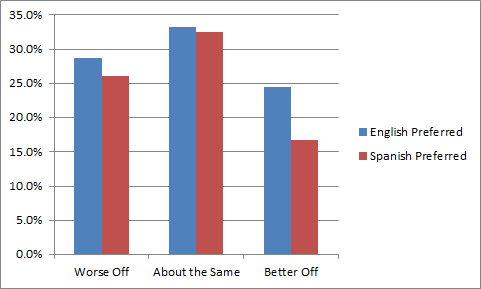
The plurality, over 30% of Latinos indicate that their financial situation is about the same as it was 12 months ago. This can mean different things. It can mean that things have not improved or that things have been as good as they were a year ago. Given the economic situation the US is going through, most likely it means that things have not improved but not gotten worse. Also, the “fatalism” prevalent in the culture may lead many to express that things are the same as usual and that in the average there is no change.
English preferred Hispanics, however, have a much more positive perspective than Spanish preferred Latinos as a substantively larger percentage of them indicate they are better off now than 12 months ago than their Spanish preferred counterparts. This may not be completely surprising since Spanish preferred respondents are more likely to be more recent immigrants and also more likely to suffer the consequences of immigration policies. These more recent immigrants are also more likely to have suffered from lack of work due to the lack of jobs in industries like construction that have traditionally employed many recent immigrants from Mexico and other parts of Latin America.
In a somewhat contradictory fashion, a few more English preferred Hispanics also report being worse off now than Spanish preferred respondents, but the differences between these two groups are very small. What is interesting is that over 25% of Latinos feel things have been worse for them in general. While not surprising, these figures bring home the notion that the economy and immigration related issues are likely to have made life worse for many Hispanics who try hard to make a living for themselves and their families.
The news for marketers are mixed. The majority of Hispanics feel they are better off or about the same as they were 12 months ago, and that is good news as that means that spending by most Latinos is likely to continue at a sustained pace. The negative news are that a substantial percentage feel the brunt of pervasive immigration and economic conditions and that their spending may be limited by their actual and perceived spending power. This brings about the importance of making politicians aware that the uncertainty of immigration reform needs to be removed for economic growth. The clarification of immigration policies and rules is likely to make the future more predictable and optimistic for many. Also, as in the overall economy, job creation should be a most important priority.
The data used here is from the Simmons National Hispanic Consumer Study and collected from January 31, 2011 to March 16, 2012. The sample contained 3,518 English preferred Latinos, and 2,104 Spanish preferred Hispanics.
Language preference among Hispanics has been considered a proxy for acculturation. It is also an indicator of the many aspects of life that impact Hispanics from media preferences to interpersonal interactions. The anti-immigration sentiment prevalent in many circles in the US these days has hurt recent immigrants in particular. In addition, economic circumstances in the past few years are likely to have affected Latinos differentially depending on their integration in the US.
Using data from the Simmons National Hispanic Consumer Study that was collected in the twelve months ended on March 16, 2012, I created crosstabulations of language preference by financial outlook among Hispanics. Language preference was gauged as the language the respondent prefers to speak in general and the response categories were Only English, Mostly English but Some Spanish, Mostly Spanish but Some English, and Only Spanish. For this analysis I collapsed Only and Mostly English and Only and Mostly Spanish to form the preferences for English or Spanish.
The financial outlook dimension was measured with the question: Do you think you are better off or worse off financially now than you were 12 months ago? The response categories were Significantly Worse Off, Somewhat Worse Off, About the Same, Somewhat Better Off, and Significantly Better Off. For the purposes of this analysis I collapsed those who answered significantly and somewhat worse off, and those who answered significantly and somewhat better off to result in three categories: Better Off, About the Same, and Worse Off.
The resulting “average” table is presented below:
The plurality, over 30% of Latinos indicate that their financial situation is about the same as it was 12 months ago. This can mean different things. It can mean that things have not improved or that things have been as good as they were a year ago. Given the economic situation the US is going through, most likely it means that things have not improved but not gotten worse. Also, the “fatalism” prevalent in the culture may lead many to express that things are the same as usual and that in the average there is no change.
English preferred Hispanics, however, have a much more positive perspective than Spanish preferred Latinos as a substantively larger percentage of them indicate they are better off now than 12 months ago than their Spanish preferred counterparts. This may not be completely surprising since Spanish preferred respondents are more likely to be more recent immigrants and also more likely to suffer the consequences of immigration policies. These more recent immigrants are also more likely to have suffered from lack of work due to the lack of jobs in industries like construction that have traditionally employed many recent immigrants from Mexico and other parts of Latin America.
In a somewhat contradictory fashion, a few more English preferred Hispanics also report being worse off now than Spanish preferred respondents, but the differences between these two groups are very small. What is interesting is that over 25% of Latinos feel things have been worse for them in general. While not surprising, these figures bring home the notion that the economy and immigration related issues are likely to have made life worse for many Hispanics who try hard to make a living for themselves and their families.
The news for marketers are mixed. The majority of Hispanics feel they are better off or about the same as they were 12 months ago, and that is good news as that means that spending by most Latinos is likely to continue at a sustained pace. The negative news are that a substantial percentage feel the brunt of pervasive immigration and economic conditions and that their spending may be limited by their actual and perceived spending power. This brings about the importance of making politicians aware that the uncertainty of immigration reform needs to be removed for economic growth. The clarification of immigration policies and rules is likely to make the future more predictable and optimistic for many. Also, as in the overall economy, job creation should be a most important priority.
The data used here is from the Simmons National Hispanic Consumer Study and collected from January 31, 2011 to March 16, 2012. The sample contained 3,518 English preferred Latinos, and 2,104 Spanish preferred Hispanics.
Twtvite Updated – Sleek New Features
Twtvite has gone through a major update since I used it last. In fact, I’m so impressed that I wanted to share with you here. “Twtvite” (pronounced Twit-vite) allows you to easily create and share tweetups with your followers on Twitter (and beyond). You can create a tweetup on the fly or plan one well in advance. If you haven't planned a tweetup before, you may want to read this post first.
Laura is a marketing professional and blogger who has been active in social media since 2005. If you enjoyed this post, please consider subscribing to this blog via Email or RSS. Laura can also be found on Twitter (@LauraCatherineO), Facebook, and LinkedIn.
In the past, you could add a logo and small banner to your Twtvite event invitations, but the rest of the invite was pretty generic. I’m sharing a screenshot of the tweetup I just created on their upgraded site, plus details on the upgrades below. If you’re in Charleston, be sure to join us for the September Charleston Ladies Who Lunch tweetup on 9/14 (info).
Twtvite Features I love:
 |
| Click photo above for full-size look |
- Customizable background adds a sleek look – upload your own or use your twitter background. I matched the background below to the background from the Charleston Ladies Who Lunch website. Great for branding!
- Nice, wide header across the top – perfect for your logo or just about anything (measures 940 pixels wide by 100 pixels tall for those designing the graphics)
- Large event photo (600 pixels wide) space just below the header – Perhaps my favorite part! What a difference it makes…
- Event hashtag prominently placed in red (top right) – love it
- Easy RSVP options (plus feature to RSVP for others who may not be on Twitter)
- As always, great Google map, RSVP count and (perhaps new?) invite views
- This was there before, but I still love the event “wall” – a play on Facebook, but still nice!
Ready to create your own Twtvite? Just visit www.twtvite.com and login with Twitter. Then, follow the simple steps to create your event in minutes. (Tips on planning a Tweetup here). I use the free version and it has served me well.
Laura is a marketing professional and blogger who has been active in social media since 2005. If you enjoyed this post, please consider subscribing to this blog via Email or
RSS. Laura can also be found on Twitter (@LauraCatherineO), Facebook, and LinkedIn.Tuesday, September 4, 2012
Keepin’ it fresh with seller ratings extensions
Nearly two years ago we introduced seller rating extensions. In addition to helping users identify highly recommended advertisers, seller rating extensions often provide a CTR lift to sellers who consistently deliver a positive online experience.
Today, we’re announcing a change to help keep ratings fresh and relevant. Previously, we would show seller rating extensions only for advertisers that have at least 30 lifetime reviews and a 4-star average. Moving forward, we will only show seller rating extensions for advertisers that have at least 30 reviews over the last 12 months and a 4-star average.
Since customer opinions about a business can evolve over time, this change will help make seller rating extensions more useful and relevant for searchers. It should also benefit businesses that satisfy customers and garner positive reviews on an ongoing basis.
For more information about seller rating extensions, please visit the AdWords Help Center.
Today, we’re announcing a change to help keep ratings fresh and relevant. Previously, we would show seller rating extensions only for advertisers that have at least 30 lifetime reviews and a 4-star average. Moving forward, we will only show seller rating extensions for advertisers that have at least 30 reviews over the last 12 months and a 4-star average.
Since customer opinions about a business can evolve over time, this change will help make seller rating extensions more useful and relevant for searchers. It should also benefit businesses that satisfy customers and garner positive reviews on an ongoing basis.
For more information about seller rating extensions, please visit the AdWords Help Center.
Subscribe to:
Posts (Atom)