Showing posts with label GoBank. Show all posts

Wednesday, October 2, 2013

GoBank Introduces One of First iOS7 Mobile Banking Apps


If you are an Apple iPhone devotee and have downloaded the new iOS7, you probably have a strong opinion about the new design. Maybe you love it. Maybe you hate it. Maybe you are like me and are still getting used to the new look, feel and functionality. 


Upon introduction, many apps immediately took on the new 'flatter' iOS7 look. That is, except for your mobile banking apps. In an industry desperately trying to keep up with customer demand for basic functionality, most didn't have time to change the look of their apps . . . except for GoBank.


In line with the GoBank brand, the relatively new mobile-first banking brand considered the introduction of a new design in late September an important differentiator for GoBank. "Being first to introduce a new design that leverages the iOS7 look shows that we're not just a bank, but also a technology company … right on the pulse of what's new and next," stated Sharon Pope, chief marketing officer of GoBank in an online interview with Bank Marketing Strategy.
  

According to Pope, GoBank's iPhone team worked carefully to incorporate Apple's new vision for the iPhone aesthetic so that the app would feel right at home on customers' recently updated devices. "You can see a lot of the elements of Apple's vision throughout the design. And a great indicator how beautifully we applied Apple's guidance is that Apple has featured GoBank as one of the "Best New Apps" for the iPhone."


Hoping to design in line with Apple's iOS7 'human interface guidelines' as outlined in their developer user interface design resource guide. According to Apple, an iOS7 design should embody the following themes:
      • Deference: The UI helps users understand and interact with the content, but never competes with it.
      • Clarity: Test is legible at every size, icons are precise and lucid, adornments are subtle and appropriate and a sharpened focus on functionality motivates the design.
      • Depth: Visual layers and realistic motion impart vitality and heighten users' delight and understanding.

Subscribe to Bank Marketing Strategies


New GoBank User Experience


Immediately upon login, it is clear that GoBank was following the lead of Apple, especially with the design of buttons, eliminating the previous hard-edged buttons, arrows, etc. and replacing them with the borderless buttons that are key to the new iOS7 design. While the use of 3D button icons were used by Apple initially to replicate the Blackberry experience that so many early smartphone users were familiar with, consumers no longer needed the transitional visual element.


In addition, the initiation of the GoBank app follows Apple's start-up standards by avoiding splash screens and other elements that inhibit the ability to open the app immediately. This has always been a strong point for GoBank, with key activities shown at start-up. "We have never wanted the user to click through 4-5 screens to get to their main reason for visiting the site," stated Pope.


It should be mentioned that of all of the mobile-first banking firms (Moven, Simple, Bluebird), GoBank had one of the most streamlined applications in it's pre-iOS7 iteration. I have written on my admiration of GoBank in the past (Seven Reasons I Love GoBank) because the UI has always been intuitive, crisp and fluid, with all primary mobile banking functions being easy to access. 

The application and communication from the bank also is informal and accessible from their Facebook page to their new iOS7 Fortune Teller application that informs users if a proposed purchase could cause a potential financial challenge.


Another iOS7 designer guideline was to let translucent UI elements hint at the content behind them. For GoBank, this can be found in the pre-login experience (what someone would see when they download the app for the first time, which overviews some of the key features).

Project Runway Update


According to Sharon Pope from GoBank, the sponsorship and product placement on Project Runway has yielded a marked increase in awareness of GoBank throughout the fashion community and their overarching target audience. "It's a great target for us, because that community is always looking to find that look for less. Our budget tool, and Fortune Teller, are great for them. We think it's the perfect accessory to any fashion-loving person on a budget. And we've received a lot of praise from early users in this area," says Pope.

The engagement with Project Runway is also highly promoted through Facebook, Twitter, Instagram and YouTube.


Subscribe to Bank Marketing Strategy Via Email


Monday, April 22, 2013

Essential Online Channel Metrics For Financial Marketers


With evolving technologies and platforms, financial marketers need a clear and comprehensive set of metrics to determine the effectiveness of their online channel. 


Instead of drowning in data and not being able to connect the dots in a meaningful way, here are four metrics that rise to the top and provide the clearest picture as to the selling power of a bank or credit union website.


By Melanie Friedrichs, Analyst for Andera, Inc.

In the Wild Wild West atmosphere of the early internet era, companies raced to slap websites online without thinking too hard about what purpose their website should ultimately serve.  Consumer retail companies found their ROI in online shopping, and their websites gradually evolved to draw visitors in and drive them to checkout.  In contrast, financial institutions focused on expanding eServices, until their websites became little more than portals to online banking. 

In the last few years, we’ve seen institutions start to wise up to a second, essential function of the online channel.  As Joe Swatek from ACTON Marketing said, “Your website has an important SALES function.”  Technology has made it possible for financial institutions to acquire new customers and members and grow relationships completely digitally, and like consumer retail websites aim to sell consumer products, financial institution websites should aim to open new deposit accounts and originate loans.  When thinking about the account opening and lending through the online channel, there are four essential metrics that financial institutions should consider:

1)      Conversion Rate


The single most important metric for a financial institution website is its conversion rate, or the percentage of qualified  unique visitors that begin applications for deposit or loan products.

Before the introduction of online account opening and lending, financial institutions focused primarily on making online banking login as easy as possible, and on providing key corporate information.  The rest of the website really didn’t matter that much, so webmasters cluttered pages with news items and product advertisements from different departments.  Over time, most financial institution websites began to resemble ill-managed community bulletin boards.


Unfortunately, bulletin boards don’t convert particularly well.  For one, the paradox of choice applies: when there are hundreds of calls to action, and no one call to action is emphasized over the others, most site visitors won’t answer any call to action at all.   This principle has been proved again and again in consumer retail.  What’s more, most financial institutions do a surprisingly poor job of emphasizing product benefits, and many hide or leave out essential rate information. For more resources on website optimization for conversion see here, here and here.

Not surprisingly, online-only banks tend to have conversion-focus websites. Three great examples are MovenGoBank, and Perkstreet Financial. All three have simple, almost spare websites that emphasize benefits and that drive visitors toward their application button.


Some institutions have ironically invested the time and money to optimize their website, but they don’t allow site visitors to sign up online, and direct them instead to a paper application, ask them to visit a branch, or ask them to phone into a call center.  Certainly, some consumers like to compare rates and products on the internet but ultimately want to open their new accounts by talking to a human directly, but in today’s online-centric world, institutions that don’t let consumers complete the process online are leaving money on the table.

2)      Abandonment Rate


The second most important metric that financial institutions should track is their abandonment rate, or the percentage of started applications that are never submitted because the applicant abandoned the process

Checkout abandonment is a much studied topic in consumer retail, and generally the experts agree on one thing: a shorter process is better.  Amazon, at the extreme, features one click purchases. Unfortunately applying for financial products requires many steps to satisfy Know Your Customer (KYC) regulations and comply with disclosure and fair practice requirements.  You will likely never be able to apply for a checking account with one click. Clients on Andera’s legacy platform on average saw between 70-80% of applicants drop-off from start to submit, compared to an average of 60-70% in consumer retail checkout.  In addition, around 10-30% of submitted, approved applicants never open accounts because they fail to complete the final few steps.  Institutions should look at both numbers.  The chart below shows application drop-off by page from start to submit, aggregated across 26 clients on the Andera Legacy online account opening platform.


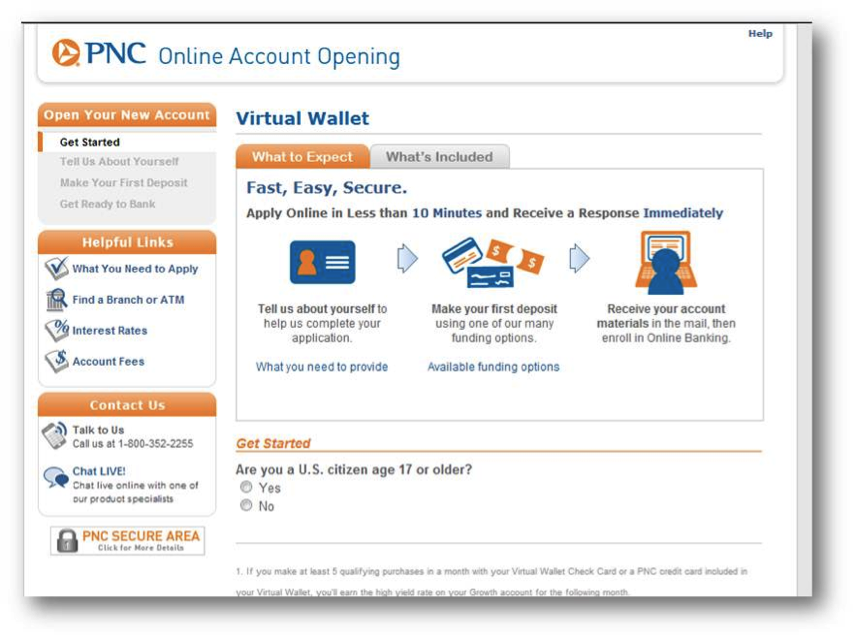
That said, there is a lot that financial institutions (or their vendors) can do to make account and loan applications a faster and easier process. When it comes to workflow design, a good user experience designer is worth his/her weight in gold. Things like page order, help text syntax, and field groupings and labels can make the difference between a completed application and a frustrated, confused, abandoner.  PNC created a winning application for their virtual wallet product in 2010 by teaming up with IDEO’s expert designers and Andera.  Our next generation platform, oFlows, is helping us make that type of experience available for all institutions.


Online account opening and lending can also create what I like to think of as ‘break downs.” Imagine that you’re test driving a luxury vehicle; the seats are roomy and comfortable, the steering is smooth, and the suspension is fantastic, so even though the road is bumpy, you don’t feel a thing. Then suddenly, the car breaks down, and you have to wait for three hours for a mechanic to come and fix it. Would you buy the car?

There are three main ways a deposit account or loan application can break down to spike abandonment rates:

  • Identity Verification Failure: Data-based identity verification systems often can’t find matches for applicants with thin credit files, and around 10-20% of matched applicants fail the out-of-wallet questions required to confirm they are who they say they are. The best systems will use alternative data to reduce IDV failures, and for those who do fail, they will make it easy to upload a photo ID for manual review. Ally’s otherwise first-class ride broke down in this way.
  • Challenge Deposit Wait Time: Financial institutions who allow funding via ACH often require applicants to verify their bank account with challenge or trial deposits. Unfortunately, challenge deposits don’t appear in the applicants bank account right away, and even if they did, verifying them would still require the applicant to navigate away from the application, login to a different system, locate the appropriate information, and return. 
  • Signature Card Mail or Fax Requirement: e-Signatures were legalized back in 2000, but many financial institutions still require applicants to fill out and mail in a “signature card” so they’ll have a copy of a physical signature on hand to compare to later checks. This is not a necessary step (many of our clients don’t require signature cards), and the cost (abandonment) is becoming less and less justifiable as check use continues to decline.  Read more here.


The three causes of “break down” and high abandonment rates are not easy to eliminate. Solving the IDV problem usually requires additional investment from the institution, either in alternative data integration or a solution that easily allows photo upload. ACH funding is cheaper for institutions than credit/debit funding, and less vulnerable to certain types of fraud. As noted, physical signatures can also help reduce the risk of fraud.  We believe that in all three cases, the incremental risk or investment isn’t worth losing applicants to abandonment.

It’s difficult to compare abandonment rates across institutions, because every institution attracts slightly different applicants and every institution has slightly different products. But abandonment is definitely something that financial institutions need to pay attention to. A small decrease in abandonment can mean hundreds of new customers or members a year. For more on abandonment, check out Andera’s report on the “7 Reasons Applicants Quit.” 

3) Cross-Sell Rate


The third important metric is the cross-sell rate.

Online account opening and lending has made it easier for banks and credit unions to acquire new customers and members, but it also has made it easier to lose them. Open a checking account for a consumer, and they don’t have much incentive to stick around. Annoy a savvy online shopper once, and he or she can switch institutions in about half an hour from their dining room table.  Open a checking account and a seven-year CD for a consumer,and bam, that relationship just got a whole lot stickier.

A good online application will incorporate an automated cross-sell step that presents applicants with pre-approved offers for deposit and loan products, and allow applicants to apply for all products they select using a single application.  Andera’s oFlows platform makes cross-sell offers as early as possible, to increase the likelihood that applicants will consider and accept the offer (towards the end of the process applicants have less patience, and may misunderstand the offer, thinking that it will require them to start a new application).

The paradox of choice also applies to cross-sell offers. Applicants usually aren’t looking to take out a new auto loan, refinance their mortgage, and open five different types of savings accounts the first time they apply, and presenting offers for all of those products might overwhelm them. (Bank of America is an offender on this point).   Our clients have found great success with targeted offers for one or two products, usually a savings account and/or a credit card. 


4) User Experience


The fourth metric is not a concrete metric like conversion, abandonment, and cross-sell.  It’s not something that you can calculate and report on monthly for your executive board. But of the four, it’s probably the most important.

For customers and members acquired through the online channel, your website and application are the first impression of your financial institution.  It doesn’t matter how friendly, concerned, and helpful your staff are, or how accessible and comfortable your branches are, or even how great your rates are; if new customers/members have a terrible user experience opening an account, they’ll start off with a terrible opinion of your bank.

Innovative new institutions that offer “neo-checking” accounts, as Ron Shevlin calls them, can’t compete with established institutions on product variety, branch network, or raw manpower.  But because of careful attention to the details and an emphasis on user-centric design, they’ve created thousands of brand advocates who spread their praise through established media, through blogs, twitter and facebook, and through good old-fashioned word of mouth.
Listen to what your customers and members are saying about your institution. Survey them on their experiences online to learn what you can do better. Make sure someone at your institution owns the user experience, and invest in new personnel if necessary. Banking is changing, and at the end of the day, user experience will matter most.  

Conclusion


Bank and credit union marketing has come a long way in the last few years, but we still see too many institutions who are stuck in 3-6-3 thinking and expect new customers to just walk in the door. To succeed in an increasingly competitive environment, banks and credit unions need to become savvy online marketers, and focus on the metrics that matter.  In this post I have focused on the subset of the funnel from site visit to submit, and not on activities further up, including institution brand awareness and total website traffic, or further down, including application approval rate. 

For more tips on optimizing the online channel, check out Andera's free webinars and whitepapers as well as additional posts on The Andera Blog.


About the Author


Melanie Friedrichs is an analyst for Andera, Inc, is the leading provider of online account opening and lending solutions for banks and credit unions in the US. Melanie is a 2012 Venture for America fellow and a graduate of Brown University. She writes about innovation and marketing in retail banking for The Andera Blog, and contributes posts to Bank Innovation and BankNXT.  Melanie is based in Providence, Rhode Island.


Subscribe to Bank Marketing Strategy Via Email


Sunday, February 17, 2013

Moven: From Mobile Banking to Mobile Money

February is definitely a pivotal month for the start-up previously known as Movenbank, having changed it's name to Moven, winning the best of show honors at Finovate Europe and gearing up for a February 25 closed beta launch of its mobile-optimized financial services application. 


Founded by Bank 3.0 author Brett King, with $2.4 million in seed funding, Moven is the latest but not the last in a plethora of unique banking alternatives including Simple™, GoBank™ and Bluebird™.


So what sets Moven apart from not only traditional banking organizations, but also the less traditional financial intermediaries that are entering the banking battlefield? 

First of all, Moven is not a bank. Similar to Simple, while not having a banking charter, Moven provides a unique customer experience interface with a traditional banking organization working in the background (with banking licenses, FDIC insurance, etc.). The focus of Moven from the beginning of development has been to 'help customers spend, save and live smarter' using mobile technology.

According to Brett King, "With Moven, we're not talking about downsizing an Internet banking portal onto a mobile screen or downloading a debit card onto a mobile wallet. Instead, we are creating an entirely new way of thinking about a bank account, giving the customer mobile insight and control every time they make a decision that could impact their financial health."
Subscribe to Bank Marketing Strategies

Not Mobile Banking . . . Mobile Money Management


         Moven PayPass Sticker
It is the goal of Moven to leverage the power of the smartphone as the primary payment device and to provide immediate feedback with every spending decision. As a customer pays at the cash register using their contactless MasterCard PayPass sticker on the back of their phone, they will get real-time feedback on how the purchase impacts their financial health right on their phone's screen. 

According to King, while initial customers will have the option to receive a plastic card with a magnetic stripe for times when the tap-to-pay option is not available and for ATM withdrawals, the ultimate goal of Moven is to have a cardless, branchless experience. 

One of the tools that is being used to assist customers is Moven's personal financial management (PFM) interface called MoneyPulse™ which will analyze spending behavior and provide visual cues (green, yellow and red indicators) to let customers know how they are doing compared to past behaviors. 

Moven MoneyPulse™

While MoneyPulse looks at how a customer is doing from an individual transaction perspective, MoneyPath™ charts a customer's spending over a month's time to allow the customer to understand spending patterns. According to King, "Moven will allow customers to see how much they've spent at a certain location over a specific period. For instance, one scenario would let the customer know that they've spent say $230 at Starbucks during the month, allowing them to identify an unconscious habit that's hurting their savings patterns. The power of mobile allows us to provide scalable, real-time personal financial management."

Moven MoneyPath™

A unique feature from Moven integrates the MoneyPath financial timeline with a customer's Facebook social timeline allowing a customer to see the impact their social life has on their spending habits . . . essentially linking a purchase or spending decision with a check-in or status update.

In addition, there will be real time categorization and gamification around spending behavior. According to King, "The 'cool factor' is the ability to create immediate financial awareness ("Crap, I didn't know I spent that much in local bars or on coffee!") and then gamifying behavior to encourage saving and other positive behaviors".

Moven Budget Categorization
Moven Geo-location Receipt
Real-Time Budget Monitoring
So how do all of these capabilities work together from a customer perspective? Moven just released a 3 minute video to show how MoneyPulse, MoneyPath and some of the other features work. What can be seen from the video is how much emphasis Moven places on immediate feedback to financial decisions. It is clear that this form of feedback would not be possible in either a check or card environment


Engaging Without Being Intrusive


Moven's mission is to leverage mobile technology to continually encourage customers to be more aware and responsible with their financial behavior without being too judgmental or intrusive. The Moven team has a psychologist, behavior specialist, user experience specialist, designers and experienced banking industry professionals on staff. This combination is behind the unique skill set that Moven believes is needed to develop tools and provide ongoing insight into better personal money management.

Financial education is extended beyond the mobile applications, with helpful hints provided regularly on the Moven blog. Beyond announcements around the future introduction of Moven, there are musings regarding savings, retirement, budgeting, credit use, etc. which all reinforce the Moven brand.

One of Moven's most unique engagement tools is their CREDscore®. Taking into account an individual's traditional credit score in addition to a customer's use of digital payment channels, social connectivity and money management beliefs, CRED assesses risk as well as a customer's financial potential. Unlike a credit score, CRED is designed to be a sort of financial health or wellness score, like a calorie counter on your phone – a score that goes up when a customer gets better at saving or managing their money.

"CRED goes beyond just a credit rating to include a view of social and financial management credibility," says King. "The key will be to provide customers a valid value trade-off, where they will be willing to share social data to participate in building a better financial solution".

Another engagement tool is the Financial Personality, that uses an interactive survey to determine where a customer may fall in comparison to others. As with all other elements of Moven, this tool can change over time and allows for social channel engagement, since sharing and comparing of Financial Personalities is encouraged. The real purpose of the Financial Personality tool to further customize the real-time feedback and messaging according to the personal 'money style' of each customer.


Removing Friction From Banking


Chris Skinner, who writes the Financial Services Club Blog recently did a post entitled, 'The Bank That Removes The Friction Will Win' where he discusses the benefits provided organizations that have removed friction from commerce using digital data such as Amazon, Apple, Google, Facebook, Paypal, etc. His belief is that banks that leverage the available customer data and make banking as easy and intuitive as Apple makes entertainment and Amazon makes shopping will be both disruptive and successful.

While Moven will be introduced later this month with only a portion of the eventual functionality, what do we know today about how Moven wants to disrupt the traditional banking model initially and in the future?

Account Opening

The unique user experience begins at account opening. There are no extensive new account forms to sign and no involved opening process. Simply deposit funds, receive a MasterCard PayPass sticker and start using the account. When I opened my relationship, the process also asks for information on accounts I hold elsewhere and allows me to build my Financial Personality and my CRED score. Similar to Mint, Moven wants to be at the center of a customer's money management process.

Platform Support

Moven already has an online and mobile introductory site and plans on launching their beta platform on both iPhone and Android platforms out of the gate (unlike most other new players). In fact, they already have an Android app for CRED available on the store. Moven also has Facebook apps available for customers and prospects today, such as the Financial Personality profiling tool.

Card vs. No Card

As mentioned above, customers during the first 90 days will be provided the option of receiving a card for cash withdrawals at ATMs and for transactions not supported by PayPass. That said, it is the intention of Moven to quickly move to a cardless engagement due to Moven's belief that there are significant limitations to a card-based strategy.

This positioning was reinforced at Finovate Europe, where King drew the line in the sand by stating, "Any bank that still issues a plastic card to their customers in the future doesn't understand where mobile fits in the emerging banking experience."


Product Line Expansion

When viewing an application or business like Moven, it is normal to try to view the offering within the normal product-focused perspective of traditional banking. Is it a mobile banking app? Is it a mobile wallet? Is it PFM?

This would be a mistake, since the strategy at Moven does not focus on the underlying products, but on the utility of banking and the utility of a consumer's money. That's why Moven will not offer checks and is forthright in their criticism of cards.

Moven will focus entirely on retail banking services is not looking to expand into the small business space at this time (Many of the current complaints around the Simple offering deal with their lack of business accounts as discussed in The Financial Brand blog post reviewing Simple). 

According to King, later this year, there will be unique savings functionality added that will provide impulse saving incentives and a credit/overdraft capability will be added that will not work in the same way traditional banks handle credit.

Moven Capabilities

Not Everyone is Sold on Moven . . . Yet

While Moven is bringing a new perspective to the way people can bank in the future, there are industry followers who wonder about the potential of Moven to move market share. 

For instance, in a blog recap of the Finovate Europe conference, Forrester's Benjamin Ensor stated he was impressed with the innovation done by the Moven team, but believes the solution could be overhyped because of the difficulty in launching a brand new bank. According to Ensor, "Moven's biggest impact may be in encouraging traditional banks to raise their game, rather than the customers it takes from them". He did add that he would welcome being wrong.

Similarly, Daoud Fakhri from Datamonitor Financial wrote a blog entitled, 'Market Not Yet Ready for Moven', where he expresses concern that consumers may not be ready to embrace the concept of a virtual bank that only exists in the digital realm. Fakhri references Datamonitor's 2012 Financial Services Consumer Insight Survey that found that 90% of US consumers regard a conveniently located branch as an essential feature, and that only 26% would even consider switch to a bank with no branches. 

Fakhri summarized, "Moven looks impressive on paper, but consumers are just not ready to embrace virtual banks right now. The move is a brave gamble, but one that is likely to prove too far ahead of its time."

JJ Hornblass from Bank Innovation, while not necessarily being skeptical of Moven or any other recent new player, believes that many may be missing the potential risk of new channels and new business models. As stated in his recent post entitled, 'Amid the Innovation Hubbub, Are We Forgetting Risk Management?, Hornblass says, "How can an enterprise fully understand the entire gamut of risks of something that is entirely new"? While he doesn't suggest these risks are insurmountable, he just believes managing risk should be part of the equation.

Counter to these cynics, Ron Shevlin believes we are entering a new phase of competition where the importance of location is replaced with the expectation of being able to monitor personal financial performance in real time as discussed in his recent Snarketing 2.0 blog entitled, 'The Next Wave of Banking Competition'.

In Shevlin's blog entitled, 'NeoChecking Accounts', he also discusses many of the benefits of the new mobile offerings, stating that the likely early adopters may be those consumers who are less entrenched in their current financial relationships - Gen Yers. When asked whether this would be a drawback, Shevlin believes that affluence is not what will drive the profitability of Moven. "Profitability will most likely be driven by potential fees (people will pay for value), interchange, and the potential to generate revenue from third parties who would benefit from Moven's customer insight".

Brett King's response to the skeptics is even more straightforward. "We're carefully timing our launch to match emerging smartphone behaviors and launching a bunch of unique innovations, but at our core we're just trying to make a consumer's money and banking experience work better, minus the friction and inefficiencies of a typical bank. In that way, I think we are already becoming the benchmark of what a banking experience will become. However, in reality, many are probably hoping we will fail because I think they realize when we succeed we will render current distribution methods largely obsolete."


Additional Resources


Amid The Innovation Hubbub, Are We Forgetting Risk Management? - Bank Innovation (February 2013)

The Bank That Removes The Friction Will Win - The Financial Services Club Blog/Chris Skinner (February 2013)

Market Not Yet Ready For Moven - Datamonitor Financial (February 2013)

The Future of Movenbank - Snarketing 2.0 (October 2011)

Will The Power Of Mobile Make Branches Disappear - Bank Marketing Strategy Blog (February 2013)

The Next Wave of Banking Competition - Snarketing 2.0 (February 2013)

NewChecking Accounts - Snarketing 2.0 (January 2013)

Moven to All Digital Banking - Bank Marketing Strategies (April 2012)