Tuesday, December 6, 2011

Facebook Insights Update: How to Export Old Insight Data (by December 15, 2011)

Do you use Facebook Insights? It’s a helpful tool that tells you how many people are visiting your business page each month. It also gives you the number of post views, the kinds of users your page has, and the most popular interactions, among other things.


Today I’m sharing a Facebook Insights update.  Here’s the scoop: on December 15, 2011, the “old” Facebook Insights tool will stop collecting data. Instead, the new “Pages Insights” will be the go-to tool for analytic information on your biz page.


All old insight data will be deleted on 12/15, so Facebook recommends that you login to the “old” insights before then and export anything that you want to keep. I’m sure the “new” insights tool will offer even more data and become one of your favorite tools!


Since I’m not sure what will stay and what will go, I recommend logging into your old insight data before 12/15 and doing a few exports of the various insights (overview, users, and interactions) so that you’ll have the information handy should you ever need it.

Facebook Insights Update: How to Export Old Insight Data (by 12/15/2011)
1. Login to your Facebook account

2. Go to your Facebook business page

3. Click on “use Facebook as [your business page name]”

4. Click on “view old Insights” from the right-hand side of the page (below admins)
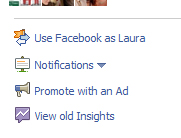
5. Refer to “overview”, “users”, and “interactions” tabs at left-hand side of the page.

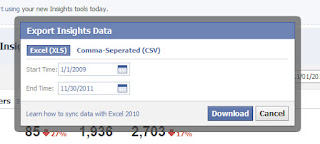
6. Be sure to click on “export” above the data.

7. Select your dates (go as far back as you’d like to) and format, then click “download”
Be sure to visit my blog again in mid-December for a review of the new “Pages Insights” tool being rolled out on Facebook.


Laura Catherine Otero is a marketing professional and blogger in Charleston, SC who has been active in social media since 2005.  If you enjoyed this post, please consider subscribing to this blog via Email or  RSS. Laura can also be found on Twitter (@LauraCatherineO), Facebook, and LinkedIn. 

Monday, December 5, 2011

Has your logo gone square?


There has been an unintended consequence of social media that has flown under the radar. With all the social media and networking sites popping up, companies and individuals have the option to add logos or photos to their profiles, also known as avatars. However, the only option for the large majority of sites is a small square.

But there is a problem. Most logos don't easily fit into a square. Can you imagine the Coca-Cola swirl inside of a square? And what about the entire word Google spelled out? These wouldn't fit into a square very easily without negatively impacting the core brand identity.

To solve this problem, some companies have created a square logo from the first initial of their name. Others have gone so far as to create a new logo that they launched as part of their overall social media initiatives. Others have tweaked their logos so that they fit into a square shape, but they may not be very easy to read. At the end of the day, you may ask, is all of this additional work worth the effort? The answer is a resounding YES.

With so much attention paid to social media (Twitter, Facebook, YouTube, Google+, LinkedIn, Flickr, and countless peripheral and industry-specific sites), whatever appears in those little square logo boxes reinforces a company's or individual's brand. No one wants to see an egg profile in Twitter or a blank blue head shot profile in Facebook - these mean that someone just doesn't understand the world of social media.

So what did you consider when making your logo go square?

YouTube and TV: better together

Each day, people watch more than 3 billion videos on YouTube - the equivalent of every American watching about 9 videos a day. U.S. online consumers now spend as much time online as they spend watching TV. With the consumer shift to online media consumption, many of our advertisers wonder how online video ads measure against traditional TV ads. Do traditional and new media ads complement each other? Which format drives recall most effectively?

To get answers, we partnered with Ipsos to measure the relative and combined effects of YouTube in-stream ads and TV ads on ad recall and brand metrics across six advertiser campaigns.

After conducting tests of 15- and 30-second spots on YouTube pre-roll instream ads and TV ads, the results revealed that YouTube and TV ads work better together. People who watched both YouTube and TV ads showed a 2X increase in brand recall than people who only saw TV ads. Those that
only watched a YouTube ad had a brand recall rate 1.5X those who only watched a TV ad.


Hotels.com, one of the advertisers that participated in the study, uses YouTube video ads to drive incremental reach for TV campaigns. "Our customers are online today, so it only makes sense for e-commerce brands like Hotels.com to find entertaining and engaging online formats to interact with our audience," says Vic Walia, senior director of brand marketing for Hotels.com. "YouTube video ads is a great distribution vehicle for us to efficiently maximize our reach, but the fact that is has the added impact of improving our overall ad recall metrics is a tremendous win."

This study comes on the heels of our multi-screen research, which found that brand recall jumps dramatically for consumers shown ads across all screens - TV, PC, smartphone and tablet devices. As more people consume media across multiple devices, having a multi-channel campaign strategy helps reach consumers at different points throughout the day.

To learn more about our study, download the infographic and slides from Think Insights or check out our video. And, when planning your media buys, consider using a combination of YouTube ads and TV ads to help you achieve higher ad recall than TV ads alone. You can find out more information about YouTube video ads here.

Posted by Lizzy Van Alstine & Christina Park, Google Research and Marketing

+1 button in DFP for direct sold ads

In March, we introduced the +1 button on search results to make it easier for people to get recommendations from the people they trust right when they’re searching. Then in early October we expanded that to include Google Display Network ads across the web on both desktop and mobile.

Today, we’re excited to expand this capability to publishers who sell their ad space directly to advertisers using a new creative template available in DART for Publishers and the new DFP. Using the Image or Flash with Google +1 custom creative template, publishers can now add the Google +1 button to their ads so that people can share your offers with others across the web.

If you’d like to learn more about how publishers can integrate the +1 button on your direct-sold ads, please visit the DART or new DFP help centers.

Posted by David Flinner, Product Manager.

Friday, December 2, 2011

Think With Google’s December Adventure: Search Tips Recap

As we announced earlier this week, we'll be sharing insights and daily tips this month on Think with Google's Plus Page, to help you make the most of your holiday marketing.

Here are the four search ad related insights we covered this week (and a fun factoid):
Click on the titles to view the original Google+ posts and comments.
  1. Monday: 57% of shoppers still plan to do most of their holiday buying after Cyber Monday – Prepare for the big shopping days ahead by scheduling budgets to meet demand. Learn how in the "budget scheduling" section of this helpful article to learn how.
  2. Tuesday: Online ads are surprisingly under-served during the holidays – Take a look at the seasonal spike in shopping queries versus the level supply of ads. Grab people's attention with ads at the top of the page by taking advantage of our newly launched options for Automated Rules.
  3. Wednesday: Searches for "layaway" are heating up – Layaways are catching fire again with budget-conscious consumers at retailers such as Wal-Mart, Target and Kmart - especially in the Southern US. Geo-target your campaigns to areas where holiday shoppers are looking through the Location Targeting Tool.
  4. Thursday: December has arrived, bringing eight projected $1 billion+ online shopping days – Target those last-minute, undecided buyers with keyword terms such as "quick and easy gift ideas." The rush to purchase gift cards has also started, so make sure you have relevant keywords and ads.
  5. Friday Fun Factoid: The Cold Truth – Did you know people in the US catch an average of three colds a year, per person? At about 1 billion colds annually, that's nothing to sneeze at. And this year's cold season could be worse than usual: Cold- and flu-related searches on Google are up by 61% so far over the same period last year. That means we'll see 14.1 million more cold- and flu-related searches this December than last December. So wash your hands before hitting the keyboard and bundle up, folks!
To learn more, follow Think with Google on Google+ or add this helpful holiday calendar to automatically see these tips on your Google Calendar.

Posted by Andrew Truong, Inside AdWords Crew

Find what you need fast in the new AdWords Help Center

Today we are happy to announce the launch of our new AdWords Help Center for opted in U.S. users. Based on your feedback we redesigned the Help Center to make it much easier for you to find the information for which you're searching.

Here are some of the changes we've made:

1. Simplified navigation: More easily navigate to the right content using the new menu at the top of each page.


2. Visible contact options: Find options to reach Google with a click on the "Contact us" button in the top right of any page.

3. More screenshots and videos: Use the screenshots and videos in many of the articles to quickly learn how to make the most of Google AdWords.

To opt into the new Help Center, select “Try the new look” from the yellow bar at the top of the page.


You can also opt out at any time by selecting “Go back to the old look” in the bottom right corner.

We're rolling the changes out gradually, starting with about 60 of the most important topics. Stay tuned for more updates, as well as the global roll out, over the new few quarters.

Do you like the new Help Center? We'd like to hear what you think. Once you've opted-in to the new Help Center, just click the "Send Feedback" link in the lower right corner of any Help Center page.

You can also follow a thread in the Forum if you have something to share with the users in the AdWords Community.

As Channel Proliferation Increases, Consumers Still Prefer and Trust Direct Mail for Financial Services Communication

According to a just released consumer channel preference study from marketing services firm Epsilon entitled, The Formula for Success: Preference and Trust, 36% of consumers prefer to receive financial services communication through the mail (compared to only 8% preferring email), while 50% state that they pay more attention to direct mail than email. Interestingly, U.S. consumers actually receive an emotional boost from receiving mail, with 60% agreeing that they "enjoy checking the mailbox."

The 2011 study is the latest in a series of studies conducted by Epsilon around communication channel preferences. In the latest study, it was found that the preference for direct mail extended to the 18-34 year old demographic, highlighting the risk in making assumptions around age and channel preferences. Part of this preference bias compared to email and other channels could be caused by the level of trust associated with the channels reviewed, since 26% of U.S. consumers found direct mail to be more trustworthy than email. The least trustworthy channel continued to be social media, with the channel only being viewed as trustworthy by 6% of consumers. Consumers also found direct mail to be more 'private' than email or online channels (important for 37% of consumers).


"Consumers use and trust certain communication channels more than others," states Warren Story, VP of product marketing at ICOM. "This means that marketers need to understand which channels resonate most at various stages of the consumer purchase cycle and incorporate a cross-channel strategy that leverages data and technology to communicate on a 1:1 basis." Story also suggests starting with direct mail and layering other channels into the marketing mix for message reinforcement.

Not only do consumers seem to prefer direct mail communication, but there seems to be an increasing frustration with the amount of email received and the level of satisfaction received from receiving emails. The study showed that 75% of U.S. consumers get a lot more emails that are not opened, with 65% saying they get too many emails overall. Conversely, 43% of consumers surveyed still enjoy receiving emails from brands on new products, indicating that targeting and messaging of communication is needed to capture attention.


For financial services communication, consumers also overwhelmingly preferred personally addressed mail as opposed to 'dear occupant' mail that doesn't have the emotional pull of a personally addressed communication. (This should be tested on an ROI basis however, since I have found that the financial benefits of less personalized direct mail can work in some instances).

Even with the strength of direct mail indicated in this study, financial marketers should not exclusively use direct mail or remove email from their marketing mix. In fact, the Epsilon study showed a greatly increasing use of Facebook and mobile phones as communication channels, while showing that the most trusted channels were newspapers, company websites and television. The study also showed that there were many perceived benefits to both direct mail and email as shown below from people who preferred direct mail to email and visa versa..


In this time of communication message overload, financial marketers need to balance the use of multiple channels based on consumer preference, financial considerations, objective of the marketing program, and the results of multichannel effectiveness measurement initiatives. Bankers also need to continue efforts to improve the targeting of messages through all channels from both a financial and customer satisfaction perspective. 

And while social media did not perform well from the perspective of trust, social channels provide several benefits that should be leveraged in a multichannel communication program due to economic considerations and the expanded use and reach of social media. Mobile channel communication should also be tested as we enter the new year and are building our marketing plans.

Of greatest importance is the development and use of advanced metrics that can assist you and your team in measuring the effectiveness of channels and channel mix. As opposed to measuring only single channels independently, advanced analytics are now available that can provide a view into the consumer's media consumption patterns and the impact of different channels.

As we enter 2012, the importance of an effective and efficient marketing communications mix is important. Budgets should be shifting to digital and social channels to build a reservoir of learnings that can be leveraged in the future, but it appears that the projected demise of traditional channels such as direct mail has been overstated. 

How will your team be shifting marketing channel dollars in the new year? How will you be measuring the impact of your efforts?

I would love your comments.